Would you trust your car’s steering at high speeds if you knew the desert heat had already compromised your suspension? It’s a chilling question for anyone commuting on Sheikh Zayed Road, yet many drivers ignore the subtle clues until a dangerous failure occurs. Understanding worn tie rod symptoms Dubai owners experience is the first step in maintaining your vehicle’s safety and performance. You’re right to be cautious; the city’s extreme temperatures and humidity are notoriously harsh on the rubber boots and joints that keep your steering precise.
We’ll help you identify five critical warning signs that indicate your tie rods are failing. You’ll gain a clear understanding of why our unique environment accelerates mechanical wear and how to distinguish these issues from other common suspension problems. This guide provides the expert insight you need to move from uncertainty to a professional, high-end resolution. Let’s ensure your vehicle remains reliable, safe, and ready for the road ahead.
Key Takeaways
- Identify early steering instability through vibrations and alignment issues, which are hallmark worn tie rod symptoms Dubai motorists should monitor.
- Learn how the combination of extreme heat and fine desert dust turns vital lubricants into abrasive paste, destroying your suspension from the inside out.
- Grasp the severe safety implications of a snapped tie rod end, including the dangerous “wheel outward” scenario that causes total loss of control.
- Find out why high-end brands like Range Rover and Audi require specialized workshop equipment and precise laser alignment for a successful restoration.
What Are Tie Rods and Why Are They Critical for Steering?
Have you ever wondered how your steering wheel actually moves your tires? Tie rods are the mechanical bridge between driver intent and wheel direction. Without this vital connection, your steering wheel would be little more than a useless plastic circle. These components act as the pivot point between your steering rack and the wheel assembly, allowing the force from your hands to translate into precise movement on the asphalt. If you’re looking for a technical foundation, understanding What is a Tie Rod reveals that it’s a structural necessity for any modern steering mechanism.
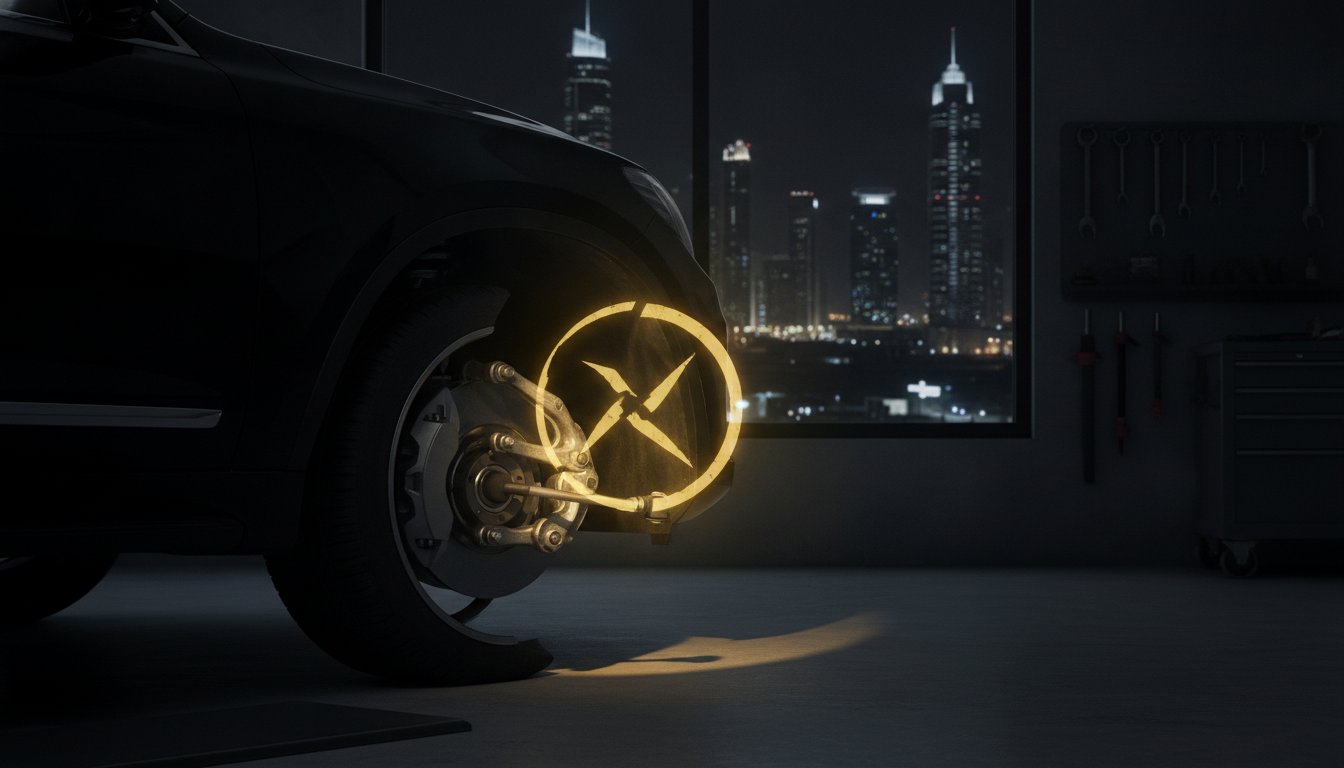
The system relies on a ball-and-socket design that provides a wide range of motion while maintaining a rigid connection. Inside each tie rod end is a lubricated joint that must remain smooth and friction-free. To protect this joint, manufacturers use a rubber dust boot to seal in grease and keep out road grime. In the UAE, these boots face extreme challenges. Monitoring for worn tie rod symptoms Dubai drivers often report starts with checking these rubber seals for cracks or leaks.
Inner vs. Outer Tie Rods
Your steering system uses a two-part assembly to manage the complex geometry of your suspension. The inner tie rod connects directly to the steering gear or rack. It’s usually tucked away behind a large rubber bellows to protect it from the engine’s heat. The outer tie rod end attaches to the steering knuckle, which is the component that actually holds your wheel and brake assembly. Because the outer tie rod ends are closer to the road and exposed to the elements, they almost always fail first. They take the brunt of every pothole and speed bump you encounter.
The Mechanics of Steering Precision
Precision is everything when you’re behind the wheel of a high-performance machine like an Audi, BMW, or Mercedes. Tie rods are the primary adjustment point for your vehicle’s “toe” setting. This alignment angle determines if your tires are pointing exactly parallel to each other. Even a millimeter of wear in the internal ball joint can throw this setting out of balance. This leads to the steering instability that characterizes worn tie rod symptoms Dubai owners notice at high speeds. When these parts degrade, your luxury car loses its signature handling and begins to feel disconnected from the road. Maintaining this mechanical bridge is the only way to ensure your wheels track straight and respond instantly to every input.
5 Critical Symptoms of Worn Tie Rod Ends
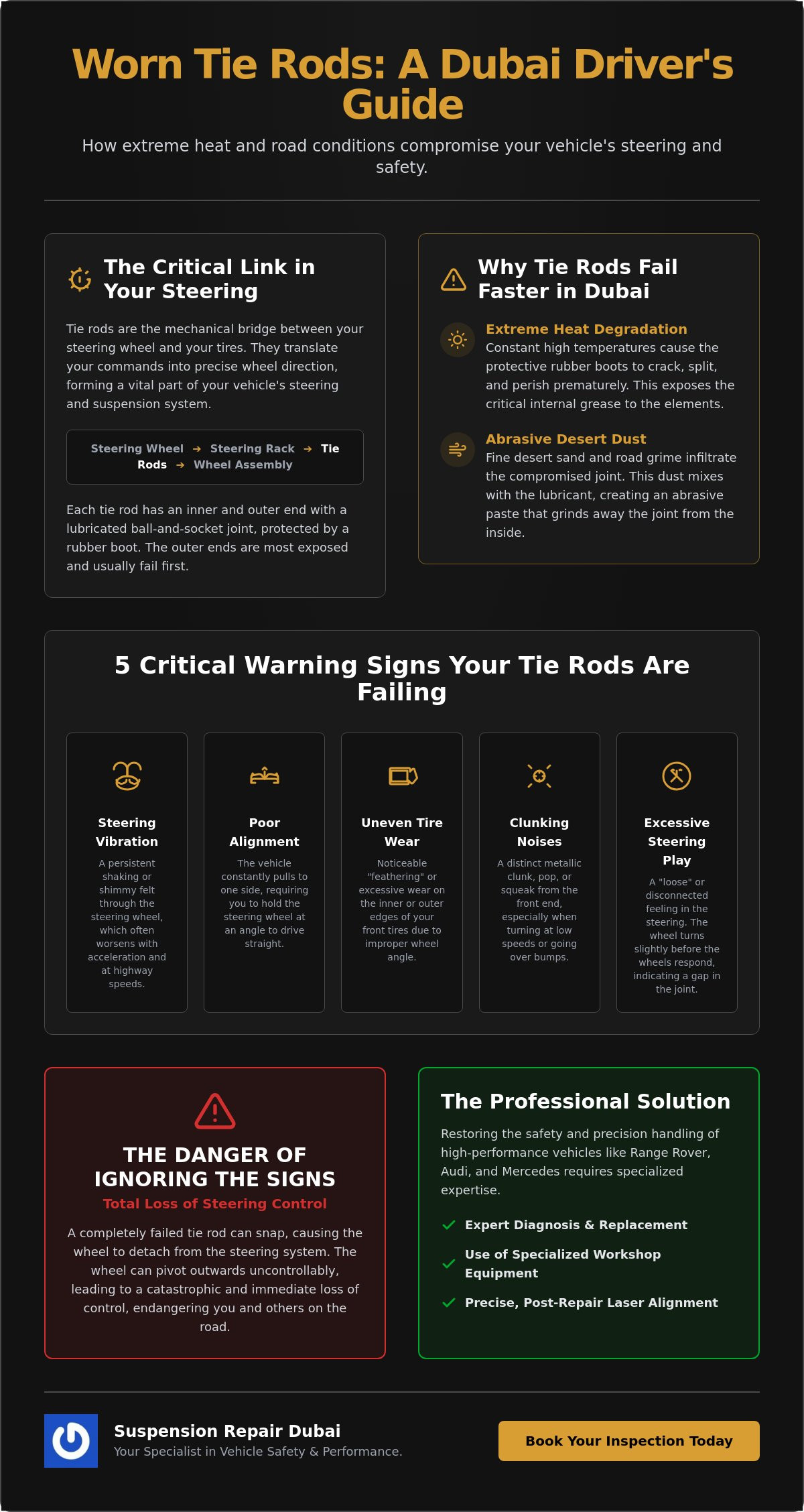
Ignoring the early signs of steering failure is a risk no driver should take. Because tie rods are the literal link between your steering wheel and your tires, their degradation directly impacts your ability to control the vehicle. Identifying worn tie rod symptoms Dubai motorists frequently encounter allows you to address the issue before it leads to a costly breakdown or a dangerous loss of steering. Here are the five most common indicators that your suspension needs immediate attention:
- Steering Wheel Vibration: You’ll likely feel a persistent shaking or rhythmic vibration through the wheel, particularly as you accelerate to highway speeds.
- Poor Wheel Alignment: If your car constantly pulls to the left or right while you’re trying to drive straight on a flat road, your tie rods may have shifted or worn out.
- Uneven Tyre Wear: Inspect your tires for “feathering” or excessive wear on the inner or outer edges. This happens because the wheels are no longer tracking parallel.
- Clunking or Squeaking Noises: Listen for metallic sounds when navigating speed bumps or making sharp, low-speed turns in parking garages.
- Excessive Steering Play: A “loose” or “disconnected” feeling when you turn the wheel suggests the internal ball joint has developed too much physical gap.
Tactile Warnings: Vibrations and Loose Steering
A shaking steering wheel is often one of the first worn tie rod symptoms Dubai drivers notice during their daily commute. This vibration occurs because the loose ball joint allows the wheel to shimmy independently of your steering input. It’s different from power steering issues, which usually involve a heavy or stiff wheel due to fluid loss. If you suspect a problem, you can perform a basic “shake test” while the car is safely jacked up. Grasp the tire at the 3 and 9 o’clock positions and try to move it side-to-side. Any clicking or physical movement indicates the tie rod has failed. For more technical details on these indicators, you can review this guide on Signs of a Damaged Tie Rod.
Audible Clues: Clunks and Squeaks
Dubai’s roads are filled with speed bumps and ramps that put immense pressure on your suspension. If you hear a distinct metallic “clunk” every time you cross a threshold, your tie rod ends are likely bottoming out in their sockets. Squeaking is another red flag. It typically points to a cracked rubber boot that has allowed the factory grease to leak out, leaving the metal joint to grind dry. We’ve detailed how to identify these sounds in our specialized guide on suspension noise diagnosis Dubai. If your car is making these sounds, don’t wait for the part to snap completely. It’s safer to book a professional inspection immediately to confirm the diagnosis and restore your peace of mind.
How Dubai Heat and Road Conditions Impact Tie Rod Life
Did you know that a vehicle in Dubai ages differently than one in London or New York? The “Dubai Factor” is a real mechanical challenge that forces suspension components to work twice as hard. When temperatures soar above 50°C in the peak of summer, your car’s steering system is under constant thermal stress. This intense heat is the primary reason many drivers experience worn tie rod symptoms Dubai earlier than expected. It isn’t just about the miles you drive; it is about the environment you drive in.
Extreme Heat and Rubber Degradation
Rubber components are designed to be flexible, but extreme heat causes them to become brittle and lose their elasticity. In the UAE, the rubber dust boots that protect your tie rod’s ball joints are particularly vulnerable. Once these boots dry out, they crack and split under the pressure of steering movements. Heat-cracked boots are the #1 cause of premature tie rod failure in Dubai. Without a flexible seal, the internal lubrication evaporates or becomes contaminated, leading to rapid metal-on-metal wear that compromises your steering precision.
Sand Ingress: The Silent Component Killer
Sand is an inescapable part of life in the desert. Even if you never leave the pavement, fine desert dust is constantly kicked up by traffic on major highways like the E11 and E311. When a protective boot develops even a microscopic crack, sand particles find their way inside the joint. This creates an abrasive grinding paste when mixed with the remaining grease. This paste acts like sandpaper, eating away at the precision-machined surface of the internal ball-and-socket joint.
Luxury SUVs like the Range Rover, Land Rover, or Porsche Cayenne are particularly susceptible if they are used for occasional desert driving. The fine silt found in the dunes is even more invasive than standard road dust. If you enjoy weekend adventures, you must prioritize more frequent suspension checks to catch worn tie rod symptoms Dubai before they lead to a total steering failure. Beyond the sand, our infrastructure also contributes to wear. The frequent pavement transitions and high-profile speed bumps in residential communities create repetitive vertical stress. Every time you navigate a bump, the tie rod end pivots to absorb the impact. Over thousands of cycles, this mechanical fatigue adds up, eventually leading to the loose steering and vibrations that signal a needed repair.
The Safety Risks of Ignoring Worn Tie Rod Symptoms
Safety on the road isn’t just about having functional brakes or working airbags. It’s about maintaining absolute control over your vehicle’s direction. When you ignore worn tie rod symptoms Dubai, you’re essentially gambling with the mechanical link that keeps your car on its intended path. A failure here isn’t just a minor inconvenience; it’s a critical safety breach that can lead to a total loss of steering at the most dangerous moments. Don’t mistake a small vibration for a harmless quirk of an aging car.
Catastrophic Failure at Speed
What happens when a tie rod end snaps completely? The results are almost always catastrophic. If the ball joint separates from its socket while you’re cruising at 120 km/h on Sheikh Zayed Road, that wheel is no longer connected to your steering rack. This often results in the “wheel outward” scenario. In this situation, road forces pull the disconnected wheel toward the curb while the other wheel continues to point straight. You’ll find it impossible to maintain a lane or perform evasive maneuvers to avoid traffic. Ensuring your vehicle remains stable is a core part of ride comfort restoration Dubai, as a smooth ride is inseparable from a safe one.
Even before a total snap, worn components compromise your safety during hard braking. Loose steering linkages allow the wheels to “wander” under the immense pressure of a sudden stop. This increases your braking distance and can cause the car to pull violently to one side, potentially leading to a rollover or a collision. Identifying worn tie rod symptoms Dubai early is the only way to prevent these life-threatening emergencies.
Financial Impact of Delayed Repair
Beyond the physical danger, delaying a repair is a poor financial decision. A worn tie rod is a relatively affordable part to replace, but it acts as a catalyst for much more expensive damage. Because your wheels are no longer aligned, your tires will develop “feathering” wear that can destroy a brand-new set of high-performance tires in just a few weeks. Additionally, the constant vibration and “play” in the system put unnecessary stress on your steering rack and shock absorbers.
You might save a few hundred dirhams today by skipping the workshop, but you’ll likely face a bill in the thousands for new tires and suspension overhauls later. Professional suspension specialists Dubai can diagnose these issues with precision, saving you from collateral damage to your vehicle’s expensive steering rack. If you’ve noticed any instability or strange noises, contact our team today for a comprehensive safety inspection before a small problem becomes a major emergency.
Specialist Tie Rod Replacement and Diagnosis in Dubai
Luxury vehicles aren’t just cars; they’re precision instruments. When you start noticing worn tie rod symptoms Dubai motorists often report, you can’t rely on a neighborhood garage with basic hand tools. High-performance brands like Ferrari, Maserati, and Range Rover utilize complex steering geometries and electronic racks that require specialized diagnostic equipment. A standard mechanic might miss the subtle signs of internal wear that compromise a vehicle capable of high speeds on the E11. Precision is the only way to ensure your luxury investment remains safe and responsive.
Why is specialized care so critical after a component fails? It’s about the geometry. Replacing a tie rod is only half the solution. Every time a steering component is disconnected or replaced, the vehicle’s alignment is fundamentally altered. We mandate a comprehensive 4-wheel laser alignment after every tie rod replacement. This ensures your tires are perfectly parallel, preventing the rapid “feathering” wear and steering instability mentioned in previous sections. Without this level of precision, your new parts will fail prematurely under the stress of the UAE’s road conditions.
Precision Diagnostics for Performance Vehicles
How do we identify microscopic play in a high-end steering rack? Our specialists use high-load simulation tools to stress the suspension while the vehicle is on a specialized lift. This reveals tiny gaps in the internal ball joint that are invisible during a standard visual check. We exclusively utilize OEM or high-grade equivalent tie rod ends to ensure longevity. A sub-par part won’t survive a single Dubai summer before the rubber degrades. During every service, we also perform a meticulous check of the steering rack bellows. If these protective covers show any signs of cracking, we replace them immediately to prevent sand from destroying your expensive steering rack.
Book Your Inspection at Car Suspension Repair
Are you ready to restore that factory-fresh steering feel to your vehicle? Car Suspension Repair is the preferred choice for exotic and luxury vehicle owners who demand excellence. We don’t just swap parts; we calibrate your entire steering system to meet original manufacturer specifications. Whether you require a specialized Audi suspension repair Dubai or a comprehensive safety check for your Porsche, our workshop is equipped with the latest technology to handle the task. Don’t wait for your steering to become a safety hazard on the highway. Book your professional inspection today and experience the peace of mind that comes with expert, specialized care.
Restore Your Vehicle’s Precision and Safety
Your car’s ability to navigate the unique challenges of the UAE depends entirely on a perfectly functioning steering system. We’ve explored how extreme heat and abrasive sand turn minor wear into major safety risks for your suspension. Identifying worn tie rod symptoms Dubai early isn’t just about avoiding a noisy commute; it’s about maintaining total control on high-speed highways. Don’t let a small vibration compromise your safety or lead to expensive collateral damage to your tires and steering rack. Proactive maintenance is the only way to ensure your luxury vehicle remains reliable throughout the year.
Our team provides the professional intervention your performance vehicle deserves. As a dedicated suspension workshop, Car Suspension Repair acts as a specialist for high-end brands like Audi, Range Rover, and exotic machinery. Every repair we perform includes an expert 4-wheel laser alignment to ensure your vehicle tracks perfectly and handles with precision. Book Your Specialist Steering Inspection at Car Suspension Repair today. We’re here to restore your car’s factory-fresh feel and give you absolute peace of mind for every journey. Drive with confidence knowing your steering is in expert hands.
Frequently Asked Questions
Can I drive with a bad tie rod in Dubai?
No, you should not drive with a damaged tie rod. It’s a critical safety component that maintains your steering control. If the joint snaps completely while you’re driving on high-speed roads like the E11 or E311, you’ll lose the ability to steer that wheel. This creates a life-threatening emergency for you and other motorists. Get an inspection immediately if you suspect a failure.
How much does it cost to replace tie rods in Dubai?
The cost of replacement varies significantly based on your vehicle’s make and model. While general suspension repairs in the city can range from AED 1,500 to AED 8,000, the final price for tie rods depends on whether you’re replacing inner or outer ends and the cost of parts for your specific brand. Always request a detailed quote from a specialist to understand the exact requirements for your car.
Will a bad tie rod cause a clunking noise when turning?
Yes, a metallic clunking or clicking sound is a common indicator of a failing joint. This noise occurs because the internal ball-and-socket has developed excessive play, causing metal components to strike each other when you turn the wheel or navigate speed bumps. If you hear these sounds, the protective boot has likely failed, allowing the factory grease to escape and causing metal-on-metal friction.
How long do tie rods usually last in the UAE climate?
While tie rods can last up to 100,000 kilometers in temperate zones, you may notice worn tie rod symptoms Dubai drivers face much earlier. The extreme 50°C+ summer heat causes the rubber protective boots to become brittle and crack. Once sand enters these cracks, it acts as an abrasive that destroys the joint from the inside, often requiring replacement every 60,000 to 80,000 kilometers.
Do I need an alignment after replacing a tie rod end?
Yes, a professional 4-wheel laser alignment is mandatory after any tie rod replacement. These components directly control your vehicle’s “toe” setting. Even a microscopic difference in the length of the new part will throw your alignment out of specification. Skipping this step will result in a crooked steering wheel and will destroy your expensive tires in a matter of weeks.
What is the difference between a bad tie rod and a bad ball joint?
Tie rods are part of the steering system and connect the steering rack to the wheels to control direction. Suspension ball joints are part of the chassis and connect the control arms to the steering knuckle to support the vehicle’s weight. While both cause clunking sounds, a bad tie rod specifically creates a “loose” feeling and vibrations directly in the steering wheel.
Can a bad tie rod cause my steering wheel to be off-centre?
Yes, an off-centre steering wheel is one of the more frustrating worn tie rod symptoms Dubai owners deal with regularly. When a tie rod wears out or bends, it changes the angle of the wheel relative to the steering rack. This forces you to hold the wheel at an angle just to keep the car tracking straight on a flat road.
Is it better to replace tie rods in pairs?
It’s highly recommended to replace tie rods in pairs. Both sides of your vehicle are exposed to the same heat, sand, and road conditions. If the left side has failed due to age and environmental stress, the right side is likely nearing the end of its lifespan. Replacing them together ensures consistent steering feel and saves you the cost of a second alignment later.