Is your Audi’s legendary “Vorsprung durch Technik” feeling more like a rough commute through the backstreets of Al Quoz? It’s a common frustration for owners in the UAE; the extreme heat and demanding road conditions eventually take a toll on even the most sophisticated air suspension systems. You likely bought your car for its precision, so feeling every pebble on the road is unacceptable. Finding reliable Audi suspension repair Dubai shouldn’t mean choosing between a drained bank account at the agency or an unqualified mechanic who might trip a complex sensor.
We understand that you want your car’s signature comfort back without the stress of hidden costs or long delays. It’s entirely possible to achieve a “factory-feel” drive while staying within a sensible budget. This article will show you how expert diagnostics can pinpoint exact faults in your struts or bushings, ensuring you only pay for what you need. You’ll learn about your rights under UAE law to choose independent specialists and how our tailored approach gets you back on the road with a faster turnaround time. We’ll explore the digital-mechanical ecosystem of your vehicle and the specialized solutions required to keep it performing at its peak.
Key Takeaways
- Identify critical warning signs like vehicle “nose-diving” or uneven height before they lead to costly damage to your Audi’s complex air system.
- Discover why specialized Audi suspension repair Dubai requires Audi-specific ODIS diagnostic software rather than generic scanners to ensure precision.
- Understand the importance of using high-quality components that match your car’s engineering to maintain the signature Quattro handling and comfort.
- Learn how a 360-degree digital inspection pinpointing exact faults can save you from the inflated quotes often found at official service centers.
- See why trusting a suspension-only specialist ensures a faster turnaround time and a restoration of that original factory-feel drive.
Understanding Audi’s Sophisticated Suspension Engineering
Audi’s reputation for precision isn’t an accident. It’s the result of complex engineering that blends mechanical parts with advanced software. While most cars use basic struts, your Audi likely features a sophisticated multi-link suspension system designed to provide maximum contact with the road. This setup allows each wheel to react independently to bumps, which is vital for the Quattro all-wheel-drive system to distribute power effectively. When you’re driving at high speeds on the Sheikh Zayed Road, the suspension isn’t just absorbing shocks; it’s actively managing the massive loads generated by the drivetrain to keep the car stable.
This complexity means that standard fixes often fall short. Specialized Audi suspension repair Dubai is necessary because these systems rely on electronic control modules that communicate directly with the physical shock absorbers. If a sensor fails or a software calibration is off, the physical components won’t perform correctly. This often leads to a stiff or unpredictable ride that ruins the luxury experience you expect from the brand.
Adaptive Air Suspension vs. Magnetic Ride
Audi uses two primary high-end technologies to deliver its famous ride quality. Adaptive Air Suspension, found frequently in the A6, A8, and Q7 models, replaces traditional springs with air-filled bellows. This allows the car to raise or lower its ground clearance based on speed and terrain, providing a cloud-like feel. On the other hand, Audi Magnetic Ride, often found in S and RS models, uses a specialized fluid containing tiny iron particles. By applying a magnetic field, the car’s computer can change the fluid’s viscosity in milliseconds. This instantly stiffens the dampers for better cornering or softens them for a smoother cruise through Downtown Dubai.
Why Dubai’s Climate is Hard on Audi Components
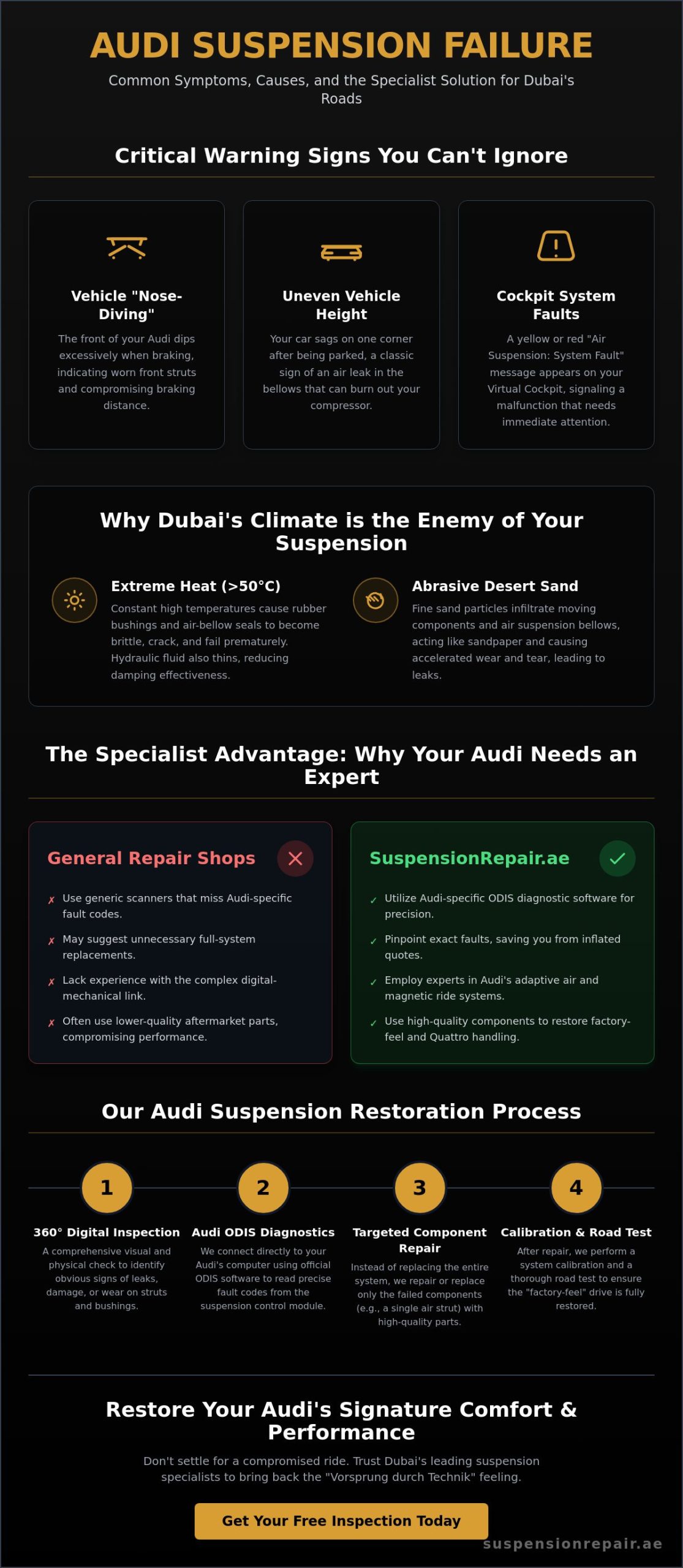
Your Audi was engineered for the German Autobahn, but the UAE presents an entirely different set of challenges. The extreme heat, often exceeding 50°C during summer, is the primary enemy of rubber components. Suspension bushings and seals that would last a decade in Europe can become brittle and crack in just a few years here. Once these seals fail, hydraulic fluid leaks out or air pressure drops. Additionally, fine desert sand acts as an abrasive. It infiltrates the air bellows and moving parts, causing premature wear that leads to the “leaking air” sound many owners notice after parking. High-speed highway driving in this heat also causes hydraulic fluid to thin; this reduces the dampening effectiveness and puts more stress on the entire system.
Common Symptoms of Audi Suspension Failure
Is your Audi starting to feel less like a precision machine and more like a heavy boat? While the engineering behind these vehicles is world-class, the components aren’t invincible. Recognizing the early warning signs of failure is the best way to avoid a total system collapse. One of the most obvious indicators is a noticeable “nose-dive” when you’re braking at traffic lights in Downtown or Al Quoz. If the front of your car dips significantly toward the tarmac when you slow down, your front struts are likely failing to manage the weight transfer. Understanding how suspension systems work helps you realize that these parts must resist immense pressure; when they’re worn, your safety and braking distance are compromised.
Another red flag is a car that looks “tired.” Have you noticed your Audi sitting lower on one side after being parked overnight? This usually points to a leak in the air bellows. You might even hear a faint “hissing” sound as air escapes. If you ignore this, your air compressor will work overtime to compensate, eventually burning out and leading to a much higher bill for Audi suspension repair Dubai specialists to resolve. Before committing to any repairs, it’s worth understanding the full breakdown of Audi air suspension repair cost Dubai owners typically face, so you can budget accurately and avoid inflated quotes.
Diagnostic Warning Signs in the Audi Virtual Cockpit
Your Audi is designed to tell you when it’s hurting. The Virtual Cockpit will often display an “Air Suspension: System Fault” message. Don’t ignore the color of the icon. A yellow symbol is a warning that the system is malfunctioning but still operational; it’s a plea for a workshop visit. A red icon is a critical failure. In many cases, the car’s computer will enter a “limp mode” and limit your top speed to prevent further damage. Don’t assume a simple software reset will fix this. While electronic glitches happen, these warnings are usually triggered by physical leaks or sensor misalignments that require expert intervention.
Physical and Auditory Red Flags
Listen to your car. Audi’s multi-link setup uses several control arms; when the rubber bushings in these arms perish, you’ll hear a distinct metallic clunking or groaning over speed bumps. You can also perform a quick “bounce test” at home. Push down hard on one corner of the car and let go. A healthy Audi should settle almost instantly. If it continues to oscillate or bounce, your dampers are finished. Finally, look for oily residue on the body of the shock absorbers. Since these are hydraulic units, any visible oil is a “red alert” sign that the internal seals have failed. If you’re experiencing excessive vibrations through the steering wheel at speeds over 100km/h on the Sheikh Zayed Road, it isn’t always a wheel balance issue. It often indicates that your struts can no longer dampen the natural frequencies of the road. When this happens, professional strut replacement Dubai services can restore the precise, controlled handling your Audi was designed to deliver. For a broader understanding of how these issues affect all vehicle types, our guide on shock absorber repair Dubai specialists recommend covers the full diagnostic and restoration process in detail.
Audi Specialist Workshop vs. General Repair Shops
Why would you trust a generalist to handle one of the most complex parts of your vehicle? Many workshops in Dubai claim to fix “all brands,” but luxury German engineering requires more than a standard toolkit. A general repair shop typically relies on generic OBD-II scanners. These tools might find a basic fault code, but they can’t access the deep-layer data required for a perfect calibration. Audi specialists use ODIS (Offboard Diagnostic Information System), the factory-level software that communicates directly with your car’s electronic control modules. This is essential for Audi suspension repair Dubai because it allows for the precise leveling of air springs and the recalibration of ride-height sensors after a component is replaced.
The materials matter just as much as the software. Audi utilizes an extensive amount of aluminum in its chassis to reduce weight. This metal is sensitive to torque. A mechanic at a general garage might use a standard impact wrench and “feel” the tightness. This is a recipe for disaster. Audi specifies exact torque-to-yield settings for every bolt. Over-tightening can strip threads or cause micro-fractures in the aluminum components, leading to catastrophic failure later. Choosing a specialized, suspension-only facility ensures that every technician understands these nuances and treats your car with the technical respect it deserves.
Equipment and Tooling Requirements
Fixing an Audi suspension properly requires specialized heavy-duty spring compressors and hydraulic bushing presses designed specifically for German multi-link geometries. Standard tools can slip or damage the delicate finish of the control arms. Furthermore, high-performance models often require nitrogen charging for their dampers to prevent oil foaming during spirited drives on the E11. We also prioritize digital 3D alignment. Any intervention in the suspension geometry, even a simple bushing swap, changes the wheel’s contact patch. Without laser-guided alignment, your Audi will suffer from accelerated tyre wear and diminished handling precision.
Value Proposition: Specialist Quality at Independent Prices
You don’t need to pay dealership premiums to get dealership-level quality. Large official service centers have massive overheads, from expansive showrooms to large administrative teams. A specialized boutique workshop operates with a leaner structure, allowing us to pass those savings directly to you. We source our components from the original equipment manufacturers (OEM) like Bilstein, Lemförder, and Sachs. These are the exact same companies that supply Audi’s production lines. You receive the same high-performance parts without the inflated “brand-box” markup. Most importantly, you can speak directly with the specialist working on your car, ensuring total transparency throughout the repair process—a philosophy of personalized care also championed by international experts like Eurotech Automotive.
Our Audi Suspension Restoration Process
Restoring your Audi’s signature handling isn’t just about swapping out old parts. It’s a technical restoration that requires a balance of mechanical skill and digital expertise. At our facility, the process for Audi suspension repair Dubai is designed to be transparent and thorough, ensuring no detail is overlooked. We don’t believe in guesswork. Every vehicle undergoes a 360-degree digital suspension inspection to identify the root cause of instability or noise before a single bolt is turned.
Once we identify the faults, we use Audi-specific specialized tools for the precision removal of worn components. This prevents damage to the aluminum chassis and surrounding sensors. We only install premium OEM or genuine Audi parts, ensuring every fastener is tightened to manufacturer-spec torque. This methodical approach guarantees that the repair lasts, even under the stress of Dubai’s high-speed highway commutes and extreme temperatures.
Step 1: Advanced Diagnostics and Leak Testing
We begin by hunting for microscopic air suspension leaks that generic shops often miss. Our technicians use high-pressure smoke testers and specialized solutions to find pinhole leaks in air bellows and lines. We also perform a health check on the air compressor and the valve block to ensure they haven’t been compromised by an existing leak. By reading historical fault codes through the ODIS system, we can identify intermittent sensor issues that might not be currently active but could cause a “limp mode” event later. This proactive care saves you from repeat visits and unexpected breakdowns.
Step 2: Component Replacement and Calibration
Hardware replacement requires a strict focus on balance. We always recommend replacing Audi control arms and struts in pairs. If one side is worn, the other is usually close behind; replacing only one creates an uneven load that ruins the “factory-feel” handling. The most critical step is the “Ride Height Calibration.” After installing new hardware, the car’s computer must be taught exactly how the new parts sit. We use digital leveling tools to ensure the car is perfectly horizontal. We also reset the steering angle sensor. This ensures your Audi’s electronic stability control (ESC) and Quattro systems recognize the new suspension geometry, providing seamless intervention when you need it most.
If your Virtual Cockpit is flashing a fault code or your car sits lower after a night in the garage, don’t wait for a total system collapse. Book your specialized Audi suspension inspection today to catch microscopic leaks before they turn into expensive compressor failures.
The final stage of our restoration is a rigorous road test. We take the vehicle across various Dubai road surfaces to verify that the ride comfort and acoustic insulation are fully restored. Only when the car passes our strict quality control checks is it ready to be delivered back to you.
Why SuspensionRepair.ae is Dubai’s Top Choice for Audi Owners
Choosing the right partner for Audi suspension repair Dubai is a decision that impacts both your safety and your car’s resale value. Why settle for a jack-of-all-trades workshop when your vehicle requires specialized engineering? We are a dedicated suspension-only facility. We don’t divide our attention between engine overhauls and transmission swaps. Instead, we focus 100% of our resources, training, and equipment on the complex systems that define your Audi’s ride quality. This singular focus allows us to diagnose issues faster and more accurately than general garages.
Our expertise covers the entire Audi lineup. Whether you drive a nimble A3, a family-focused Q7, or a high-performance RS6, we understand the specific suspension geometry of your model. Each vehicle in the Audi range has unique dampening rates and sensor configurations. We treat a performance-heavy RS model with a different technical approach than a standard sedan, ensuring the specific handling characteristics of your car are preserved. Our strategic location in Dubai means you get fast turnaround times, helping you avoid the logistical nightmare of being without a car in this fast-paced city.
Our Commitment to Audi Precision
We refuse to cut corners on safety-critical components. Your suspension is the only thing keeping your tyres in contact with the road; using inferior parts isn’t an option for us. As part of our May 2026 update, we’ve invested in the latest Audi-specific diagnostic interfaces to stay ahead of the brand’s rapid digital evolution. This equipment allows us to communicate with the newest electronic damping systems found in
Reclaiming Your Audi’s Signature Performance
Your Audi was built to deliver a specific balance of comfort and agility. Don’t let worn bushings or leaking air bellows compromise that experience. Successful Audi suspension repair Dubai requires more than just mechanical labor; it demands specialized ODIS diagnostics and precision sensor calibration that general workshops simply can’t provide. By choosing a specialized facility, you ensure your car receives OEM-quality parts installed by expert German car technicians who understand the nuances of an aluminum chassis.
Taking action now prevents a minor leak from turning into a total compressor failure. Our Dubai-wide reputation is built on transparency and technical excellence. This gives you the peace of mind that your luxury vehicle is in the right hands. It’s time to stop tolerating clunks and nose-dives. Return to the smooth, factory-feel drive you love today. Restore Your Audi’s Smooth Ride – Get a Free Quote Now!
We look forward to helping you get back on the road with total confidence and precision.
Frequently Asked Questions
How much does Audi suspension repair cost in Dubai?
Costs for repairs vary significantly depending on your specific model and whether you require a simple bushing replacement or a full air strut. Independent specialists typically offer a more cost-effective alternative to dealership prices while maintaining the same technical standards. For a detailed breakdown of what to expect, our comprehensive guide on Audi air suspension repair cost Dubai owners should budget for in 2026 covers every major component and labor factor. Always ensure your quote is provided in AED and clearly accounts for the mandatory 5% VAT to avoid any surprises when you collect your vehicle.
Can I drive my Audi if the air suspension warning light is on?
You should stop driving immediately if the warning light is red, as this indicates a critical system failure that could damage your chassis. A yellow light means a fault is detected but the car is still mobile. However, driving with a yellow light puts excessive strain on your air compressor. It’s best to visit a specialist for Audi suspension repair Dubai before a small leak turns into a total system collapse.
How long does it take to replace Audi shock absorbers?
Most standard shock absorber replacements are completed within 4 to 6 hours. If your vehicle features a complex Adaptive Air Suspension system, the process might take longer due to the required digital calibration and ride-height leveling. We focus on an efficient turnaround to ensure you aren’t left without a car in Dubai’s fast-paced environment for more than a single day.
Do you use genuine Audi parts for suspension repairs?
We use a combination of genuine Audi parts and premium OEM components from manufacturers like Bilstein, Sachs, and Lemförder. These OEM suppliers are the same companies that produce the original parts for Audi’s assembly line. This approach ensures your car retains its precision handling and factory comfort without the unnecessary “brand-box” markup often found at official agencies.
Why is my Audi leaning to one side after being parked overnight?
A leaning car almost always indicates a leak in an air suspension bag or a malfunctioning valve block. While the car is parked, air escapes from the weakest point, causing that corner to drop. This is a common issue in the UAE, where extreme heat causes rubber seals to perish faster. Address this quickly to prevent your air compressor from burning out while trying to level the car.
Is it better to repair or replace an Audi air suspension compressor?
Replacement is generally the more reliable solution because a failing compressor has usually suffered internal wear from overheating. While minor seal repairs are sometimes possible, they often act as a temporary fix. Installing a new unit ensures your entire air system receives consistent pressure, which protects your expensive air struts from the damage caused by fluctuating air levels.
Do you provide a warranty on Audi suspension work in Dubai?
Yes, we provide a comprehensive warranty on all Audi suspension and shock absorber work. This guarantee covers both the high-quality parts we install and our expert labor. Because we use specialized tools and follow strict manufacturer torque settings, we’re confident in the durability of our repairs. This gives you peace of mind and long-term protection for your investment.
How often should I have my Audi’s suspension inspected in the UAE?
We recommend a professional suspension inspection every 20,000 kilometers or at least once a year during your major service. The harsh desert climate and fine sand in the UAE act as abrasives on your car’s undercarriage. Regular checks allow us to spot cracked bushings or microscopic leaks early, saving you from much larger repair bills in the future.