Imagine you’re cruising down Sheikh Zayed Road when your luxury SUV suddenly dips, the dashboard flashes a warning, and your smooth ride turns into a bone-jarring nightmare. Have you ever wondered why these sophisticated systems fail so prematurely in the UAE? It’s no secret that the 50°C summer sun acts as a silent killer for sensitive rubber bellows and overworked compressors. You’ve likely felt the anxiety of a potential suspension collapse or the sting of high OEM replacement costs.
Learning how to protect air suspension in Dubai heat is the only way to ensure your vehicle remains both safe and road-legal under 2026 RTA regulations. We’ve gathered expert-vetted strategies to help you shield your investment from extreme desert temperatures and avoid those dreaded summer repair bills. This guide delivers a clear preventative checklist, identifies the early warning signs of failure, and provides actionable steps to extend the lifespan of your air bellows. You’ll discover how to manage thermal stress effectively so your luxury car handles the highways with total reliability and professional-grade performance.
Key Takeaways
- Understand why Dubai’s 50°C+ temperatures and coastal salinity act as a silent killer by causing rubber bellows to crack and components to corrode.
- Learn to manage the Compressor Duty Cycle to prevent thermal burnout caused by the system overworking in extreme desert heat.
- Discover the ultimate protection checklist, including strategic parking habits and the ideal height settings to preserve your system while stationary.
- Master how to protect air suspension in Dubai heat by switching from reactive repairs to proactive inspections that save thousands in replacement costs.
- Identify why brand-specific diagnostic tools like ODIS and ISTA are essential for detecting micro-leaks before they lead to a total suspension collapse.
Why Dubai’s Climate is the “Silent Killer” of Air Suspension Systems
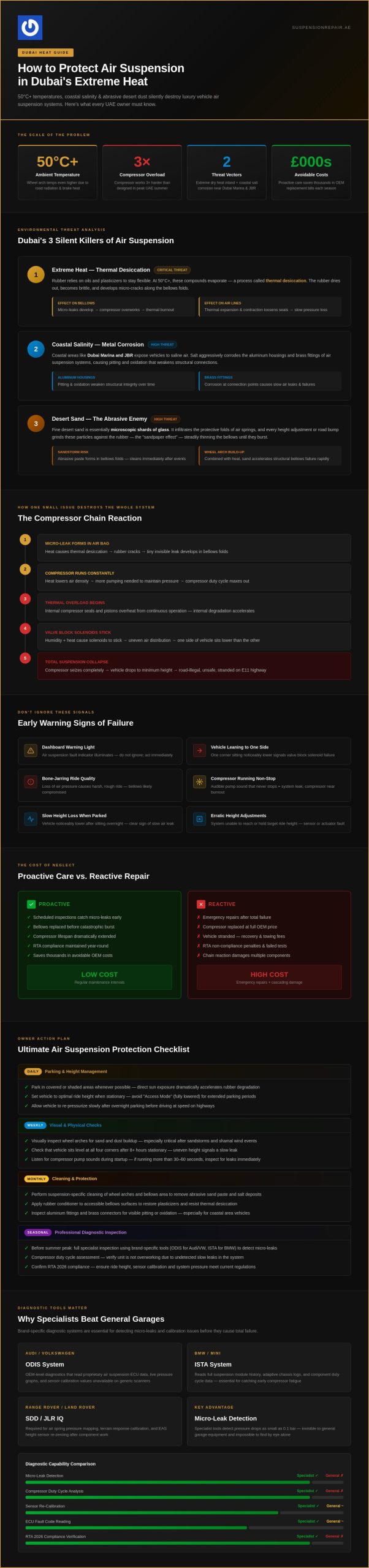
Dubai’s climate is a relentless testing ground for automotive engineering. While your car’s exterior might look pristine under the city lights, the hidden components are under constant attack. Ambient temperatures frequently soar past 50°C during the peak of summer; however, the temperature within your wheel arches can be significantly higher due to road radiation and braking heat. This extreme environment places immense stress on pressurized systems. If you’re a luxury car owner, understanding how to protect air suspension in Dubai heat is not just a maintenance tip; it is a financial necessity. Knowing how to protect air suspension in Dubai heat is the difference between a smooth commute and a stranded vehicle on the E11.
Coastal areas like Dubai Marina and JBR introduce a second threat: high humidity and salinity. Salt is highly corrosive to the aluminum housings and brass fittings found in sophisticated Air suspension systems. Over time, this saline air causes pitting and oxidation, which weakens the structural integrity of the system’s connections. Luxury SUVs, particularly Range Rovers and Audis, are engineered for high-performance comfort, but their complex air springs are often the first to fail under these local conditions. They demand specialized care to survive the UAE’s unique environmental cocktail.
The Chemical Impact of Heat on Air Bellows
Rubber is an organic polymer that relies on specific oils and plasticizers to remain flexible. Extreme heat causes these essential compounds to evaporate. This leads to a phenomenon known as thermal desiccation. Thermal desiccation is the process where intense heat strips rubber of its moisture and elasticity, resulting in a brittle surface prone to structural cracking. As the rubber dries out, micro-leaks develop along the folds of the bellows. These leaks might be invisible at first, but they force your compressor to work harder to maintain ride height. Thermal expansion also plays a role, as air lines expand and contract, eventually loosening the seals that keep the system airtight.
Sand and Dust: The Abrasive Enemy
Fine desert sand is essentially microscopic shards of glass. In Dubai, this dust finds its way into every crevice, including the protective folds of your air springs. When your vehicle adjusts its height or hits a bump, these particles create a “sand-paper effect” against the rubber. This constant grinding thins the bellows until they eventually burst under pressure. Sandstorms are particularly dangerous for your suspension. Learning how to protect air suspension in Dubai heat involves more than just parking in the shade; it requires active management of these abrasive elements. If you don’t perform a suspension-specific cleaning after a major dust event, you’re leaving an abrasive paste to eat away at your car’s struts.
The Mechanics of Failure: Rubber, Sensors, and Compressors
Why does your air suspension seem to fail exactly when the mercury hits 45°C? It’s rarely a single component’s fault. Instead, it’s a mechanical chain reaction triggered by extreme thermal stress. When you consider how quickly a vehicle can heat up in the UAE sun, it’s easy to see why internal temperatures wreak havoc on sensitive electronics and pressurized hardware. Understanding how to protect air suspension in Dubai heat starts with recognizing that your compressor is likely working three times harder than it was designed to. This increased duty cycle is simply not sustainable over a long summer.
Heat reduces air density, which means the compressor must pump more air to achieve the same pressure. If your system has even a microscopic leak, the compressor will run almost constantly. This leads to thermal overload, where the internal seals and pistons of the compressor unit overheat and eventually seize. Valve blocks are equally vulnerable. The combination of intense heat and coastal humidity can cause the internal solenoids to stick. When this happens, air won’t distribute evenly to the four corners of the car. You’ll notice one side sitting lower than the other, even if the air bags themselves are perfectly intact.
The Compressor Chain Reaction
A tiny leak in an air bag might seem minor. It isn’t. It is the death sentence for your compressor. In the Dubai summer, rubber expands and micro-leaks become far more pronounced. The compressor then runs continuously to compensate, causing it to burn out from the inside. Humidity plays a destructive role too, as the desiccant dryer becomes saturated and fails to keep moisture out of the system. This is why Audi suspension repair Dubai often requires a full system diagnostic rather than just a simple patch. You can’t just fix the leak; you must ensure the compressor hasn’t been compromised by heat-induced fatigue.
Sensor and ECU Vulnerabilities
Heat doesn’t just target the rubber; it targets the brains of the system. Your vehicle’s height sensors are located near the road surface where temperatures are highest. This causes sensor calibration drift, where the ECU receives inaccurate data. You might experience “Ghost Faults” where the car thinks it is leaning when it is actually level. While an air suspension reset Dubai can clear these codes temporarily, it won’t fix a wiring connector that has become brittle from years of thermal expansion. Learning how to protect air suspension in Dubai heat involves checking these electronic connections before they fail completely. If you notice your car struggling to level itself, you can speak with a technician today to prevent a total system collapse.
Proactive vs. Reactive Care: The Real Cost of Neglect
Many owners ignore the subtle signs of a sagging strut, but in the UAE, mechanical neglect carries a heavy financial premium. The effects of heat exposure on vehicle components extend far beyond the battery or air conditioning. When you understand how to protect air suspension in Dubai heat, you quickly realize that a routine inspection is a fraction of the cost of a full strut replacement. A reactive approach often means paying for four new air bags and a compressor rather than just a single seal or sensor. Waiting for a total failure is the most expensive way to maintain a luxury vehicle.
A compromised air system doesn’t just sit low; it ruins your wheel alignment instantly. This leads to rapid, uneven tyre wear, often forcing owners to replace expensive performance tyres months ahead of schedule. Additionally, an uneven ride height increases aerodynamic drag and forces the engine to work harder to maintain speed. This kills your fuel efficiency during those long daily commutes between Dubai and Abu Dhabi. By the time you notice the car is leaning, you’re already losing money at the petrol pump and the tyre shop.
The “Don’t Wait” Financial Framework
Ignoring a “Height Restricted” warning is a financial gamble you will eventually lose. As the system struggles to stay level, the increased vibration damages the car’s chassis and prematurely wears out expensive control arm bushings. This creates an expensive domino effect of repairs. Consistent maintenance provides several key benefits:
- It preserves the structural integrity of the chassis and subframe.
- It prevents premature wear on expensive rubber bushings and ball joints.
- It maintains the vehicle’s high resale valuation in the competitive UAE market.
Investing in luxury car suspension repair Dubai is an investment in vehicle longevity. It ensures your car remains a high-value asset rather than a mechanical liability. In the Dubai resale market, buyers are incredibly savvy. A documented history of professional suspension maintenance is a major selling point that preserves your car’s valuation and speeds up the sale process.
Safety at 140 km/h
Speed is a constant factor on Dubai’s major highways. At 140 km/h, your suspension is the primary component keeping your tyres in contact with the asphalt. Worn shocks cause “nose-diving” during emergency braking, which can add several meters to your stopping distance. Modern stability control and ABS systems rely on precise suspension calibration to function correctly during a sudden swerve. If a pressurized bag suffers a blowout in heavy Sheikh Zayed Road traffic, you lose steering control almost instantly. This is a life-threatening risk that is entirely preventable. Learning how to protect air suspension in Dubai heat is ultimately about keeping your family safe on the road. Safety on the road is paramount, but it is equally important to maintain other high-tension systems around your property, such as garage door springs; for a safety-first guide, click here.
The Ultimate Air Suspension Protection Checklist for Dubai Owners
How do you stay ahead of the summer curve? While you can’t change the weather, you can control how your car reacts to it. Knowing how to protect air suspension in Dubai heat requires a disciplined approach to daily habits. Your goal is to minimize the thermal load on the rubber and the electrical load on the compressor. If you follow a consistent routine, you can effectively double the lifespan of your air struts despite the harsh environment.
Strategic parking is your first line of defense. Always prioritize underground or shaded parking. Direct solar radiation can raise surface temperatures of suspension components by an additional 20°C compared to ambient air. When you do park, leave your vehicle in the “Standard” or “Neutral” height setting. High-pressure settings put unnecessary tension on the bellows, making them more likely to develop micro-cracks while sitting in the sun. This simple habit reduces the internal pressure against heat-softened rubber.
Daily and Weekly Protection Habits
Implement an “Under-Wash” protocol as part of your weekly car care. After a trip to the coast or a particularly dusty week, use a low-pressure hose to rinse the air springs. Focus on the folds where sand accumulates. This prevents the abrasive grinding that leads to premature punctures. Be careful with high-pressure washers; don’t spray them directly at the electronic sensors or wiring connectors.
Friday morning inspections are essential. Before you start the car, look at all four corners. Is one side sitting lower? This “Overnight Sag Test” is the most reliable way to detect a leak before the dashboard warning light ruins your day. If the car has dropped, the compressor will have to work overtime the moment you turn the key. Avoid using “Off-Road Mode” for extended city driving in high heat, as the increased pressure makes the system more vulnerable to thermal expansion.
Professional Preventative Maintenance
May is the critical month for professional intervention. Don’t wait until July when the system is already failing under 50°C stress. A professional health check ensures your compressor filter is clean and your desiccant is dry. Software updates for suspension ECUs are also vital to optimize thermal management for the upcoming peak temperatures. For a deeper look at long-term care, consult our ultimate guide to car suspension repair in Dubai. Staying proactive is the only way to guarantee a stress-free summer. Learning how to protect air suspension in Dubai heat starts with these small, professional steps.
Don’t let a minor leak turn into a major repair. Schedule your professional suspension inspection before the summer heat peaks to ensure your luxury SUV remains reliable.
Professional Inspection: Why Specialists Beat General Garages
Why would you trust a million-dirham vehicle to a generalist mechanic? Luxury air suspension systems are masterpieces of engineering, but they are also incredibly sensitive to the environment. When you are looking for the best way how to protect air suspension in Dubai heat, the quality of your diagnostic partner is your most important decision. General garages often rely on “trial and error” methods that lead to unnecessary part replacements and inflated bills. Specialists understand the heat-specific failure patterns unique to the UAE, allowing them to pinpoint issues before they become catastrophic.
Exotic brands like Rolls Royce, Bentley, and Lamborghini require a level of technical intimacy that standard workshops simply cannot provide. These vehicles use proprietary air spring designs and complex valve configurations that demand expert hands. A specialized workshop doesn’t just fix a leak; they analyze why the leak occurred in the context of Dubai’s climate. They ensure that every seal, fitting, and line is rated for the extreme thermal expansion that occurs during a typical July afternoon.
The Diagnostic Advantage
General OBD scanners are fine for checking engine lights, but they often miss the subtle nuances of a failing air system. They can’t detect minor sensor drift or the early stages of a struggling compressor. This is why brand-specific tools like ODIS for Audi or ISTA for BMW are non-negotiable. These systems allow technicians to perform deep-level recalibrations and stress tests that generic tools ignore. For those driving high-performance machinery, utilizing a German car suspension specialist Dubai ensures your car receives the precision it was built for.
Specialists also utilize advanced physical testing methods. A “Smoke Test” is a perfect example. By pumping pressurized smoke through the air lines, technicians can visually confirm even the smallest micro-leaks that are invisible to the naked eye. This proactive approach is a core part of how to protect air suspension in Dubai heat, as it stops the “compressor chain reaction” before it starts.
Expert Workmanship and Guarantees
Accuracy saves you time and money. Specialized mechanics work on luxury struts every day, meaning they are significantly faster and more accurate than a general mechanic who only sees an air system once a month. This expertise ensures that your interior trim, sensors, and wiring are handled with care during the repair process. High-end workshops also refuse to use low-quality aftermarket “fixes” that often fail within weeks of exposure to 50°C temperatures. They insist on OEM or high-grade equivalent parts that are built to last.
Working with dedicated suspension specialists Dubai provides the peace of mind that comes with a professional warranty. You aren’t just paying for a repair; you are investing in a long-term solution. Don’t wait for your car to sag or for a “Suspension Fault” to appear on your dash. Secure your vehicle’s performance by booking a professional health check at Car Suspension Repair today.
Secure Your Luxury Drive for the Summer Ahead
Your vehicle represents a significant investment in engineering and comfort. Don’t let the harsh UAE summer compromise that experience. By shifting from reactive repairs to proactive care, you avoid the high costs of total system failure and ensure your car remains safe at highway speeds. Mastering how to protect air suspension in Dubai heat is ultimately about consistency. It’s about choosing shaded parking, performing regular under-washes to remove abrasive sand, and identifying warning signs early.
Are you ready to guarantee your car’s reliability before the next heatwave? Our team at Car Suspension Repair provides specialized care for Audi, BMW, Mercedes, and exotic brands. We utilize advanced diagnostic technology for precision leak detection and employ expert mechanics who focus exclusively on suspension systems. This specialized approach ensures your vehicle receives the exact attention it deserves without the guesswork of generalist garages. Take the logistical burden off your shoulders and let the experts handle your vehicle’s most sensitive components.
Book Your Summer Suspension Health Check at Car Suspension Repair Today. Drive with the peace of mind that comes from professional expertise and specialized care.
Frequently Asked Questions
Is it normal for my car to sit lower after being parked in the Dubai sun?
No, a healthy air suspension system should maintain its ride height even when parked in extreme heat. While air does contract slightly as temperatures drop overnight, a visible sag in one or more corners indicates a micro-leak. The intense sun softens the rubber bellows, making existing cracks more prone to leaking under the vehicle’s weight. If you notice your car sitting lower than usual, it’s a clear warning that the system’s integrity is compromised.
How often should I clean my air suspension bellows in the UAE?
You should rinse your air suspension bellows at least once every two weeks or immediately following a sandstorm. Fine desert dust and salt from coastal areas like the Palm Jumeirah accumulate in the rubber folds, creating an abrasive paste. This grit grinds against the bellows during every height adjustment, leading to premature punctures. A simple low-pressure water rinse is an essential habit for anyone learning how to protect air suspension in Dubai heat.
Can I drive my car if the “Air Suspension Fault” light is on?
No, you should stop driving as soon as you can safely pull over. An active fault light often means the compressor is running non-stop to compensate for a leak, which will lead to a total thermal burnout within minutes. Driving on a collapsed or “bottomed out” suspension also transfers road impact directly to the chassis, potentially causing thousands of dirhams in additional damage to your subframe and bushings.
How much does it cost to repair air suspension in Dubai?
The cost of repairs depends entirely on your vehicle’s make and the specific components that have failed. Replacing a single height sensor or recalibrating the system is a relatively minor expense compared to the high cost of a full compressor or air strut replacement. Because luxury systems vary so much between a Porsche and a Rolls Royce, you should always seek a brand-specific diagnostic to get an accurate repair estimate for your particular model.
Will the extreme heat cause my air compressor to explode?
No, your compressor won’t explode, but it is highly likely to seize due to internal thermal overload. Air compressors generate significant heat during normal operation; however, when ambient temperatures exceed 45°C, the unit can’t dissipate that heat. The internal seals and pistons eventually melt or seize, causing the system to fail completely. This is why managing the compressor’s workload is a vital part of how to protect air suspension in Dubai heat.
What is the “Z-height” calibration and why does it matter in summer?
Z-height calibration is the factory-specified measurement between the wheel center and the chassis. In the Dubai summer, extreme heat can cause electronic height sensors to drift, sending incorrect data to the ECU. If the Z-height is off, the car may sit unevenly, putting lopsided pressure on the rubber bellows and accelerating wear. Re-calibrating this height ensures the load is distributed perfectly across all four struts.
Are certain luxury car brands more prone to suspension failure in the heat?
Luxury SUVs like Range Rovers, Mercedes-Benz GL-Class, and Audi Q7s are more susceptible to failure because of their heavy curb weight and complex air spring designs. These vehicles operate under higher internal pressures, which puts more strain on the rubber as it softens in the sun. Owners of these brands must be especially vigilant about performing regular health checks to avoid the sudden collapse of these high-pressure systems.
Does window tinting or car covers help protect the suspension system?
Window tinting and car covers protect your interior and paint, but they provide almost no protection for the suspension components located under the vehicle. The real danger comes from road surface radiation and the heat trapped within the wheel arches. The only effective way to thermally shield your suspension is to park in underground or shaded areas where the chassis isn’t exposed to direct solar loading and rising asphalt temperatures.