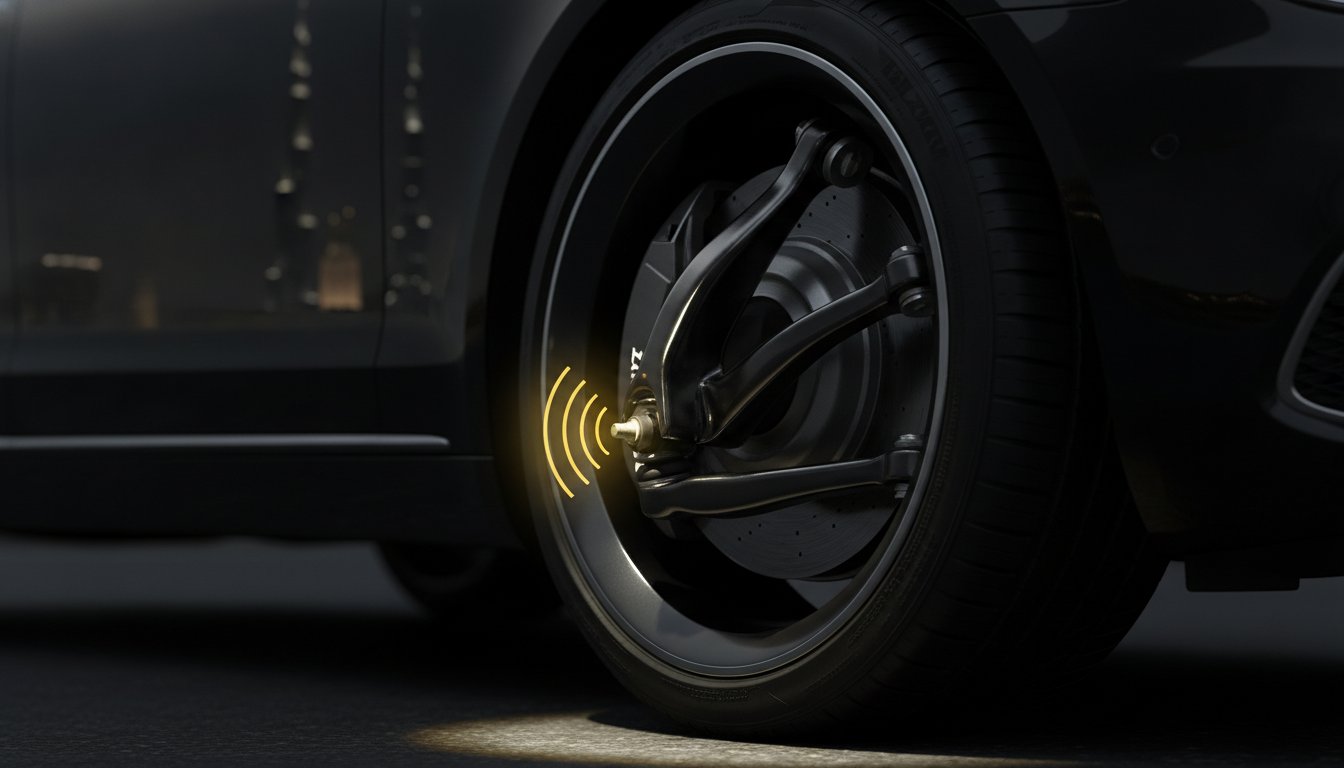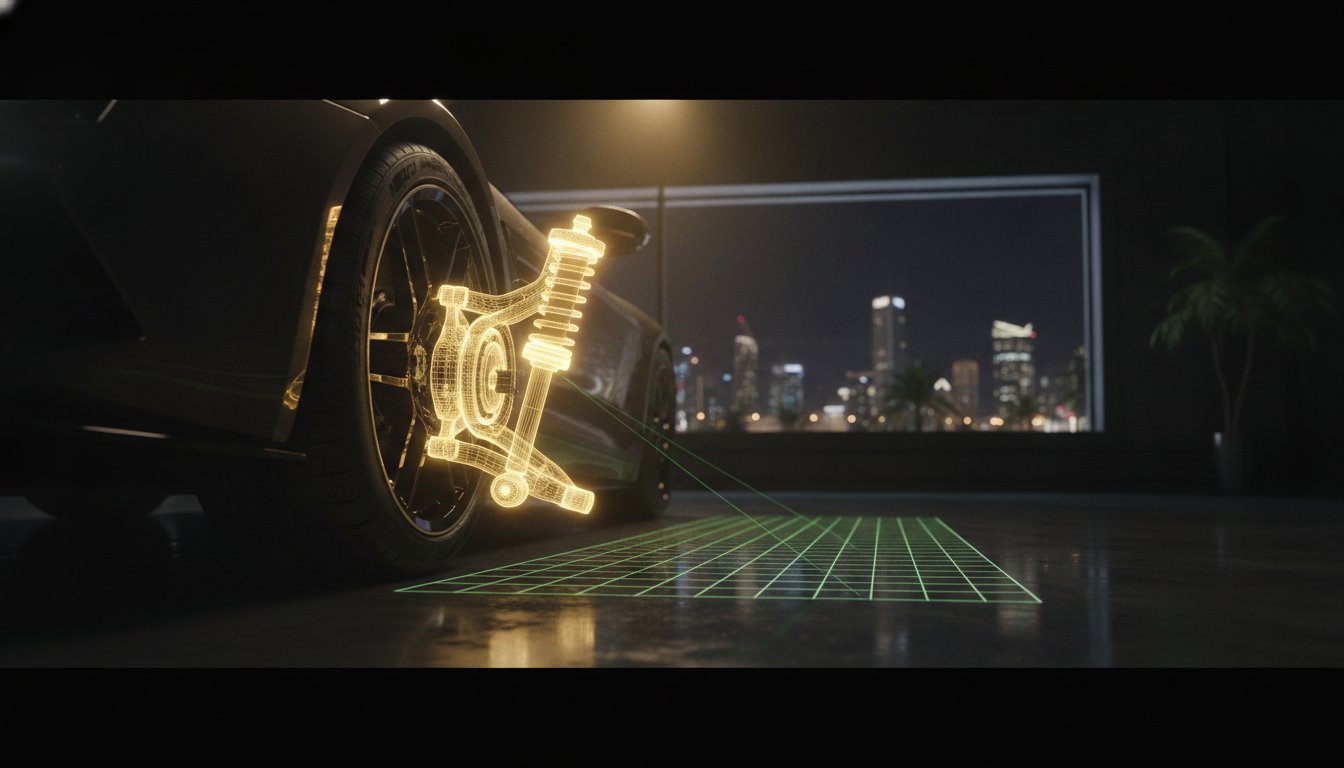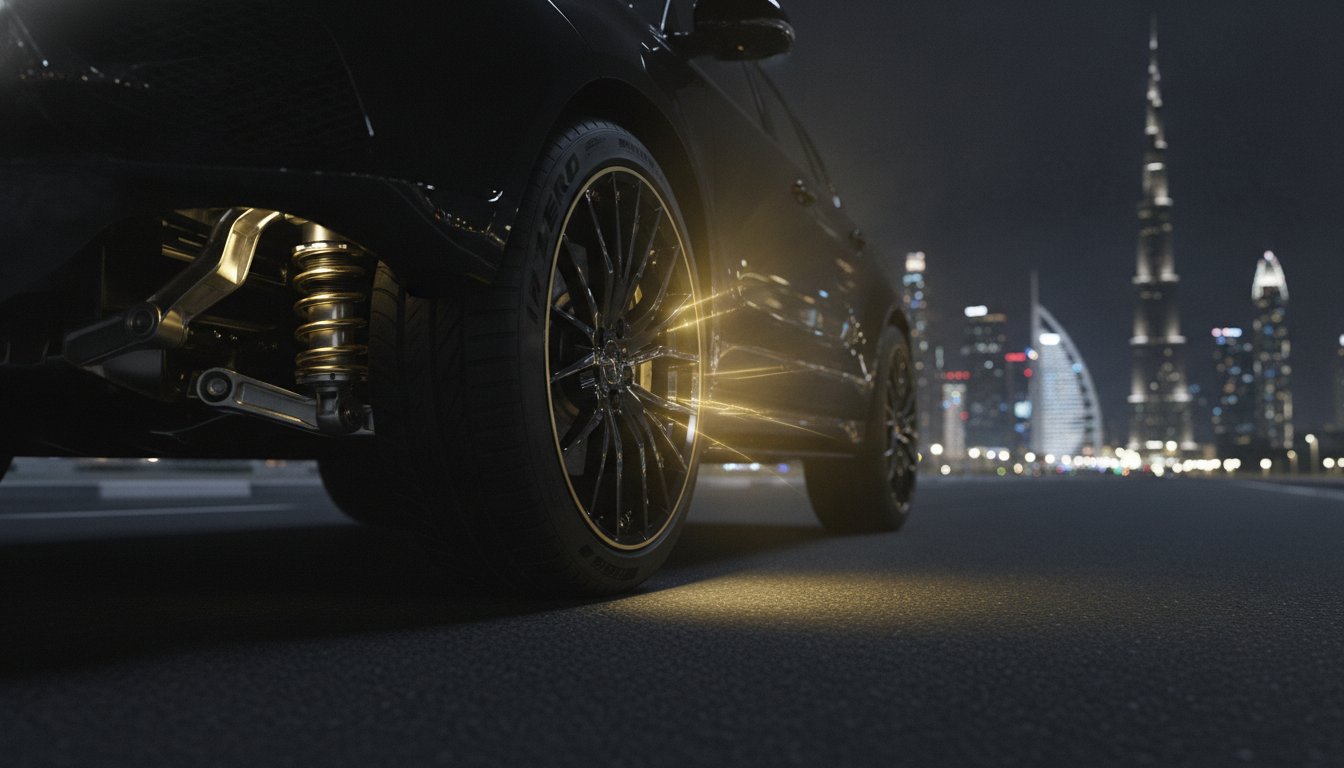
Why does your premium SUV feel like a desert buggy on some of the world’s smoothest highways? It’s a frustrating contradiction when your car feels bumpy on Dubai roads, especially when the RTA has recently invested in 17 kilometers of fresh asphalt across the city. You expect a silent, cloud-like experience, yet you’re currently white-knuckling the steering wheel through high-speed vibrations on Sheikh Zayed Road or wincing at loud thuds over community speed breakers. This loss of refinement isn’t just annoying; it’s a sign that Dubai’s unique environment is taking a toll on your vehicle’s sophisticated underpinnings.
We’re here to help you regain that factory-fresh comfort. This guide will reveal why your luxury ride has deteriorated and how local conditions, from extreme heat to aggressive speed humps, impact your suspension system. You’ll learn to identify the specific components causing the bumps and discover the steps needed to restore original ride quality. We’ll also show you how to address these issues early to avoid secondary damage to your tyres and ensure your vehicle remains roadworthy for its next annual inspection.
Key Takeaways
- Understand how extreme UAE temperatures and high-speed highway driving accelerate the wear of your luxury vehicle’s suspension components.
- Learn why your car feels bumpy on Dubai roads and identify the specific mechanical culprits, from worn shock absorbers to degraded bushings.
- Discover the hidden risks of ignoring suspension fatigue, including compromised braking distances and rapid tyre “cupping” that ruins new sets in weeks.
- Follow a simple two-step diagnostic checklist to evaluate your vehicle’s stance and listen for warning signs over community speed breakers.
- Find out why restoring a “cloud-like” ride requires brand-specific expertise rather than temporary patches for high-end machinery.
The Dubai Paradox: Why Smooth Roads Can Feel Bumpy
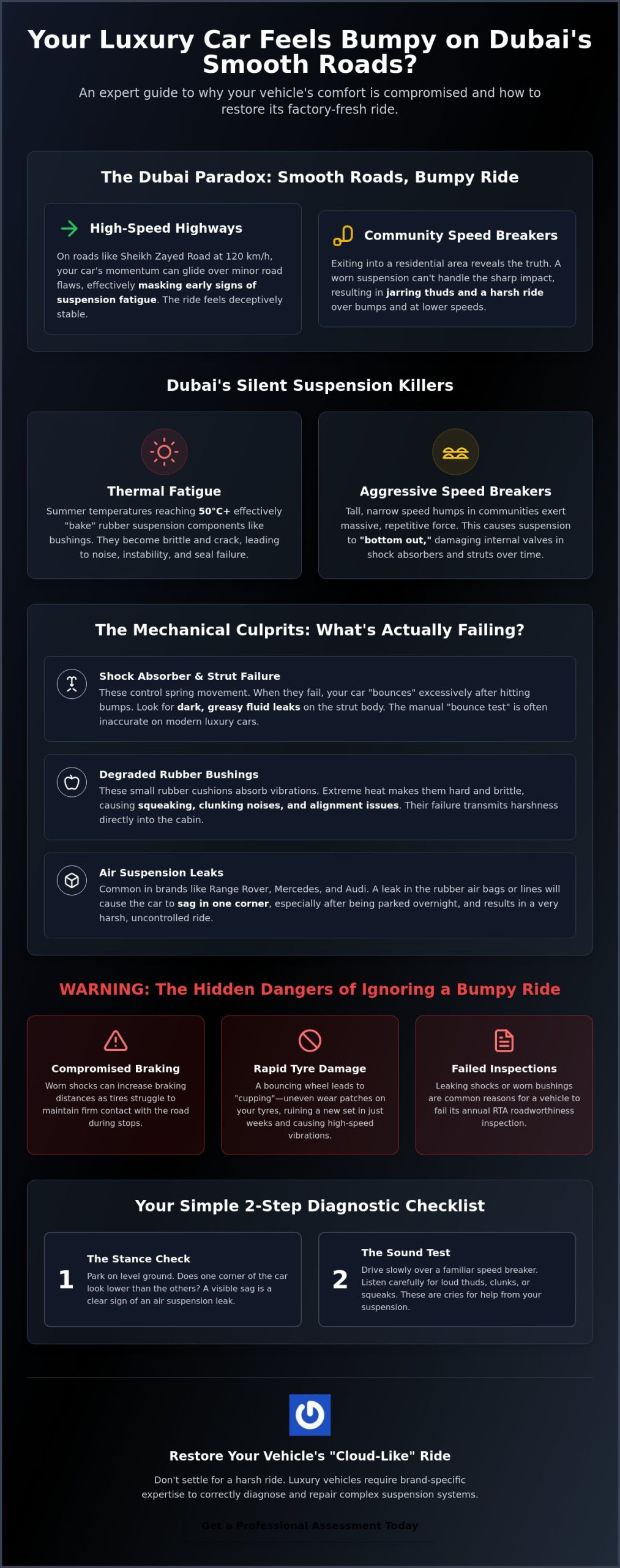
Dubai boasts some of the most advanced infrastructure in the world. In June 2026, the RTA completed another 17 kilometers of asphalt rehabilitation across major corridors. Yet, many drivers find that their car feels bumpy on Dubai roads despite this pristine surface. It’s a frustrating contradiction. You glide along the newly rehabilitated stretches of Sheikh Zayed Road at 120 km/h, feeling relatively stable, only to experience jarring thuds the moment you exit toward a residential community. This happens because high-speed driving often masks early suspension fatigue. At highway speeds, the momentum of a heavy luxury vehicle can skip over minor imperfections, hiding the fact that your dampers are no longer controlling the spring’s rebound correctly.
Luxury cars are particularly susceptible to this paradox. These vehicles utilize a complex vehicle suspension system designed to provide a “cloud-like” ride. While these systems are engineered for performance, they rely on dozens of sensitive rubber seals and hydraulic valves. When these components begin to degrade, the sophisticated electronics try to compensate, often resulting in a ride that feels “busy” or jittery rather than smooth. If your car feels bumpy on Dubai roads, your vehicle is likely struggling to manage the transition between high-speed stability and low-speed compliance.
Thermal Fatigue and Your Suspension
The UAE’s climate is a silent predator for automotive underpinnings. With summer temperatures frequently reaching 50°C, the ground temperature can soar even higher. This intense heat, combined with high UV radiation, effectively “bakes” the rubber components of your car. Rubber bushings that are designed to be pliable and absorb road noise become brittle and cracked. Thermal fatigue is the primary cause of premature bushing failure in the Middle East. A vehicle parked outside in the sun suffers significantly more than one kept in a basement, as the constant expansion and contraction cycles accelerate the breakdown of vital seals. Once these seals fail, the hydraulic fluid inside your struts can leak, leaving you with nothing but a metal spring to support your car’s weight.
The Impact of Community Speed Breakers
While the highways are smooth, Dubai’s residential areas like Jumeirah and Mirdif are famous for aggressive speed humps. These tall, narrow breakers exert massive vertical force on your suspension in a very short window of time. Repetitive compression from these ramps leads to “bottoming out,” where the suspension hits its physical limit. Over time, this repetitive stress causes internal valving in the shock absorbers to fail. You might notice a faint squeak or a loud thud when entering your villa’s driveway. These aren’t just annoying sounds; they’re warnings that your shocks are no longer dissipating energy, forcing the rest of the chassis to absorb the impact instead.
Common Culprits: What is Actually Breaking?
When your car feels bumpy on Dubai roads, the issue is rarely a single “broken” part. Instead, it’s usually the gradual failure of several interconnected components. While many drivers assume a simple wheel alignment will fix the vibrations, alignment is often just a symptom of worn hardware. Identifying which part is actually failing is the first step toward restoring your vehicle’s original refinement. In luxury vehicles, these systems are highly tuned. Even a small amount of play in a single joint can compromise the entire driving experience.
There are four primary mechanical failures that lead to a harsh or unsettled ride. Understanding these symptoms helps you communicate more effectively with a specialist. If you’ve noticed your car drifting or feeling unstable, you should also review tire safety and maintenance guidelines, as suspension issues and tyre health are deeply linked. Neglecting one often leads to the rapid destruction of the other, especially in the UAE’s high-speed environments.
Shock Absorber Leaks and Failure
Shock absorbers and struts are the primary reason for “the bounce.” Their job is to control the energy of the springs. When they fail, your car continues to oscillate long after you’ve hit a bump. Look for dark, greasy hydraulic fluid leaking down the body of the strut. Don’t rely on the traditional “bounce test” of pushing down on the car’s corner. Modern electronic dampers, common in BMW or Porsche models, are too stiff for this manual test to be accurate. If you suspect a leak, seeking professional shock absorber repair Dubai is the only way to ensure your damping rates are correctly restored.
Air Suspension Leaks in Luxury Vehicles
Do you own a Range Rover, Mercedes, or Audi? You likely have an air suspension system. If you notice your SUV sitting lower on one side in the morning, you have a leak. This usually stems from a perforated air bag or a failing compressor. Don’t ignore the “Air Suspension Inactive” warning on your dashboard. A leaking bag forces the compressor to run constantly to maintain ride height. This eventually burns out the motor, turning a simple bag replacement into a much more expensive system-wide overhaul. It’s a critical safety matter that impacts your car’s ability to handle emergency maneuvers.
Bushings and Mounts: The Silent Comfort Killers
Rubber bushings act as the cartilage between your car’s “bones.” They isolate road noise and prevent metal-on-metal contact. As we discussed earlier, Dubai’s heat bakes these components until they crack. Once the rubber loses its elasticity, you’ll hear “clunking” sounds over speed breakers. Replacing these bushings can instantly restore that “new car” feeling and eliminate the harshness that makes your car feels bumpy on Dubai roads. If your ride has lost its silence, it’s time for a professional inspection. Speak with a specialist today to diagnose your suspension’s health.
- Worn Ball Joints: These cause a “loose” or wandering feeling in your steering wheel.
- Control Arm Fatigue: Leads to unpredictable handling during heavy braking.
- Stabilizer Links: The source of “rattling” noises on uneven surfaces.
The Danger of Ignoring a Bumpy Ride
Ignoring the early signs when your car feels bumpy on Dubai roads is a gamble with both your safety and your wallet. While the initial irritation might be a slight vibration or a soft thud, the mechanical reality is far more severe. Your car’s suspension system is the only thing keeping your tyres in constant contact with the road. When this contact is broken, even for milliseconds, you lose the ability to steer and stop effectively. This is especially critical on high-speed arteries like the E11 or E311, where emergency maneuvers require absolute precision. If your car isn’t planted firmly on the asphalt, your safety systems cannot do their job.
Mechanical issues in luxury vehicles don’t stay small. They compound. A minor bushing failure puts excessive stress on the struts, which then forces the ball joints to work harder. What starts as a simple rubber replacement can quickly escalate into a full system restoration. Proactive care is the only way to maintain the safety and value of your high-end machinery. Don’t wait for a total component failure to take action.
The Hidden Cost of Tyre Wear
One of the most immediate financial consequences of a failing suspension is “cupping” or scalloping. This occurs when a worn shock absorber allows the wheel to bounce, causing the tyre to hit the pavement with uneven force. This creates high and low spots across the tread. In Dubai, a single premium tyre can cost between 200 and 1,000 AED depending on your vehicle’s brand and size. A bad suspension can ruin a brand-new set of these tyres in just a few weeks. By consulting suspension specialists Dubai, you can identify these issues during a routine check. It’s much cheaper to replace a bushing than to buy four new tyres because of uneven wear patterns.
High-Speed Stability Risks
Do you feel a “floaty” sensation when driving at highway speeds? This isn’t just a quirk of your vehicle; it’s a sign of insufficient tyre-to-road contact. This lack of grip becomes dangerous when sudden wind gusts hit your car on the open road. Your vehicle’s ABS system also relies on stable contact to function correctly. At 120km/h, a single worn shock can increase braking distance by up to 2 meters. That distance is often the difference between a safe stop and a collision. Don’t take the risk. If your car feels bumpy on Dubai roads, your braking performance is already compromised, even if you don’t feel it every day.
Diagnostic Checklist for Dubai Drivers
How do you confirm if your vehicle’s suspension is failing or if you’re just sensitive to the road surface? Identifying why your car feels bumpy on Dubai roads requires a methodical approach that accounts for our specific driving conditions. While a smooth highway might hide a failing strut, a residential speed breaker will expose it instantly. Use this five-step checklist to evaluate your vehicle’s health before a minor vibration turns into a major repair bill.
- Step 1: The Visual Stance Check. Park on a flat surface and walk around the vehicle. Does one corner sit lower than the others? A “leaning” car usually indicates a collapsed spring or a leaking air bag.
- Step 2: The Low-Speed “Community” Test. Drive through a residential area like Jumeirah or Mirdif. Listen for audible squeaks or groans as you cross tall speed humps. These humps exert maximum vertical force, making them perfect for testing component compliance.
- Step 3: The Highway Stability Test. On the E11, pay attention to the steering wheel at 100 km/h. Does the car drift to one side or feel “floaty” during lane changes? A lack of precision often points to worn control arm bushings.
- Step 4: The Tyre Inspection. Run your hand along the tread of your front tyres. If you feel “hills and valleys” rather than a smooth surface, your suspension is allowing the wheel to bounce excessively.
- Step 5: The “Nose Dive” Test. Observe the front of your car during a firm stop at a traffic light. If the nose dips aggressively and then bounces once or twice after stopping, your shock absorbers have lost their damping ability.
How to Perform a Safe Visual Inspection
You don’t need to be a mechanic to spot a failing component. Turn your steering wheel to full lock and look behind the tyre into the wheel well. You’re looking for signs of hydraulic fluid on the body of the shock absorber. It’s easy to confuse dry “road grime” with a leak. Real hydraulic failure looks wet, dark, and greasy. If you have an air suspension system, check the ride height immediately after the car has been parked overnight. If the car has “slumped” toward the ground, you have a slow air leak that needs urgent attention. Catching these leaks early prevents the air compressor from burning out due to overwork.
Listening for Suspension Noises
Sound is often the first warning sign of mechanical fatigue. A sharp “clunk” or “bang” over a bump usually means a bushing has disintegrated, allowing metal-on-metal contact. Conversely, a “hissing” sound after you park suggests a leak in an air line or bag. In the intense Dubai heat, you’ll often hear a rhythmic “squeak.” This typically points to rubber components that have dried out and lost their lubrication. If you notice any of these sounds, it’s time to visit a professional suspension shop Dubai for a detailed inspection. Don’t let a small noise become a safety risk. Book a professional diagnostic check today to ensure your luxury ride remains safe and silent.
Professional Restoration: Fixing the Bumpy Ride
Why settle for a “good enough” fix when your luxury vehicle was engineered for perfection? When your car feels bumpy on Dubai roads, a simple patch job often ignores the underlying mechanical fatigue. Many general workshops focus on “patching” leaks or replacing a single component to save on immediate costs. However, in a complex suspension system, one worn part often accelerates the wear of its neighbors. A professional restoration isn’t just about swapping parts. It’s about recalibrating the entire system to ensure every bushing, strut, and mount works in perfect harmony to deliver that factory-smooth ride quality.
Restoring a performance vehicle requires more than just a wrench and a lift. Modern luxury cars utilize active suspension technologies that communicate with the vehicle’s central computer thousands of times per second. If a new component isn’t correctly integrated or if a generic part is used, the car’s computer may struggle to manage the damping rates. This results in a ride that feels disconnected or jittery. Specialized workshops use advanced diagnostic tools to communicate with these electronic dampers, ensuring the restoration meets the exact specifications of the original manufacturer.
Specialized Care for Luxury Brands
Audi, BMW, and Mercedes systems are highly sophisticated and cannot be treated by general mechanics who lack brand-specific training. These manufacturers use unique hydraulic and air-based technologies that require specialized tools for assembly and calibration. Furthermore, the UAE climate demands the use of high-quality struts and bushings specifically designed to withstand extreme thermal stress. Using inferior parts often leads to a return of the bumpy sensation within months. For a deeper look at why these brands require a higher standard of service, consult our luxury car suspension repair Dubai guide.
The Specialist Advantage at Suspension Repair
We provide an exclusive focus on what matters most for your comfort: the shock absorbers and struts. Our expertise isn’t spread thin across general engine work or transmission repairs. We are dedicated specialists who understand the intricate nuances of high-end machinery. This focused approach allows us to handle even the most demanding exotic brands, including Ferrari, Lamborghini, and Bentley. We understand that these vehicles are precision instruments that require a stress-free, high-end resolution to any mechanical issue.
- Precision Calibration: We ensure all electronic and air systems are synced perfectly.
- Climate-Ready Parts: We only use components capable of surviving 50°C ground temperatures.
- Expert Diagnosis: We identify the root cause to prevent secondary damage to your tyres.
Don’t let a deteriorating ride compromise your safety or driving pleasure. It’s time to reclaim the luxury experience you deserve. Contact our Dubai suspension specialists for a comprehensive inspection and let us restore your vehicle to its original, cloud-like comfort.
Reclaim Your Luxury Driving Experience
Your vehicle was engineered to provide a seamless, refined journey. When your car feels bumpy on Dubai roads, it is a clear signal that the city’s extreme 50°C temperatures and aggressive community speed breakers have compromised that original engineering. Ignoring these early warning signs doesn’t just ruin your comfort; it risks expensive secondary damage to your tyres and increases your braking distance during high-speed highway travel. Protecting your investment requires moving beyond generic fixes toward specialized, technical intervention.
As specialists in luxury and performance brands, we provide expert shock absorber and air suspension repair using Dubai-specific, climate-tested solutions. We understand the unique stresses placed on high-end machinery in the Middle East and offer a stress-free path to total restoration. Don’t let a deteriorating suspension compromise your safety or the pleasure of your daily commute.
Restore your ride comfort; Book a professional suspension inspection today!
Take the first step toward a smoother, safer drive and enjoy the cloud-like ride your car was built to deliver.
Frequently Asked Questions
Why does my car feel bumpy even though the roads look smooth in Dubai?
High-speed driving on pristine highways like the E11 often masks the early stages of suspension fatigue. At 120 km/h, your vehicle’s momentum can carry it over minor surface imperfections, hiding the fact that your dampers aren’t correctly controlling the spring’s rebound. You only truly notice the issue when you exit the highway and hit the “mini speed bumps” or residential breakers found in communities like Jumeirah. If your car feels bumpy on Dubai roads, it’s a sign that your suspension can no longer manage the transition between high-speed stability and low-speed compliance.
Is it safe to drive with a bumpy suspension in the UAE?
No, driving with a compromised suspension is a significant safety risk, especially at the high speeds common on UAE roads. Your suspension is responsible for keeping your tyres in constant contact with the asphalt. When components are worn, your braking distance can increase by up to 2 meters at 120 km/h. This lack of road holding also makes your vehicle less stable during sudden wind gusts or emergency maneuvers on the highway. Don’t risk a loss of control; address the issue as soon as you feel a change in ride quality.
How much does it cost to fix a bumpy suspension in Dubai?
The cost of suspension repair depends entirely on the specific components that have failed and the brand of your vehicle. A simple rubber bushing replacement is far more affordable than replacing a full air suspension strut or an electronic damper. Luxury brands like Bentley, Porsche, or Mercedes require specialized parts and diagnostic tools, which influences the final investment. We recommend a professional inspection to identify the exact part causing the harshness, as replacing only what is necessary prevents inflated repair bills.
Can heat really damage my car’s suspension system?
Yes, the extreme UAE heat is the primary cause of “thermal fatigue” in automotive underpinnings. When ground temperatures soar near 50°C, the rubber bushings and hydraulic seals in your suspension effectively bake and become brittle. This leads to cracks and fluid leaks that wouldn’t occur as quickly in cooler climates. A car parked in the sun suffers significantly more wear than one kept in a basement, as the constant heat cycles accelerate the breakdown of these vital, pliable components.
What are the signs of an air suspension leak?
The most obvious sign of an air suspension leak is seeing your vehicle “slump” or sit lower on one side after being parked overnight. You might also hear a faint hissing sound from the wheel well or notice that your air compressor is running constantly to maintain ride height. If you see an “Air Suspension Inactive” warning on your dashboard, it is an urgent safety matter. Ignoring a small leak will eventually burn out the expensive compressor motor, turning a simple bag replacement into a much larger system failure.
How often should I have my car’s suspension inspected in Dubai?
You should have your suspension inspected at least once a year or every 10,000 kilometers. While the RTA requires an annual technical inspection for vehicles older than three years, these tests focus on basic roadworthiness. A specialist inspection is necessary to catch early signs of thermal fatigue or slow hydraulic leaks that a standard test might miss. It’s especially wise to check the system after the peak summer months when heat damage to rubber bushings is most likely to have occurred.
Will a bumpy suspension cause my tyres to wear out faster?
Yes, a failing suspension will rapidly destroy your tyres through a process called “cupping” or scalloping. When your shock absorbers are worn, they allow the wheel to bounce rather than stay planted on the road. This creates uneven high and low spots across the tread. Because a single premium tyre in Dubai can cost up to 1,000 AED, it’s much more cost-effective to fix your car feels bumpy on Dubai roads early. A healthy suspension protects your tyre investment and ensures your car passes its next RTA registration test.
Can I just replace one shock absorber or do I need to replace both?
You must always replace shock absorbers in pairs across the same axle. Replacing only one side creates an imbalance in damping rates, which can lead to unpredictable handling and uneven tyre wear. Your car’s safety systems, such as ABS and traction control, rely on consistent performance from both sides of the vehicle to function correctly. To restore the original “factory smooth” ride and ensure balanced braking, always install new dampers in sets of two.