Did you know that a tiny, invisible leak in your air spring can destroy your compressor in less than a week during a Dubai summer? It’s a frustrating reality for many owners when that “Suspension Fault” message flashes on the dashboard or your vehicle gets stuck in “Access Height.” You’re likely worried about Range Rover air suspension problems Dubai heat makes worse, especially when faced with astronomical dealership repair quotes. It’s stressful to feel like your luxury SUV is one bump away from a total system collapse.
We understand that your time and safety are paramount. This 2026 diagnostic guide will help you identify common faults and understand how our 60°C road temperatures accelerate rubber degradation and sensor failure. You’ll learn exactly how to spot a leak before it leads to a costly compressor replacement, ensuring your vehicle remains reliable and comfortable. We’ll walk you through the specific symptoms of L405 and L460 models and provide a clear path to a professional, high-end resolution that bypasses the usual dealership headaches. Protect your investment by catching these issues early.
Key Takeaways
- Learn how Dubai’s extreme heat and abrasive desert sand specifically degrade your vehicle’s rubber seals and height sensors.
- Master simple diagnostic techniques like the “Soap Water Test” to identify Range Rover air suspension problems Dubai heat often triggers before they lead to total compressor failure.
- Understand the critical difference between yellow and red dashboard warnings to know exactly when your car is safe to drive and when it requires an immediate stop.
- Discover how to spot early warning signs like overnight sagging or uneven ride height to prevent minor leaks from becoming major repair bills.
- Find out why specialized calibration and OEM-standard components are essential for maintaining the sophisticated suspension systems of British luxury SUVs.
Common Range Rover Air Suspension Problems in Dubai
Have you ever walked out to your driveway in the morning only to find your luxury SUV leaning heavily to one side? This “sagging” is more than just a cosmetic annoyance; it’s a clear warning of mechanical distress. Identifying Range Rover air suspension problems Dubai owners face usually begins with these visual cues. When your vehicle sits overnight, any small leak in the system allows air to escape, causing the car to drop toward the bump stops. If your car looks like it’s kneeling, the system is struggling to maintain equilibrium.
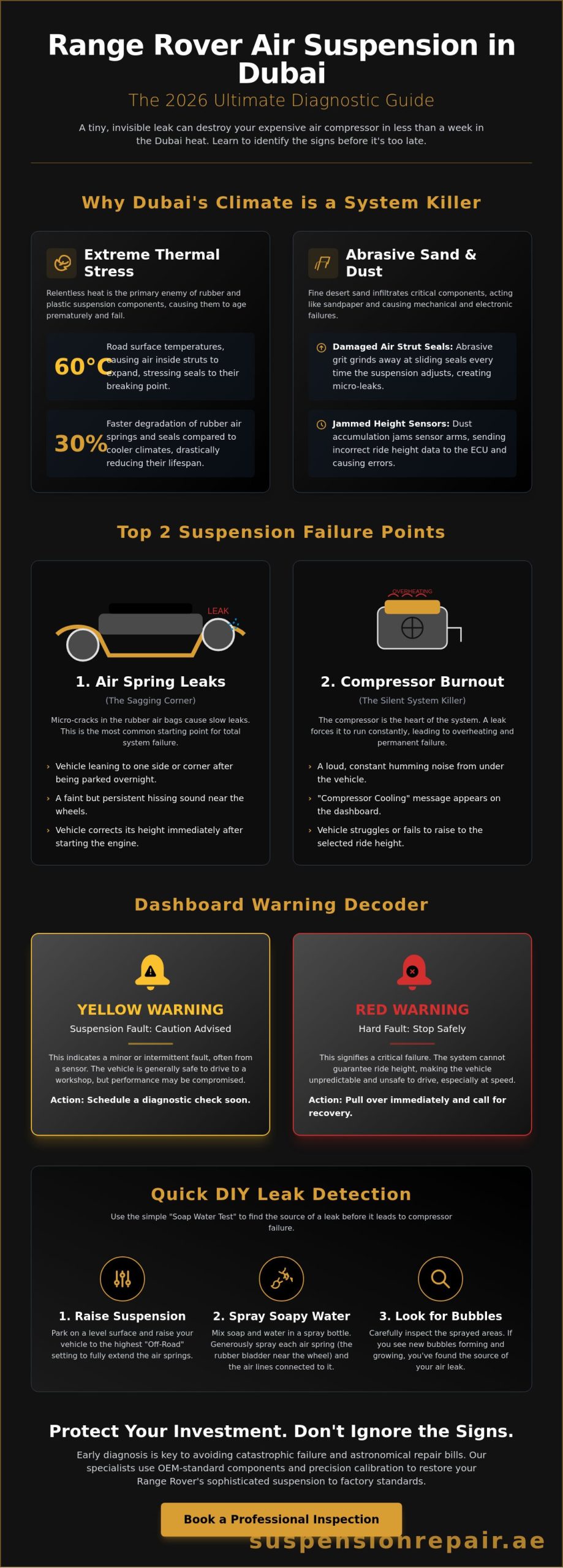
Dashboard warnings are your next point of contact. A yellow “Suspension Fault” icon serves as a cautious nudge, suggesting that while the car is still drivable, a sensor or minor component is failing. However, a red icon is a “Stop Safely” command. This indicates a hard fault where ride height can no longer be guaranteed, making the vehicle unpredictable at highway speeds. You might also notice your car feels like a boat on the waves. This lack of dampening occurs when the air bags can’t maintain the correct pressure to counteract road imperfections. Listen for unusual noises too. A persistent hissing from the wheel wells or a loud, constant compressor hum indicates the system is fighting a losing battle against a leak.
The Sagging Corner: Air Spring Leaks
The core of modern air suspension systems involves thick rubber bladders that inflate to support the vehicle’s weight. Over time, these rubber components perish. Constant pressure cycles combined with Dubai’s extreme heat cause the material to develop micro-cracks. A “blown” strut is easy to spot because the corner will drop almost instantly. However, slow micro-leaks are more deceptive. They often manifest as a slight lean that disappears once the engine starts and the system re-pressurizes. Ignoring one sagging corner is a mistake. It forces the other three corners to overcompensate, eventually leading to a total system failure that leaves you stranded.
Compressor Burnout: The Silent System Killer
Think of the compressor as the lungs of your Range Rover. It’s the hardest working part of the Electronic Air Suspension (EAS) because it must constantly pump air to maintain height. If you have a leak, the compressor runs much longer than it’s designed to. You might hear a loud, constant hum coming from the chassis or see “Compressor Cooling” messages on your dash. These are signs of an overworked pump on the verge of burnout. A small, inexpensive air leak is almost always the culprit behind a total compressor failure. By the time the pump dies completely, the repair becomes significantly more complex. Catching the leak early is the only way to save the heart of the system.
Why Dubai’s Climate Accelerates Suspension Failure
Dubai’s environment is uniquely hostile to high-performance machinery. While your Range Rover was engineered for luxury, its air suspension wasn’t necessarily built to withstand the relentless 50°C heat and abrasive desert sand found in the UAE. Understanding why Range Rover air suspension problems Dubai occur requires a look at how the local climate interacts with the vehicle’s physics. From the salt-laden air of the Marina to the fine dust of the desert, every element works against the longevity of your suspension components.
The Thermal Stress Factor
Heat is the primary enemy of any pressurized system. When road temperatures exceed 60°C, the air inside your suspension bellows expands, placing immense structural pressure on the rubber seals. This isn’t just about pressure; it’s about material science. According to the NHTSA’s advice on how summer heat affects vehicle components, high temperatures significantly accelerate the aging of rubber and plastic parts. In the UAE, these 50-degree summers effectively reduce the lifespan of suspension rubber by 30% compared to cooler climates. This thermal stress also attacks the internal mechanics, as the lubricating grease inside your suspension compressor can dry out, leading to friction-based wear and eventual seizure.
Sand and Dust Contamination
Sand ingress adds another layer of complexity to vehicle maintenance. Fine Dubai sand is highly abrasive. It works its way into the sliding seals of your air struts, acting like sandpaper every time the vehicle raises or lowers. This grit also builds up in the mechanical arms of your height sensors. When these sensors become jammed with dust, they send incorrect data to the car’s computer, leading to uneven ride height or “Suspension Fault” errors. Furthermore, fine dust often clogs the air intake filters of the suspension compressor, forcing the pump to work harder to draw in air, which leads to premature motor failure.
If you live near the coast, humidity and salinity pose even more risks. Saline air triggers corrosion in the metal fittings and internal valve blocks that distribute air throughout the system. When these valves corrode, they stick, preventing the car from leveling correctly. Finally, consider the daily grind on Sheikh Zayed Road. Constant stop-and-go traffic forces the system to make hundreds of micro-adjustments to maintain stability, wearing out the compressor much faster than highway cruising would. The same harsh conditions that degrade your air springs also accelerate the deterioration of your struts; understanding the symptoms of worn shock absorbers Dubai drivers commonly experience can help you catch related failures before they compound your repair costs. If you’ve noticed your vehicle struggling to stay level after a hot afternoon, it’s wise to speak with a specialist before a minor leak turns into a total system failure. Don’t wait for the red warning light to appear.
How to Diagnose Range Rover Suspension Problems: A Step-by-Step Guide
Park your vehicle on a perfectly level surface before you begin your inspection. While the sophisticated Electronic Air Suspension (EAS) manages height automatically, a physical walk-around often reveals imbalances that the computer hasn’t flagged yet. Identifying Range Rover air suspension problems Dubai drivers encounter doesn’t always require a professional diagnostic computer. Start by observing the gap between the tires and the wheel arches. If one corner sits lower than the others, you’ve found your primary suspect.
Listen closely to your vehicle after starting the engine. Does the compressor run for more than two minutes? In a healthy system, the pump should pressurize the reservoir quickly and then shut off. If you hear a persistent humming from the chassis, the system is likely struggling to overcome a leak. You should also check the air intake filter located in the trunk area or near the compressor. This is a five-minute DIY task. If the filter is clogged with fine desert sand, it restricts airflow, causing the motor to overheat and eventually fail. Cleaning or replacing this filter is the cheapest way to save your compressor.
The Overnight Height Test
This is the most reliable way to confirm a slow leak without specialized tools. Measure the distance from the center of the wheel hub to the edge of the fender arch on all four corners before you go to bed. Record these numbers. Re-measure the vehicle in the morning before starting the engine. If only one corner has dropped, the problem is likely a leaking air strut or a specific line connector. However, if the entire front or rear axle has lowered uniformly, the issue usually points toward a faulty valve block that is failing to hold pressure across that circuit.
Using the ‘Soap Water’ Method
Mix a simple solution of dish soap and water in a spray bottle for a non-invasive diagnostic test. Spray this mixture liberally onto the top mounts of the air struts, the air line connectors, and the valve block. Watch the surfaces closely for any reaction. A “fizzing” cluster of tiny bubbles indicates a micro-leak that is currently manageable but will worsen with heat. Conversely, large bubbles that “pop” quickly suggest a structural failure in the rubber bladder. Focus your attention on the folds of the rubber air springs, as this is where Dubai’s heat causes the most significant cracking and perishing over time.
When to Stop Driving: Understanding Suspension Fault Warnings
Your dashboard acts as the primary communicator between the vehicle’s complex brain and your peace of mind. When Range Rover air suspension problems Dubai heat triggers a warning, the color of the icon dictates your next move. A yellow warning light is a “Caution” signal. It suggests the system has detected an inconsistency, such as a slow leak or a sensor out of range, but is still functioning in a limited capacity. You can usually continue your journey, but you should book a professional inspection immediately to prevent the fault from escalating into a total system shutdown.
A red warning light is an entirely different matter. This is a “Stop Safely” command that you shouldn’t ignore under any circumstances. It means the Electronic Air Suspension (EAS) has entered a hard fault mode and can no longer guarantee the vehicle’s stability or ride height. Often, this is accompanied by a “Height Restricted” message. To protect you, the car’s computer will limit your top speed, usually to 60 km/h. This limiter exists because a car with no air pressure is physically unstable. Attempting to bypass this or drive at highway speeds can lead to a loss of control during sudden maneuvers.
The most dangerous scenario is driving when the car is “on the bump stops.” This occurs when there is zero air pressure in the struts, leaving the chassis to rest directly on internal rubber blocks. Every road ripple will feel like a massive impact. Driving in this state is reckless. It transfers all road energy directly into the chassis and control arms, causing structural damage that far exceeds the cost of a simple air bag replacement. It’s a bone-jarring experience that compromises both your car and your safety.
Soft Faults vs. Hard Faults
Distinguishing between fault types is essential for an accurate repair. A “soft fault” is often transient; it might be caused by a sensor getting confused by a sudden temperature spike or grit in a linkage. Sometimes, a simple suspension inspection Dubai specialists perform can resolve this through a quick sensor recalibration. However, a “hard fault” is a permanent lockout. The system detects a major component failure, like a burnt-out compressor, and stays disabled to prevent further harm. These require specialized diagnostic tools to reset even after the physical repair is finished.
The Risks of Ignoring the Warning
Proactive care is the only way to manage luxury vehicle maintenance costs effectively. If you ignore a minor hissing sound or a yellow light, you’re inviting a financial disaster. A simple 500 AED leak repair can quickly spiral into a 5,000 AED overhaul involving the compressor and multiple struts. Beyond the money, your emergency handling is severely compromised. A car that can’t level itself will have significantly longer braking distances. If your dashboard is flashing a warning, it is time to contact our expert team for a definitive diagnosis. We’ll help you resolve the issue before it leads to a total system collapse.
Expert Range Rover Air Suspension Repair in Dubai
General garages often treat luxury SUVs like any other vehicle. This is a mistake. Resolving Range Rover air suspension problems Dubai owners face requires more than just swapping out a leaky bag; it requires a deep understanding of the Electronic Air Suspension (EAS) architecture. While a general mechanic might manage to fit a new part, they often lack the precision tools needed to ensure the system communicates correctly with the ECU. This oversight leads to uneven tire wear and persistent warning lights that never seem to go away.
Quality parts are non-negotiable for high-end machinery. We always recommend OEM components or high-quality aftermarket alternatives like Arnott. These air springs are specifically engineered to handle the high load ratings and extreme heat cycles of the UAE. Using inferior parts is a false economy. They often fail within months, leaving you back at square one. Beyond the parts, calibration is the critical step most people miss. If the car isn’t calibrated on level ground using manufacturer-grade software, the sensors will never accurately report the ride height. This causes the compressor to work harder than necessary, leading to the burnout issues mentioned earlier.
Preventative care is your best defense against unexpected bills. We suggest cleaning your struts and replacing the air intake filters every 20,000 km. This simple routine removes the abrasive desert sand that causes the micro-cracks in the rubber bladders. It’s a small investment that adds years to the life of your air bags and compressor. Don’t wait for the car to sag before taking action.
Why Choose a Specialist for Your Range Rover?
Specialists use dedicated Land Rover diagnostic software like SDD or Pathfinder. These tools are essential for reading the specific fault codes found in L322, L405, and L460 models. A general OBDII scanner simply won’t provide the depth needed for a permanent fix. By accessing manufacturer-level data, we can pinpoint whether a fault is a wiring issue, a sensor glitch, or a mechanical failure. For a deeper look at why this expertise matters, check out our Luxury Car Suspension Repair Dubai guide.
Restoring Ride Comfort and Stability
Newer models utilize nitrogen-charged systems to improve response times and reduce the load on the compressor. If your system is opened for repair, it must be recharged with high-purity nitrogen to function correctly. This is how we achieve a professional ride comfort restoration Dubai owners expect, bringing back that iconic “magic carpet” feel. Don’t let a minor leak ruin your drive or lead to a total system failure. Visit our car suspension repair Dubai workshop today and let our specialists handle the complexity for you.
Restore Your Range Rover’s Signature Ride Quality
Dubai’s extreme environment doesn’t have to mean the end of your vehicle’s legendary comfort. By recognizing the early warning signs of Range Rover air suspension problems Dubai summers cause, you can intervene before a simple leak leads to a total system failure. Remember that early detection through overnight height tests and visual inspections saves your compressor from unnecessary burnout. Professional calibration and the use of OEM-standard components remain the only ways to ensure your SUV handles safely on the road.
Our team provides the specialized diagnostics and technical expertise required to navigate the complexities of British engineering. With a convenient Dubai location and expert British car mechanics, we ensure your vehicle receives the high-end care it deserves. We use only OEM quality parts to guarantee a lasting resolution and peace of mind. Don’t let a “Suspension Fault” message compromise your safety or driving pleasure. Book Your Range Rover Suspension Inspection in Dubai Today and get back to enjoying the smooth, effortless drive your vehicle was designed to deliver. Your luxury SUV is in expert hands.
Frequently Asked Questions
Can I drive my Range Rover if the air suspension is sagging?
You should not drive a sagging vehicle because it places extreme stress on the chassis and compromises your steering control. If the car rests on the bump stops, every road impact travels directly into the frame, which can cause structural damage. It also significantly increases your braking distance. Book an inspection immediately to avoid turning a minor leak into a total system overhaul that costs significantly more.
How much does it cost to fix Range Rover air suspension in Dubai?
The total expense varies depending on whether you’re replacing a single sensor, a rubber air bag, or the entire compressor unit. Factors like the specific model year and whether you choose OEM or high-quality aftermarket parts will influence the final bill. While minor repairs are manageable, ignoring symptoms leads to much higher expenses. Always prioritize a professional diagnostic to pinpoint the exact failure point before committing to part replacements.
How do I reset my Range Rover air suspension fault?
You can attempt to clear a “soft fault” by turning the engine off and on or performing a battery reset. However, if the fault is “hard,” the system will remain locked to protect the hardware. These permanent errors require specialized Land Rover diagnostic software to clear after the physical repair is complete. Don’t simply clear codes without fixing the underlying Range Rover air suspension problems Dubai heat often causes; the warning will return.
Why does my Range Rover suspension drop overnight but raise in the morning?
This behavior is a classic sign of a slow air leak in a strut or a valve block. While the vehicle is parked, air slowly escapes through micro-cracks in the rubber or a failing seal. Once you start the engine, the compressor kicks in to level the car, hiding the problem temporarily. This cycle places immense strain on the pump and will eventually lead to a total compressor burnout if the leak isn’t sealed.
What is the lifespan of Range Rover air struts in the UAE?
In the harsh UAE climate, air struts typically last between three and five years. The intense summer heat and high humidity accelerate the degradation of the rubber bladders compared to cooler regions. Regular maintenance, such as cleaning the struts of abrasive sand every 20,000 km, can help extend this lifespan. If you notice any overnight sagging, it’s a sign that the rubber has reached its limit and requires replacement.
Is it better to repair air suspension or convert to coil springs in Dubai?
Repairing the air system is almost always the superior choice for maintaining the vehicle’s luxury performance and resale value. Converting to coil springs removes the “magic carpet” ride quality and disables the vehicle’s ability to adjust height for off-roading or highway cruising. Most buyers in the Dubai luxury market avoid vehicles with coil conversions. Investing in high-quality air suspension components preserves the driving experience the engineers intended.
Why is my Range Rover suspension compressor so loud?
A loud compressor usually indicates that the unit is overworking or the internal components are failing. If there is a leak in the system, the pump runs constantly to maintain pressure, causing it to vibrate excessively. You might also have worn rubber isolator mounts that are no longer dampening the sound. If the noise is accompanied by a “Compressor Cooling” message, the pump is at high risk of immediate failure and needs urgent attention.
Can sand really damage my SUV’s air suspension system?
Sand is a major factor in suspension failure because it acts as an abrasive on moving parts. Fine desert dust gets trapped in the folds of the air bags and the sliding seals of the struts, wearing them down like sandpaper. It also clogs the compressor’s air intake filter, restricting airflow and causing the motor to overheat. Regular cleaning and filter replacement are essential for any Range Rover driven in the UAE to prevent premature failure. For a broader understanding of how the UAE climate impacts your entire suspension system, our guide on worn shock absorbers Dubai owners should watch for covers the warning signs and risks in detail.