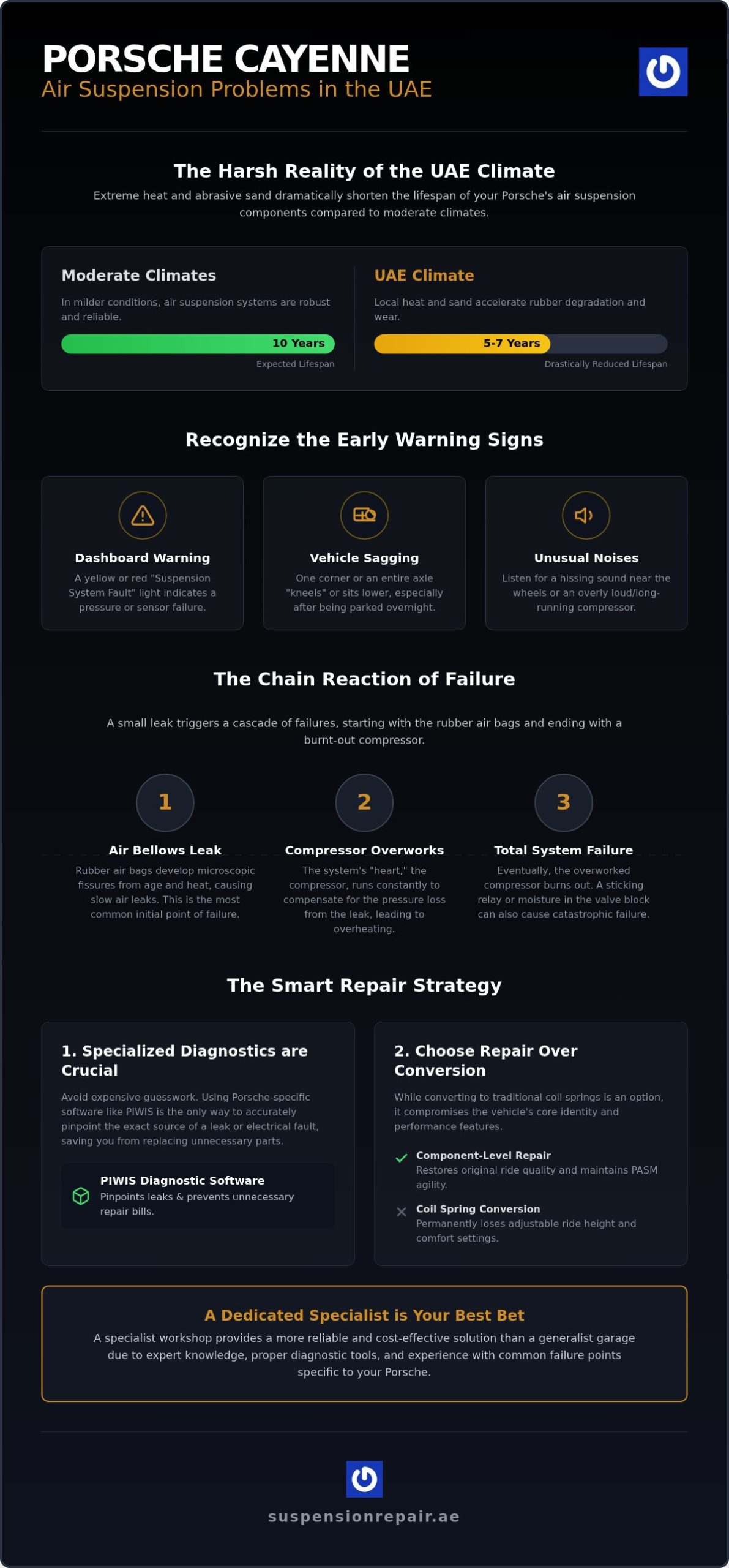
Have you ever felt that sudden, sinking feeling when your Porsche Cayenne drops into “low” mode while cruising down the E11? It’s more than just a minor inconvenience; it’s a direct threat to your safety and your vehicle’s performance. Dealing with Porsche Cayenne air suspension problems in the UAE can be incredibly frustrating. You want the luxury ride you paid for, but the extreme heat and fine sand of Dubai are relentless enemies of rubber seals and compressors. While most systems last a decade in moderate climates, the harsh local environment often cuts that lifespan down to just five to seven years.
This guide provides the expert insights you need to identify, diagnose, and resolve these issues without succumbing to the eye-watering quotes typically found at the dealership. We’ll break down the specific symptoms of failure, explain why our climate accelerates component wear, and show you how specialized diagnostics can restore your PASM agility and ride comfort. Stop guessing which parts to replace and start understanding the precise care your Porsche requires to stay roadworthy in the desert.
Key Takeaways
- Learn to decode the “Suspension System Fault” warning and recognize the early signs of vehicle sagging before they lead to a complete breakdown.
- Discover how Dubai’s extreme thermal expansion and abrasive sand specifically target Porsche Cayenne air suspension problems to accelerate component wear.
- Understand why specialized PIWIS diagnostic software is essential for pinpointing leaks and preventing unnecessary, expensive repair bills.
- Evaluate the long-term impact of component-level repairs versus coil spring conversions to ensure your Porsche maintains its original ride quality.
- Find out why a dedicated suspension specialist provides a more reliable, cost-effective solution than a generalist garage.
Common Symptoms of Porsche Cayenne Air Suspension Failure
Identifying Porsche Cayenne air suspension problems early can save you thousands in secondary damage. When that yellow or red “Suspension System Fault” light appears on your dashboard, your vehicle’s ECU has detected a pressure deviation or a sensor failure. This isn’t just a suggestion to visit a shop; it’s a warning that the car can no longer level itself safely. Often, the system defaults to a “stiff ride” phenomenon. It locks the dampers to their firmest setting to prevent the chassis from bottoming out, making your luxury SUV feel like it has no suspension at all.
The ‘Parked Sag’ Test
Do you notice your Cayenne “kneeling” on one side after sitting overnight? This is a classic indicator of a slow leak. To understand how air suspension works, you must realize it relies on airtight rubber bellows to hold the vehicle’s weight. You can perform a simple measurement at home. Check the clearance between the tire and the fender arch on all four corners. If only one corner is sagging, you likely have a perforated air bag or a leaking line at that specific strut. However, if the entire front or rear end has dropped, the culprit is often a failing valve block or a faulty check valve. These valves are designed to maintain pressure when the engine is off. When they fail, the air bleeds back through the system, leaving your Porsche sitting on its bump stops by morning.
Unusual Noises and Handling Changes
Listen for audible clues before the system fails completely. A faint hissing sound from a wheel well after you park is the sound of your repair bill growing. You might also hear the air compressor humming loudly or running for extended periods. It’s working overtime to compensate for a leak, which eventually leads to total compressor burnout. These Porsche Cayenne air suspension problems directly impact your safety on Dubai’s high-speed highways. If the front struts lose pressure, you’ll experience a dramatic “nose-dive” during hard braking. This weight shift significantly increases your stopping distance. At speeds of 120 km/h on the E11, a failing air system makes the car feel floaty and unpredictable during lane changes. Don’t wait for the car to get stuck in “low” mode. If the center console toggle fails to change your ride height, the system has already begun to shut down to protect itself.
Technical Causes: Why Cayenne Air Systems Fail
Why do these complex systems eventually collapse? The answer often depends on which generation you drive. While the older 955 and 957 models typically suffer from age-related seal degradation, the newer 958 and 9Y0 generations face challenges with more sensitive electronics and higher-pressure requirements. Most Porsche Cayenne air suspension problems follow a predictable chain reaction. A minor leak in a rubber component forces the rest of the system to overcompensate, leading to a total mechanical failure that could have been avoided with early intervention.
Porsche Air Bellows vs. Traditional Struts
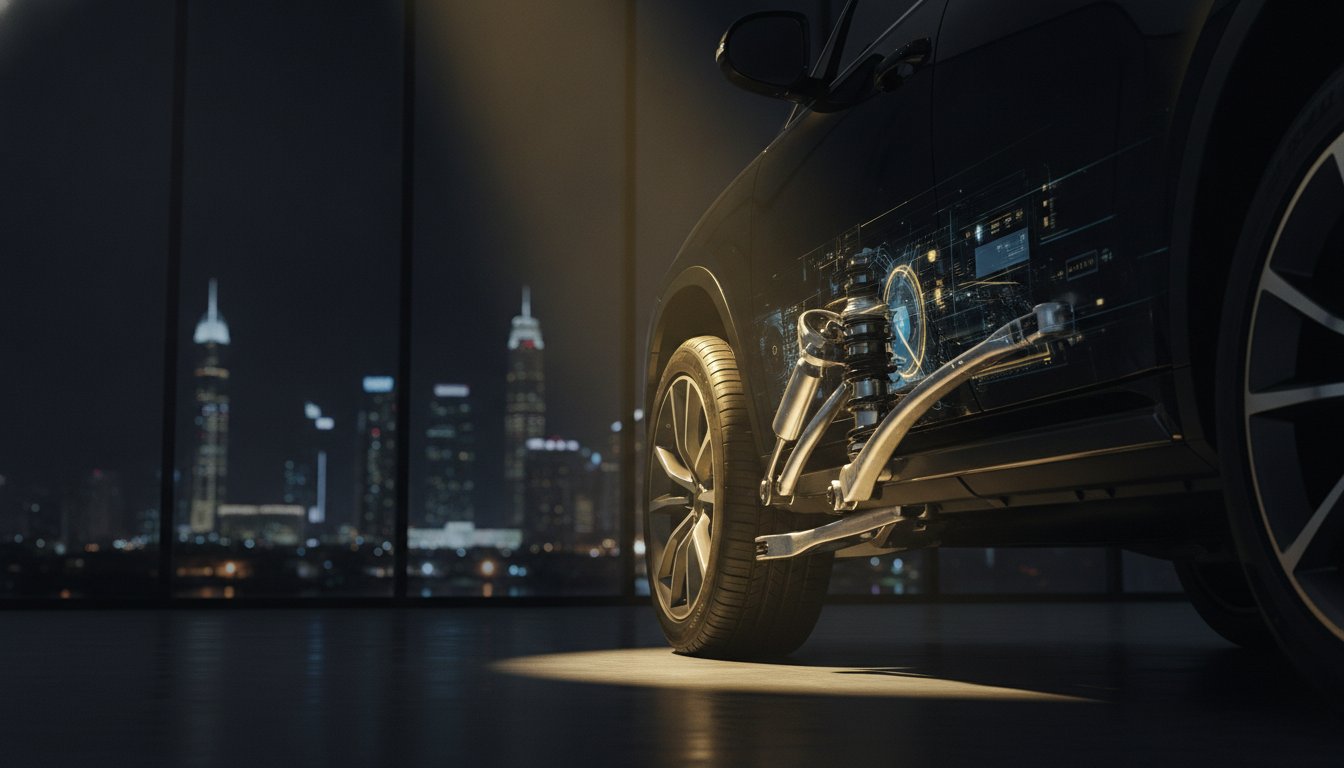
In a conventional setup, a heavy metal coil spring supports your vehicle’s weight. Porsche’s system replaces this with an air spring, or “bellows,” which allows for the signature adjustable ride height and variable damping. These rubber components are the system’s Achilles heel. Over years of constant cycling, the rubber loses its flexibility and develops microscopic fissures. Technical studies regarding Suspension System Failures and Reliability indicate that environmental stressors are the primary catalysts for this type of material fatigue. While the internal hydraulic damper manages the impact of the road, the air bag must maintain a perfect hermetic seal. Once that seal fails, the air pump can no longer maintain the necessary volume to support the chassis.
The Role of the Air Suspension Compressor
Think of the compressor as the heart of your Cayenne’s suspension. It maintains a high-pressure reservoir, usually between 15 and 17 bar, to allow for the rapid height adjustments you trigger from the cabin. Compressor burnout is rarely a primary failure; it’s almost always a secondary symptom of a leak elsewhere. If a bellows or a line is leaking, the compressor runs continuously to maintain pressure. A failing relay is another common culprit. If the relay sticks in the “on” position, the compressor will run until it literally melts its internal seals. If you notice your compressor becoming louder or vibrating excessively, it’s likely overheating and nearing the end of its service life.
Moisture and debris also play a significant role in distribution failures. The valve block acts as the system’s brain, directing air to each corner as needed. If moisture enters the lines, it can cause the solenoids within the valve block to corrode or stick. Furthermore, PASM height sensors are mounted externally near the wheel arches, making them highly vulnerable to road debris. A single stone can snap a sensor arm, causing the ECU to receive “impossible” data and shut down the system for safety. If your vehicle feels uneven or refuses to respond to height commands, consulting a specialist for a PIWIS diagnostic scan is the only way to identify the specific failure before it leads to more expensive damage.
The Dubai Factor: How Heat and Sand Accelerate Wear
Driving a Cayenne in Dubai isn’t like driving it in Stuttgart. The environment is hostile to precision engineering. Porsche Cayenne air suspension problems are often a direct result of our local climate rather than a manufacturing defect. While these systems are designed for global use, the unique combination of extreme heat, abrasive sand, and coastal humidity creates a “perfect storm” for mechanical fatigue. Understanding these regional stressors is the first step in extending the life of your vehicle’s suspension.
Heat-Induced Rubber Degradation
Heat is the primary enemy of any air-based system. When summer temperatures hit 50°C, the rubber in your air bellows undergoes constant thermal expansion and contraction. This stress causes the material to lose its elasticity and become brittle far faster than Porsche’s engineers intended for moderate climates. In the UAE, luxury suspension components often face a 30% shorter lifespan compared to vehicles driven in Europe or North America. This degradation isn’t limited to the air bags alone. High road surface temperatures also accelerate the wear of lower control arm bushings and thin out the viscosity of the hydraulic fluid within PASM shocks. For a detailed technical breakdown of how these components interact, see this Definitive Guide to Cayenne Suspension. When the rubber fails, the system can’t hold pressure, leading to the sagging issues we see daily in our workshop.
Sand and Dust Challenges
Sand is the second major threat. It’s highly abrasive and infiltrates even the smallest gaps. Fine desert dust often clogs the air intake filter of the suspension compressor. If this filter is restricted, the pump must work twice as hard to draw in air, causing it to overheat and fail prematurely. Sand also coats the height sensors mounted near the wheel arches. This buildup creates physical resistance or “fouling” of the sensor arms, which leads to the ECU receiving false readings. You might notice your car sitting unevenly even when the air bags are perfectly intact.
In coastal areas like Jumeirah or Dubai Marina, humidity adds another layer of risk. High moisture levels can saturate the compressor’s desiccant dryer. Once this dryer is full, moisture enters the aluminum valve blocks and lines. This leads to internal corrosion that causes solenoids to stick, resulting in a total system lockout. How can you protect your investment? Regular undercarriage cleaning is essential. Don’t just focus on the paintwork. Use a low-pressure rinse to clear salt and sand from the wheel wells and air bellows. This simple habit prevents abrasive particles from grinding into the rubber every time the suspension adjusts, keeping your ride smooth and your repair bills low.
While maintaining your Porsche is vital, ensuring your garage is secure and functional is another key part of protecting your vehicle. For those seeking high-quality residential service in other regions, you can discover We Do Garage Doors to see how experts handle complex door repairs and maintenance.
Repair vs. Conversion: Making the Right Choice
When your luxury SUV begins to sag, you’ll likely hear two conflicting pieces of advice. One side suggests a costly dealership repair, while the other pushes for a coil spring conversion kit. Choosing the latter might seem like a permanent escape from Porsche Cayenne air suspension problems, but it often results in a significant downgrade to your driving experience. In Dubai’s discerning secondary market, modifications that remove factory features can slash your vehicle’s resale value. Most buyers want the authentic Porsche experience, not a modified version that lacks the versatility of the original design.
Why PASM Matters for Your Cayenne
Does a coil conversion really save money in the long run? While the initial price tag is lower, the loss of ride quality is immediate. Porsche Active Suspension Management (PASM) is the heart of your vehicle’s handling. If you convert to traditional springs, you lose your “Sport” and “Comfort” modes forever. Your ECU will likely throw persistent error codes because it can no longer communicate with the suspension modules. This “Dash Light” problem is a constant reminder of a compromised system. This is why German car suspension specialist Dubai care is so vital. We focus on restoring the system to factory specifications rather than bypassing it with generic parts that weren’t designed for the Cayenne’s specific weight distribution.
Evaluating Repair Costs in Dubai
Dealerships often suggest replacing entire assemblies at a massive markup, which leads many owners to consider conversions. However, suspension specialists Dubai offer a more surgical, cost-effective approach. By using high-quality, OEM-spec components from manufacturers like Bilstein or Arnott, you can achieve dealership-level reliability without the inflated price tag. Targeted diagnostics allow us to replace only the failing valve, bellows, or sensor. This component-level repair preserves your initial investment and maintains the high-speed stability required for Dubai’s highways. Why settle for a rigid, unresponsive ride when you can restore the precision handling your Porsche was built for?
Before you commit to a modification that can’t be easily undone, consider the long-term impact on your vehicle’s performance and value. Book a specialized suspension diagnostic to see how targeted repairs can save your air system and your budget.
Specialized Porsche Suspension Repair in Dubai
Why do general garages often fail when tackling Porsche Cayenne air suspension problems? The answer lies in the complexity of the PASM architecture. Many workshops use generic OBDII scanners that only scratch the surface of the system’s fault codes. At Car Suspension Repair, we utilize PIWIS (Porsche Integrated Workshop Information System). This is the only diagnostic software capable of deep-level communication with the suspension control modules. It allows us to view real-time data from height sensors, monitor solenoid response times, and identify electrical gremlins that generalist tools simply cannot see. When you’re driving a high-performance machine, a “best guess” approach isn’t just inefficient; it’s a safety risk. Our technicians are trained specifically in these systems, understanding that a Cayenne requires a different diagnostic logic than a standard SUV.
Our Diagnostic Process
We believe in precision over the “parts cannon” method. Our diagnostic journey starts with ultrasonic leak detection. While some shops still rely on old-fashioned soap bubble tests, ultrasonic tools allow us to hear the high-frequency hiss of microscopic air leaks that are invisible to the naked eye. We also conduct a rigorous stress test on your air compressor. By measuring its output pressure against its duty cycle, we can determine if the pump is healthy or if it’s nearing a heat-induced failure. Once we’ve identified and replaced the faulty component, we perform a mandatory digital recalibration. We reset the ride height parameters to factory specifications, ensuring the vehicle’s ECU knows exactly where “level” is for all four corners. This calibration is critical because even a 5mm deviation can cause the car to pull or handle unpredictably during cornering.
Restoring Ride Comfort and Performance
Repairing a leak is only half the battle. To truly restore the “Porsche Feel,” a precision wheel alignment is essential. Even a minor deviation in ride height during a repair can throw your geometry out of balance. This results in uneven tire wear and a nervous, twitchy feeling at highway speeds. We focus on ride comfort restoration Dubai, a process that ensures the synergy between your new air struts and the vehicle’s active damping system is perfect.
Does your Cayenne still feel floaty after a repair? It’s likely because the system wasn’t properly calibrated to account for the new component’s performance. Our goal is to ensure your SUV maintains absolute stability on the E11, providing the confidence you expect from a luxury performance brand. Car Suspension Repair handles exotic and luxury SUVs with a level of specialized care that general garages can’t match. Don’t settle for a compromised driving experience. Book your professional Porsche suspension inspection at Car Suspension Repair today and get back to the smooth, controlled ride you deserve.
Restore Your Porsche’s Precision Handling Today
Why let a “Suspension System Fault” light compromise your safety on the E11? We’ve seen how early detection and specialized diagnostics prevent minor leaks from spiraling into total compressor failure. Your Cayenne’s air suspension is a precision-engineered asset. Converting to traditional springs or ignoring the signs of wear only damages your vehicle’s resale value and signature performance. Our team recognizes the exact toll that 50°C heat and abrasive desert sand take on your rubber bellows and sensors.
Don’t settle for a generic garage when you can access specialized care. Our Porsche suspension mechanics use advanced PIWIS-level diagnostics to identify the root cause of your Porsche Cayenne air suspension problems. We specialize in restoring factory-level ride comfort while addressing the specific climate challenges of the UAE. It’s time to eliminate the sagging and return to the smooth, responsive ride you deserve.
Book Your Porsche Suspension Diagnostic at Our Dubai Workshop
Frequently Asked Questions
Can I drive my Porsche Cayenne with a ‘Suspension System Fault’ light on?
No, you should not continue driving your vehicle once this warning appears. It indicates that the system can no longer maintain a safe ride height or level the chassis correctly. Continuing to drive can cause the air compressor to run continuously until it burns out. It also significantly compromises your handling and braking distances. Seek a specialist diagnostic check immediately to prevent a minor leak from becoming a total mechanical failure.
How much does it cost to replace a Porsche Cayenne air compressor in Dubai?
Replacing a compressor is a major repair that requires precise calibration. Industry research indicates that compressor failure is rarely the primary issue; it is usually the result of the pump overworking to compensate for a leak. You must identify and fix the underlying air leak before installing a new unit. Failing to do so will likely result in the new compressor burning out within weeks of installation in our high-heat environment.
Is it better to repair or replace a leaking air strut?
Replacing the entire strut is generally the superior choice for long-term reliability. While some workshops attempt to replace only the rubber bellows, this does not address wear in the internal hydraulic damper. In the extreme heat of the UAE, these partial repairs often fail prematurely. Installing a complete OEM-spec assembly ensures that your PASM system functions exactly as the factory intended, maintaining both your driving comfort and high-speed safety.
Why is my Porsche Cayenne lower on one side after parking?
A vehicle sitting lower on one side is a classic sign of a localized air leak. This usually points to a perforated air bag or a failing check valve at that specific corner. As the car sits, air slowly escapes through microscopic fissures in the rubber bellows. While the system may level itself when you start the engine, this constant cycling puts immense strain on your compressor and will eventually lead to total failure.
Will a coil spring conversion kit affect my Porsche’s resale value?
Yes, a coil spring conversion will likely decrease your vehicle’s market value in Dubai. Buyers in the luxury segment prioritize original factory specifications and the versatility of the PASM system. Removing the air suspension is often perceived as a sign of poor maintenance or a shortcut. To maintain the highest possible resale value, it is better to perform targeted repairs on the original system using specialized Porsche diagnostic tools and parts.
How long does a typical Porsche air suspension repair take in Dubai?
Most professional repairs take between one and three business days depending on the complexity of the failure. A simple sensor replacement or valve block swap is often a same-day job. However, replacing air struts requires careful installation, digital recalibration using PIWIS software, and a thorough road test. We prioritize accuracy over speed to ensure your vehicle is completely safe for high-speed driving on the E11 and other major highways.
How often should I have my air suspension inspected in the UAE?
We recommend a professional suspension inspection at least once a year. The harsh UAE climate accelerates the degradation of rubber components and seals. By catching Porsche Cayenne air suspension problems during a routine check, you can replace inexpensive parts like relays or sensors before they cause your compressor to fail. Regular maintenance is the most effective way to avoid high repair quotes and ensure long-term reliability for your vehicle.
Can sand and dust cause air suspension failure in the Cayenne?
Sand and dust are major contributors to suspension failure in the desert. Fine particles act as an abrasive, grinding down the rubber bellows every time the vehicle changes height. Dust also clogs the compressor’s air intake filter and fouls the external height sensors. This leads to overheating and false electronic readings. Frequent undercarriage washing is a simple, effective way to protect these sensitive components from the abrasive effects of the desert environment.