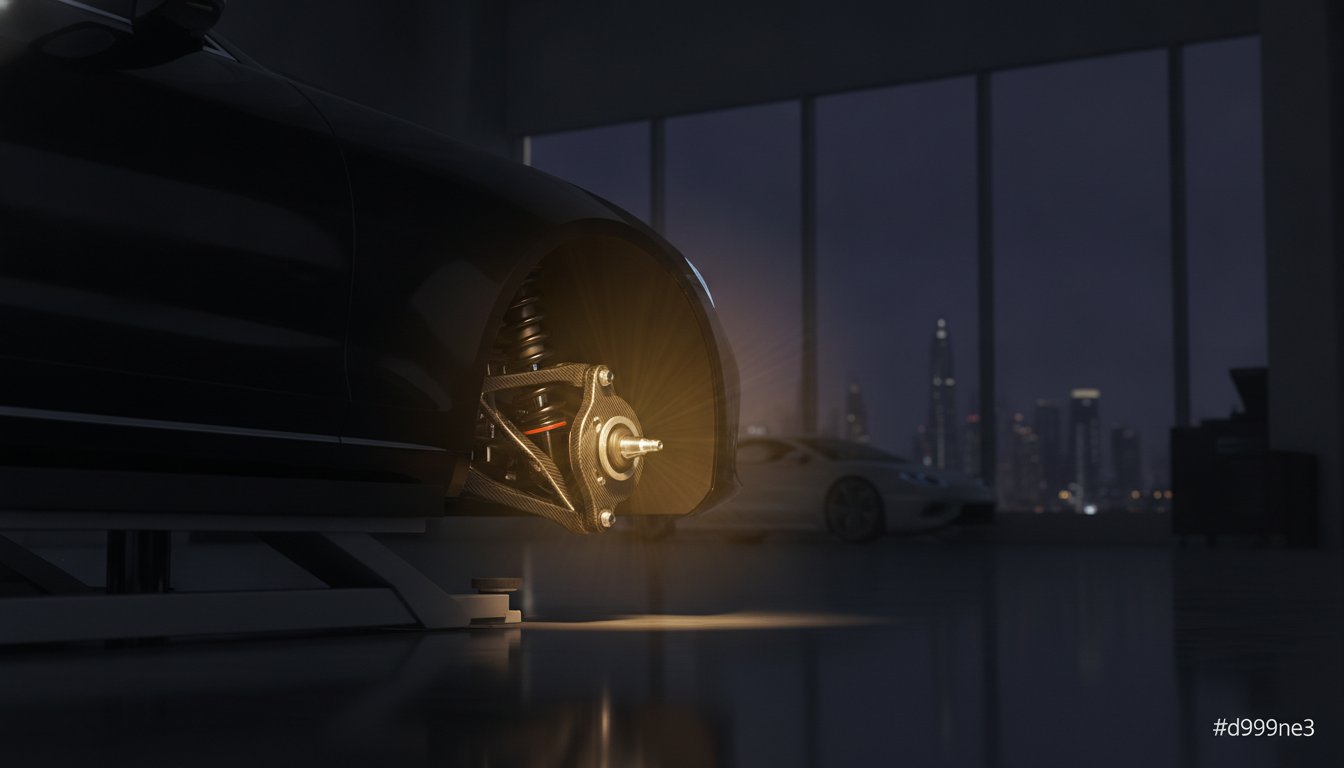
Is your Porsche leaning to one side after a night in the garage, or has that famous “Magic Carpet” ride suddenly turned into a bone-jarring experience? Seeing a “Chassis System Failure” warning light on your dashboard causes immediate anxiety about both safety and potential repair costs. You’ve likely spent hours wondering if your car is even safe to drive or if you’re facing a bill that runs into tens of thousands of dirhams. It’s a frustrating position to be in, especially when you depend on your vehicle’s precision handling for the daily Dubai commute.
We understand that you want your performance restored without the eye-watering dealership quotes. This guide provides everything you need to manage Porsche air suspension repair Dubai effectively. You’ll discover how to identify specific component failures caused by the UAE’s extreme 50°C heat and why proactive maintenance of rubber bellows can prevent total compressor burnout. We’ll show you how to get a clear diagnostic report and a fixed-price solution that includes a specialist warranty. Learn how to return your Porsche to its peak performance level while keeping your maintenance budget under control.
Key Takeaways
- Learn how Dubai’s extreme ground temperatures cause rubber air bellows to crack and why the PASM module requires specialized thermal management.
- Identify the critical difference between a minor “Morning Lean” and a severe “Chassis System Fault” warning before they lead to total compressor failure.
- Discover the significant cost-saving benefits of replacing individual air sleeves instead of the entire hydraulic strut assembly.
- Find out why a professional Porsche air suspension repair Dubai requires high-pressure nitrogen testing and Porsche-specific software for accurate calibration.
- Understand the risks of using generalist mechanics for complex pneumatic systems and how specialist expertise ensures factory-standard ride quality.
Understanding Porsche Air Suspension Failure in Dubai’s 50°C Heat
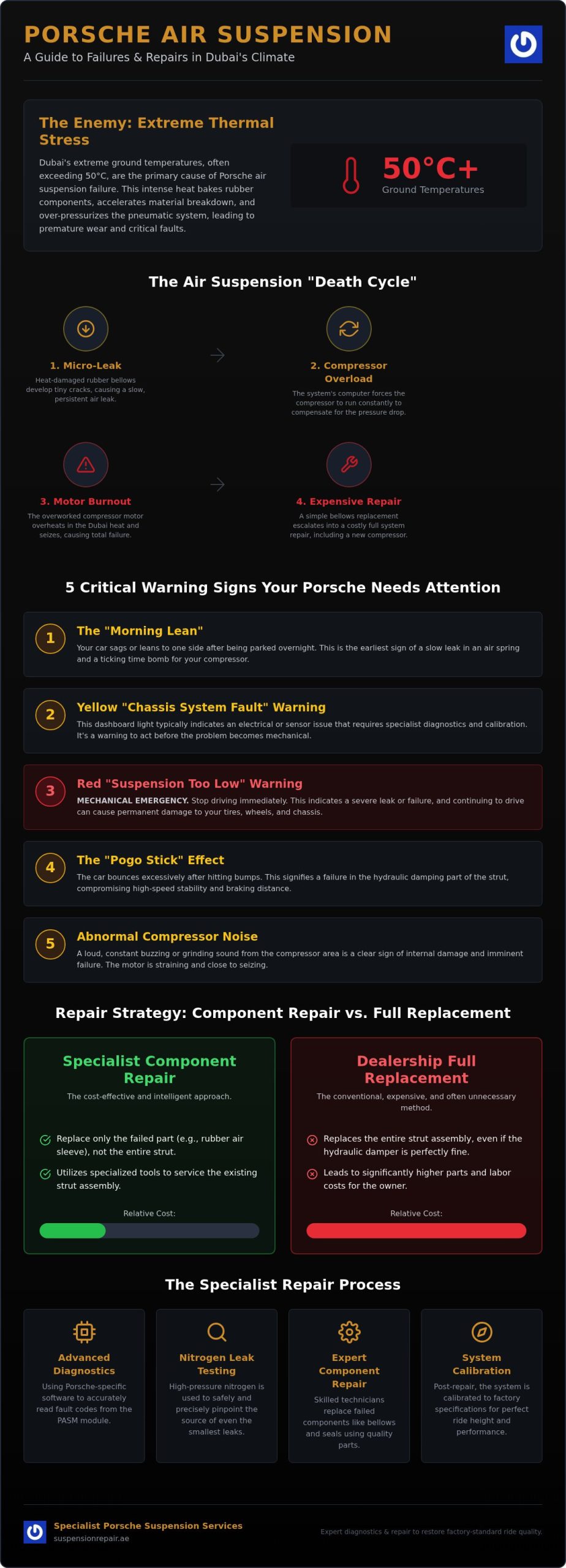
Your Porsche relies on a sophisticated Air suspension system to provide that signature blend of track-ready handling and luxury comfort. This pneumatic setup replaces traditional steel springs with pressurized air bags, all managed by the Porsche Active Suspension Management (PASM) module. While this technology is brilliant, it faces a relentless enemy in the United Arab Emirates: extreme thermal stress. When ground temperatures in Dubai exceed 50°C, the air inside the system expands, increasing internal pressure while the external rubber components are baked from the outside. This combination causes the rubber bellows to lose their essential elasticity, eventually leading to microscopic cracks that compromise the entire system.
Many owners don’t realize they’ve entered what we call the ‘Death Cycle’ of a pneumatic system. It starts with a pinhole leak in a rubber bag. Because the PASM module detects a drop in ride height, it signals the air compressor to compensate. In a healthy car, the compressor runs intermittently; however, a leaking bag forces the compressor to run almost 24/7. In Dubai’s heat, an overworked compressor motor will overheat and seize within weeks. If you don’t seek a Porsche air suspension repair Dubai specialist early, a simple bag replacement can quickly escalate into a far more expensive compressor and relay failure.
The Vulnerability of Pneumatic Bellows
The chemical breakdown of rubber is accelerated by the intense UV radiation and thermal cycles found in the UAE. Over time, the plasticizers that keep the bellows flexible evaporate. We typically see Cayenne and Macan models showing significant signs of wear after just 3 to 5 years of local driving. While it’s tempting to opt for ‘budget’ aftermarket air bags, they rarely possess the same thermal resistance as factory-spec components. These cheaper alternatives often fail within a single summer season because they can’t handle the rapid pressure fluctuations and high ambient heat. Investing in quality parts is the only way to ensure your Porsche maintains its factory-standard safety and poise.
Humidity, Dust, and Your Air Compressor
Dubai’s environment presents a dual threat of fine desert sand and high coastal humidity. Your Porsche uses a desiccant dryer to remove moisture from the air lines, but this component has a finite capacity. When humidity levels spike, the dryer can become saturated, allowing moisture to corrode internal valves. Simultaneously, fine dust particles can bypass or clog the air suspension intake filters. A clogged filter starves the compressor of air, forcing the motor to work harder and run hotter. We recommend checking your air suspension filter during every minor service. This simple, low-cost precaution can save you from a total system collapse during the peak of summer.
5 Warning Signs Your Porsche Needs Air Suspension Repair
Have you noticed your Cayenne sitting awkwardly in the garage? This is the classic “Morning Lean.” It happens when a microscopic leak in the air spring allows pressure to bleed out while the car is parked overnight. While the compressor might level the vehicle once you start the engine, this is a ticking time bomb for your wallet. Ignoring this symptom forces the compressor to work overtime, which eventually leads to a much higher repair bill. Professional Porsche air suspension repair Dubai services focus on catching these leaks before they destroy the entire system.
Your Porsche is equipped with sensors that monitor height and pressure constantly. It’s vital to differentiate between dashboard warnings. A yellow “Chassis System Fault” usually points to an electrical or sensor issue that needs calibration. In contrast, a red “Suspension Too Low” message is a mechanical emergency. If you see the latter, stop driving immediately. Continuing to drive a car with no air pressure can cause permanent damage to your wheel arches, tires, and undercarriage components.
Does your Panamera feel like a pogo stick when driving on Sheikh Zayed Road? If the car bounces repeatedly after hitting a bump, the hydraulic damping inside the strut has failed. This “Pogo Stick” effect compromises your braking distance and high-speed stability. It’s not just a comfort issue; it’s a critical safety risk. Listen for a loud buzzing or grinding from the compressor area, as these mechanical noises are clear indicators of imminent internal failure.
Visual Cues: Sagging and Uneven Ride Height
Park your car on a level surface and measure the gap between the tire and the fender on all four corners. Any discrepancy greater than 10mm suggests a leak or a calibration error. Driving a sagging car puts immense stress on your suspension bushings and can lead to uneven tire wear. For a deeper look at how these issues affect luxury vehicles in the UAE, read The Ultimate Guide to Car Suspension Repair in Dubai (2026 Edition).
Auditory Warnings: What Your Porsche is Trying to Tell You
To truly understand How Air Suspension Systems Work, you must recognize that it’s a complex symphony of pneumatic and electrical parts. A constant hiss near a wheel is a physical leak in the air bag. Rapid clicking from the center of the car, often called ‘valve block chatter,’ is a symptom of electrical control errors or a sticking solenoid. If you notice these sounds, book a specialist diagnostic today to prevent a minor leak from becoming a major overhaul.
Porsche PASM and Air Struts: Component Repair vs. Full Replacement
When your Cayenne or Panamera starts showing signs of failure, the biggest question is whether you need to replace the entire strut or just the air spring. A full Porsche strut is a complex unit combining a hydraulic damper with a pneumatic air bag. In many cases, the hydraulic shock absorber remains functional, while the rubber air sleeve has simply perished due to thermal fatigue. Replacing only the rubber component is a highly effective way to manage Porsche air suspension repair Dubai costs without sacrificing safety. It’s a precision task that requires specialized tools to reseal the unit to factory standards.
We always recommend replacing air springs in pairs across the same axle. If the front-left bag has failed after five years in the Dubai sun, the front-right is likely close to the end of its service life. Maintaining balanced pressure and rebound across the axle is essential for high-speed stability on the E11. Using a generalist garage for this work is risky. They often lack the specific knowledge to handle the delicate PASM connections, leading to electrical faults that appear weeks after the mechanical repair.
The Role of PASM in Ride Comfort
Porsche Active Suspension Management (PASM) is an electronic damping control system that adjusts each wheel’s damping force in milliseconds. It reacts to your driving style and road surfaces to minimize body roll. However, if there’s a leak in the air bag, the PASM system cannot maintain the correct vehicle geometry. This forces the electronic dampers to overcompensate, which accelerates internal wear. For advice on selecting the right components for your vehicle, consult our Luxury Car Suspension Repair Dubai: The Ultimate Specialist Buying Guide.
Why Specialized Porsche Diagnostics Matter
Generic OBD-II scanners often fail to read the proprietary fault codes stored in a Porsche’s suspension ECU. A simple height sensor fault can easily be misdiagnosed as a catastrophic strut failure by a mechanic without the right equipment. Precision is mandatory. We utilize advanced software to calibrate the ride height to within a single millimeter. This level of accuracy is why German Car Suspension Specialist Dubai services are the logical choice for owners who value factory-spec performance. Don’t let a generalist guess with your safety.
The Specialized Repair Process: Diagnostics, Leak Testing, and Calibration
Restoring your car’s handling requires more than just mechanical skill; it demands a data-driven approach. Our Porsche air suspension repair Dubai process begins with a deep digital scan of the suspension ECU. We identify hard faults and intermittent sensor errors that generic tools simply can’t see. Following the data, we perform nitrogen pressure testing. This is far more effective than traditional soapy water tests for finding microscopic leaks in high-pressure lines. Once the leak is confirmed, we replace the failed component with OEM-equivalent parts that match Porsche’s rigorous standards.
The final, most vital step is the software calibration. We use Porsche-specific software to ensure the ride height sensors are perfectly aligned. This ensures the car sits level and the PASM system communicates correctly with the chassis. If your car is currently sitting lower than it should, schedule a precision diagnostic session to get it back to factory specs.
Beyond Swapping Parts: The Importance of Calibration
Your Porsche’s onboard computer must ‘learn’ the zero-point of any new struts installed. If sensors aren’t programmed after the repair, the vehicle may still lean or pull, even with brand-new parts. We utilize specialized leveling ramps to achieve an accurate ride-height zeroing. This level of precision is mandatory for maintaining the high-speed stability you expect on UAE highways. Without this digital handshake between the hardware and the software, your “Magic Carpet” ride will never truly return.
Testing the Solenoid Valve Block and Compressor
We don’t just guess which part is failing. Our technicians bench-test the air compressor to verify its PSI output and check the solenoid valve block for internal leaks. A faulty valve block is often the culprit behind a car that sinks overnight despite having healthy air bags. We ensure the desiccant dryer is clear and the valve block is sealing perfectly. Suspension Specialists Dubai provide the precision needed for performance vehicles, ensuring every pneumatic component operates in perfect harmony.
Why a Dedicated Suspension Workshop is the Logical Choice for Porsche Owners
Choosing a generalist workshop for Porsche air suspension repair Dubai is a common mistake that often leads to repeated visits and mounting costs. While a general mechanic might excel at oil changes or brake pads, they often lack the forensic tools required for complex pneumatic systems. Engine mechanics frequently misdiagnose air leaks as faulty compressors, or vice versa, because they rely on generic scanners that miss proprietary Porsche fault codes. A specialist workshop treats the suspension as a standalone ecosystem. We don’t just clear warning lights; we address the root cause, whether it’s a perished O-ring or a saturated desiccant dryer.
Precision requires the right hardware. Many shops use standard compressed air for testing, which introduces moisture into your lines and leads to internal corrosion. We utilize high-pressure nitrogen and Porsche-specific software to ensure every component is pressurized and calibrated to factory standards. This technical rigor is why we can restore the “feel” of your drive, ensuring your Cayenne handles with the same poise it did on day one. You can see the results of this focused approach in our Ride Comfort Restoration Dubai: A Case Study.
Specialist Precision vs. Generalist Speed
A dedicated workshop offers a significant advantage in both accuracy and turnaround time. Because we focus exclusively on luxury suspension systems, we stock specialized Porsche components that generalists often have to order from abroad. This means your Panamera isn’t sitting on a lift for weeks waiting for a specific valve block or height sensor. Our technicians have seen every failure mode possible in the UAE climate, allowing them to pinpoint issues in minutes rather than hours. It’s about getting you back on the road with total confidence in your vehicle’s safety.
Ensuring Long-Term Reliability on Dubai Roads
Dubai’s environment demands a higher standard of maintenance. We perform a full system purge during every major repair to remove moisture and abrasive sand debris that could compromise new parts. Our specialists select components specifically designed to withstand the thermal expansion caused by 50°C ground temperatures. We don’t just fix the immediate problem; we harden your system against future failures. Don’t settle for a temporary fix when you can have a specialist resolution that lasts. Book your expert Porsche air suspension inspection today and experience the difference of true specialization.
Secure Your Porsche’s Performance for the Road Ahead
Maintaining a Porsche in Dubai’s extreme climate requires more than just standard mechanical care. You now understand how early detection of the “Morning Lean” can prevent a total compressor failure and why precision software calibration is the only way to truly restore that “Magic Carpet” ride quality. By choosing a workshop with a specialized focus exclusively on luxury suspension systems, you ensure your car receives the technical attention it deserves. Our dedicated mechanics for high-end German performance cars use advanced diagnostics to pinpoint issues that generalist scanners often miss.
Don’t let intermittent warning lights or a harsh ride compromise your safety or driving pleasure. From expert Porsche PASM diagnostics to high-pressure nitrogen testing, the right Porsche air suspension repair Dubai service returns your vehicle to its peak factory specifications. It’s time to take the logistical burden off your shoulders and enjoy the precision handling your car was engineered to deliver. We are here to provide a reliable, transparent, and highly specialized partner for your vehicle maintenance needs.
Restore your Porsche’s signature ride with Dubai’s suspension specialists today and experience a stress-free resolution to your chassis concerns.
Frequently Asked Questions
How much does Porsche air suspension repair cost in Dubai?
The total cost depends on whether you are replacing a specific valve, a compressor, or an entire strut assembly. A professional Porsche air suspension repair Dubai workshop provides a transparent diagnostic report before any work begins. Prices vary based on the choice between OEM-equivalent parts or factory originals. Specialized workshops focus on component-level repairs, such as replacing just the air sleeve, which often results in significant savings compared to full strut replacements at a dealership.
Can I drive my Porsche if the ‘Suspension Too Low’ light is on?
No, you should stop driving immediately if this red warning appears. It indicates a total loss of pneumatic pressure, meaning the vehicle is resting on its internal bump stops. Driving in this state can cause permanent damage to your wheel arches, tires, and undercarriage. It also severely compromises your steering and braking ability. It’s much safer to have the car transported to a specialist facility rather than risking a catastrophic failure on the road.
How long do air suspension bags last in the UAE climate?
In the United Arab Emirates, air suspension components typically last between 3 and 5 years. The intense UV radiation and ground temperatures exceeding 50°C accelerate the chemical breakdown of the rubber bellows, making them brittle. Fine desert dust also acts as an abrasive, wearing down seals and clogging intake filters. Regular inspections during every minor service help identify early signs of cracking before a total system leak occurs.
Is it better to repair the air strut or replace the whole unit?
Repairing the individual air sleeve is often the most logical choice if the hydraulic damper is still in good condition. This approach saves money compared to buying a complete strut assembly. However, if the internal hydraulic seals are leaking oil, a full unit replacement is mandatory. A specialist workshop will bench-test the strut to determine if a component-level repair is safe and effective for your specific Cayenne or Panamera model.
Why does my Porsche Cayenne sink overnight but rise when started?
This “Morning Lean” is typically caused by a microscopic leak in the air bag or a failing solenoid valve block. While the car sits, the pressurized air slowly escapes, causing the corner to sag. Once you start the engine, the compressor kicks in to restore the ride height. While it seems like a minor annoyance, this behavior puts immense strain on your compressor and should be addressed immediately to avoid a much more expensive motor failure.
What is the difference between PASM and standard air suspension?
Air suspension uses pressurized air to support the vehicle’s weight, while Porsche Active Suspension Management (PASM) is the electronic system that controls the damping force. PASM adjusts the stiffness of the shocks in real-time based on road conditions and your driving style. Most modern Porsche models integrate both systems, allowing you to adjust both the ride height and the firmness of the suspension to match the driving environment.
Can a small air leak damage my Porsche’s air compressor?
Yes, a small leak is the primary cause of compressor failure. The compressor is designed for intermittent use to maintain pressure. A leak forces it to run continuously to compensate for the air loss. In Dubai’s high ambient temperatures, this constant operation leads to rapid overheating and internal mechanical seizure. Fixing a leak early is significantly cheaper than replacing both the leaking air bag and the burnt-out compressor motor.
Do I need to replace both front air struts if only one is leaking?
We strongly recommend replacing air suspension components in pairs across the same axle. If one front strut has failed due to age and heat, the other side has likely suffered the same level of degradation. Replacing both ensures that the damping characteristics and ride height remain perfectly symmetrical. This is critical for maintaining the high-speed stability and precise handling that makes driving a Porsche a unique experience on UAE highways.