
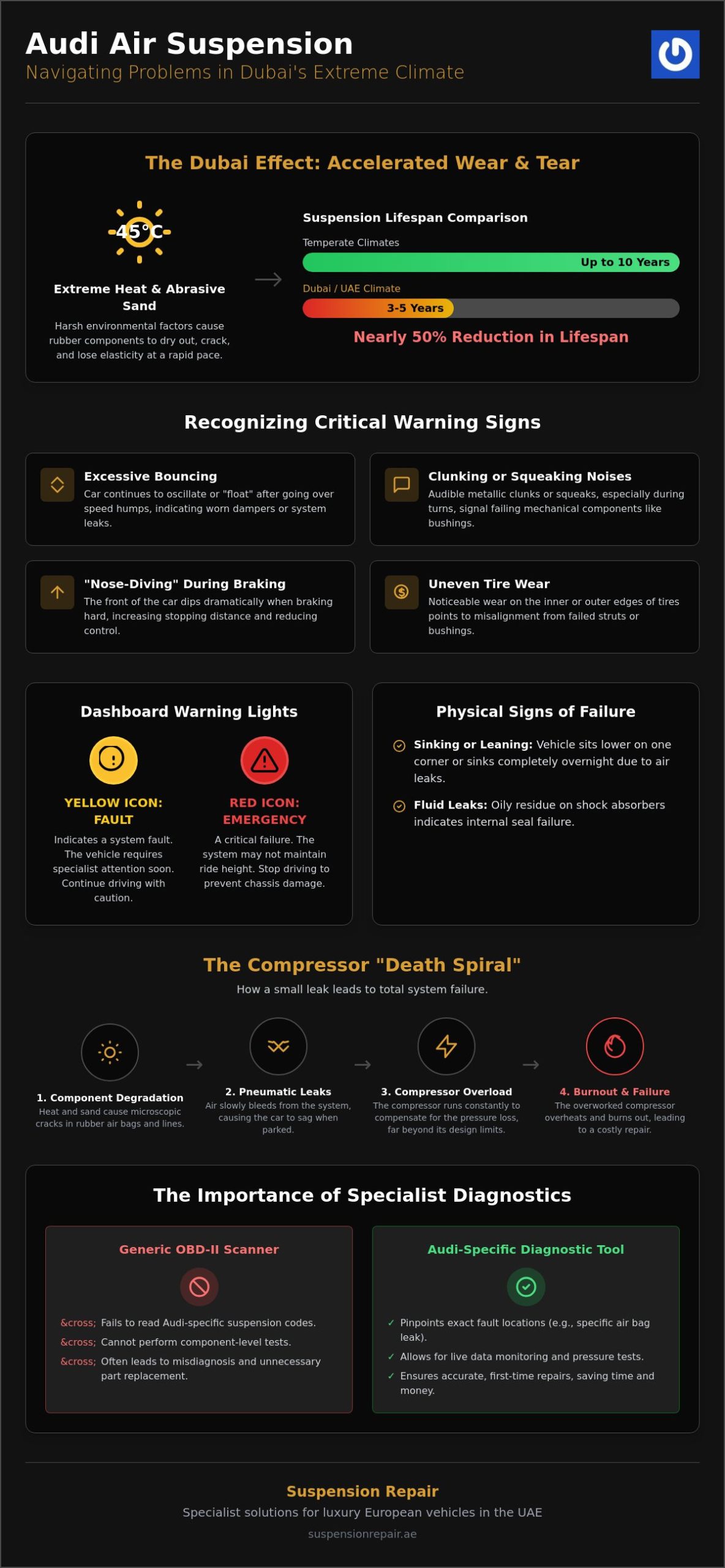
Did you know that the extreme 45°C heat and abrasive desert sand in the UAE can slash your Audi’s suspension lifespan by nearly 50% compared to cooler climates? While these systems are designed to last a decade elsewhere, Audi air suspension problems Dubai owners encounter often surface in as little as three to five years. It’s incredibly frustrating when your premium “Vorsprung durch Technik” engineering starts feeling more like a vibrating truck every time you cross a speed hump in Jumeirah or Downtown.
We understand the anxiety that comes with a sagging rear end or a sudden warning light on your dashboard. You want your luxury ride quality back, but you shouldn’t have to face the astronomical quotes typically found at official service centers. This specialist guide will help you identify common faults, from leaking air springs to compressor failures, and provide the exact strategies needed to restore your vehicle’s performance. We’ll explore why the local environment is so punishing on 2026 models and how a precision-focused repair can get you back on the road safely, smoothly, and for a transparent cost.
Key Takeaways
- Learn to identify critical warning signs like excessive bouncing over Dubai speed humps or “nose-diving” during braking before they lead to total system failure.
- Understand why Audi air suspension problems Dubai drivers face often result in vehicles sinking overnight and how to address pneumatic leaks effectively.
- Discover model-specific vulnerabilities, ranging from heavy bushing wear in the Audi Q7 to the technical complexities of the A8’s active predictive suspension.
- See how the intense UAE heat and fine desert sand accelerate the degradation of rubber components, requiring proactive maintenance to avoid costly repairs.
- Find out why specialist diagnostic tools are essential for accurate fault detection and why generic scanners often fail to pinpoint Audi-specific suspension codes.
Recognizing Common Symptoms of Audi Suspension Failure
Does your Audi feel unsettled after crossing a speed hump in your neighborhood? A healthy suspension should absorb the impact and settle immediately. If your car continues to oscillate or feels like it’s “floating” for several seconds, you’re likely dealing with worn dampers or a leak in the Air suspension system. This instability isn’t just a comfort issue; it’s a safety risk. When you’re cruising on the E11 and need to brake suddenly, a compromised suspension causes a dramatic “nose dive.” This shifts the vehicle’s weight forward, reduces rear-wheel traction, and significantly increases your stopping distance.
Keep an eye on your tyres. Uneven wear on the inner or outer edges often signals that your struts are misaligned or your bushings have perished. You might also hear a distinct clunking or a metallic squeak when navigating tight turns in underground parking lots. These noises are often the first audible warnings of Audi air suspension problems Dubai owners encounter before a total component failure occurs. Don’t ignore these early red flags. Small mechanical sounds today often turn into expensive structural repairs tomorrow.
Visual Signs and Dashboard Warnings
Your dashboard is your first line of defense. Audi uses a color-coded system to communicate the severity of a fault. A yellow suspension icon typically indicates a system fault that requires a specialist’s attention soon. However, a red warning light is an emergency. It often means the system can no longer maintain ride height, and driving further could damage the chassis. You can also perform a visual check while the vehicle is parked on a flat surface. Look for the following:
- Ride Height Discrepancies: Does one corner sit lower than the others? This “leaning” is a classic sign of a leaking air bag or a failing valve block.
- Fluid Leaks: Inspect the shock absorber housing for signs of oily residue. Hydraulic fluid leaks mean the internal seals have failed.
- Ground Clearance: If the car is “slammed” to the ground after sitting overnight, the pneumatic system is losing pressure.
The Audi “Bounce Test” Protocol
Even with the advanced sensors in 2026 Audi models, a manual “bounce test” remains a reliable diagnostic tool. Walk to each corner of the vehicle and push down firmly on the fender. A functional strut will rebound once and stop. If the car bounces two or three times, the hydraulic damping has failed. While modern Audi systems are highly digital, these physical symptoms provide the raw data our specialists use to confirm a diagnosis. Identifying the difference between a firm, controlled response and a loose, failed strut is the first step toward restoring your luxury ride quality.
Audi Adaptive Air Suspension: Leaks, Compressors, and Faults
Audi’s Adaptive Air Suspension is a sophisticated pneumatic system that replaces traditional steel springs with flexible rubber bellows, or “air bags.” These bags are inflated by an on-board compressor to maintain a constant ride height regardless of the load you’re carrying. While this technology provides a cloud-like ride, it’s inherently vulnerable to the elements. The intense UAE climate places extreme demands on every component, especially the rubber air bellows that must expand and contract thousands of times per journey. When these components fail, the precision of your luxury vehicle quickly degrades into a logistical headache.
Have you noticed your Audi leaning to one side after being parked at the mall? Or perhaps the entire car “sinks” overnight? These are classic Audi air suspension problems Dubai owners face when microscopic cracks develop in the pneumatic lines or the air bags themselves. In Dubai’s heat, rubber dries out and loses its elasticity. This leads to pinhole leaks that are often too small to see but large enough to bleed pressure over several hours. If you ignore a leaning car, you’re not just risking a bumpy ride; you’re putting an expiration date on your air compressor.
Compressor Failure vs. Air Bag Leaks
The air compressor is the heart of the system. It’s designed to run intermittently to top up pressure. However, when a leak is present, the compressor must work 24/7 to keep the vehicle level. This leads to a “death spiral” where the compressor overheats and eventually burns out. If you hear an unusually loud buzzing sound or find that your car takes several minutes to lift, your compressor is likely on its last legs. Common diagnostic codes like “01583” (Leak Detected) or “01400” (Level Control Fault) often confirm this pneumatic struggle.
Valve Block and Height Sensor Issues
The system also relies on a solenoid valve block to distribute air to each corner and height sensors to monitor the car’s position. In the desert, fine sand can infiltrate the sensors, leading to erratic readings and an uneven ride. While some garages suggest an air suspension reset Dubai, this is usually a temporary software fix for a hardware problem. A sticking valve block won’t be cured by a computer reboot; it requires a specialist to inspect the internal seals for sand ingress or mechanical wear. Addressing these faults early prevents a total system collapse that could leave your Audi stranded.
Model-Specific Audi Suspension Issues: From Q7 to RS Models
Why does a Q7 handle differently than an RS6? While both represent elite German engineering, their suspension architectures are tailored for vastly different missions. Understanding the specific Audi air suspension problems Dubai owners face requires looking at the individual chassis. For instance, the heavy-duty components in a Q7 are under constant stress from the vehicle’s 2.5-ton curb weight; meanwhile, an A4 deals with high-frequency vibrations that wear out smaller ball joints. Identifying these model-specific patterns—an approach also taken by expert centers like CJ Auto Services LLC—is the only way to ensure a permanent repair rather than a temporary patch.
For A4 and A6 owners, the most common issues involve the multi-link front suspension. These models use multiple control arms to provide precise steering, but the ball joints in these arms are prone to play after 60,000 kilometers of Dubai driving. You’ll feel this as a slight “wiggle” in the steering wheel when driving over uneven surfaces or a faint rattling over small bumps. If left unaddressed, this wear can lead to accelerated tyre degradation and compromised steering safety.
Audi SUV Suspension Challenges
The Audi Q7 and Q8 are notorious for front-end knocking sounds. This is rarely the air bag itself; it’s usually the upper and lower control arm bushings. These rubber components bear the brunt of the SUV’s weight during every turn and stop. In the UAE, the heat makes this rubber brittle. If you’ve been taking your Q7 on weekend excursions, the fine sand acts like sandpaper on these joints. Restoring that factory-fresh feel requires specialized ride comfort restoration Dubai services that replace these worn bushings with high-durability alternatives.
Performance Sedan and Magnetic Ride Faults
Moving to the executive A8 and S8, the complexity increases with the electronically controlled suspension system. This predictive setup uses cameras to scan the road ahead and adjust the dampers in milliseconds. When this fails, the ride becomes jarringly stiff. Meanwhile, RS models utilize Dynamic Ride Control (DRC), a purely hydraulic system that links diagonal shock absorbers to counteract body roll. If you notice fluid leaking from an RS damper, don’t wait. These systems are under immense pressure; a leak can lead to a total loss of handling precision. For TT and R8 owners, Magnetic Ride failure often presents as a “bouncy” rear end. This signals that the iron-particle fluid inside the shock has lost its properties. Repairing these high-end dampers is a precision task that requires specialized tools most generic shops simply don’t have.
How the Dubai Environment Accelerates Audi Suspension Wear
Why do Audis in Europe often reach 100,000 kilometers without a single suspension fault, while Audi air suspension problems Dubai owners encounter often surface much earlier? The answer lies in the aggressive chemical and mechanical degradation caused by our local climate. While German engineering is world-class, it faces a unique set of challenges in the UAE. The combination of extreme thermal cycles and abrasive particulates creates a “perfect storm” that targets the most vulnerable parts of your vehicle’s chassis.
High-speed highway driving on routes like the E11 or E311 also has a significant thermal impact. Friction within the shock absorbers generates internal heat during every compression cycle. When the ambient temperature is already 45°C, the dampers can’t dissipate this heat effectively. This thins the hydraulic fluid and accelerates the wear of internal valves, leading to a “floaty” feel that compromises your control at high speeds.
Rubber Seal and Bushing Degradation
Your Audi relies on dozens of rubber bushings and seals to isolate road noise and maintain pneumatic pressure. In the UAE, these components suffer from “dry rot.” This occurs when the plasticizers in the rubber evaporate due to extreme 50°C summer heat. Once the rubber loses its elasticity, it develops microscopic cracks. In the air suspension bellows, these cracks lead to the slow leaks discussed earlier. Even your control arm bushings aren’t safe; they become brittle and tear, resulting in the knocking sounds common in the Q7 and Q8 models. High humidity also plays a role, as it can lead to oxidation on electronic suspension sensors, causing erratic ride height readings.
Sand and Dust Contamination
Sand is the silent killer of luxury suspension systems. Fine desert dust acts as an abrasive, essentially serving as sandpaper against your strut seals every time the suspension moves. If sand bypasses the protective bellows, it scores the piston rod, leading to permanent hydraulic leaks. You must also consider the air suspension compressor. This unit draws in ambient air to inflate the bags. If the intake filter is clogged with fine Dubai sand, the compressor must work twice as hard to achieve the same pressure, leading to premature burnout.
Protecting your investment requires more than a generic service. It demands specialized Audi suspension repair Dubai services that include deep-cleaning of the air bellows and inspection of the pneumatic intake system. If your ride quality has noticeably declined, schedule a specialist diagnostic inspection to catch these environmental issues before they lead to a total system failure.
Professional Diagnostics and Repair Solutions for Audi in Dubai
Are you relying on a generic OBD-II scanner to diagnose your vehicle? While these tools are fine for basic engine codes, they often fail to detect the nuanced Audi air suspension problems Dubai vehicles experience. Audi’s pneumatic and adaptive systems communicate through proprietary protocols that generic software simply cannot interpret. To accurately pinpoint a failing valve block or a sensor calibration error, you need dealer-level diagnostic software. Choosing a German car suspension specialist Dubai ensures that you aren’t just guessing which parts to replace; you’re applying a precision-focused solution to a specific mechanical fault.
Many owners fear the high costs associated with official service centers. However, opting for specialized luxury car suspension repair Dubai provides a transparent alternative without compromising on quality. Specialists focus exclusively on chassis and damping systems, allowing for more efficient labor and better access to OEM-grade components. Once the repair is complete, precision is paramount. Any work on your struts or control arms alters the vehicle’s geometry. We always conclude repairs with a precision 3D wheel alignment to ensure your tyres wear evenly and your Audi tracks straight on the highway.
Specialist Tooling for Audi Repairs
Precision repair requires more than just a wrench. Replacing Audi bushings, for example, requires heavy-duty hydraulic presses to ensure the new components are seated perfectly without damaging the aluminum control arms. After installing new air bags or height sensors, the entire system must be digitally calibrated. This process tells the car’s computer exactly where “level” is, preventing the uneven ride height issues discussed in previous sections. A dedicated suspension shop Dubai houses these specific tools, resulting in a faster turnaround and a repair that lasts.
Next Steps for Your Audi
Don’t wait for a total system collapse that leaves your car stranded. Proactive maintenance is the key to longevity in the UAE’s harsh climate. We recommend booking a comprehensive 20-point suspension health check if your vehicle is over four years old or has exceeded 50,000 kilometers. This inspection identifies early signs of “dry rot” in bellows and play in ball joints before they become safety hazards. All our specialist repairs come with a clear warranty, giving you peace of mind on every journey. Ready to restore your ride? Contact Car Suspension Repair today for a specialist quote and expert diagnostic advice.
Restore Your Audi’s Precision and Driving Comfort
Your Audi’s advanced chassis was engineered for peak performance, but the unique environmental challenges of the UAE require a proactive approach to maintenance. By identifying early warning signs and choosing specialized repair over generic solutions, you can avoid the high costs of total system failure. Addressing Audi air suspension problems Dubai doesn’t have to be a stressful or prohibitively expensive experience when you have the right partner. Our team at Car Suspension Repair utilizes advanced diagnostic technology to pinpoint leaks and mechanical wear with absolute accuracy.
We operate a specialized shock absorber workshop in Al Quoz, designed specifically to restore the luxury ride quality you expect from your vehicle. Don’t let a sagging corner or a stiff ride compromise your safety on the road. Take the first step toward a smoother, safer journey today. Restore Your Audi Ride Quality – Book an Inspection at Car Suspension Repair. Your vehicle deserves the highest standard of care to navigate Dubai’s roads with confidence and ease.
Frequently Asked Questions
How do I know if my Audi air suspension is leaking?
The most obvious sign is a vehicle that sits noticeably lower on one corner or “sinks” toward the ground after being parked overnight. You may also notice the air compressor running more frequently or for longer durations than usual as it struggles to maintain pressure. If you see a “Vehicle Leveling” message or the car feels unsettled over small bumps, it’s time for a professional leak test.
Is it safe to drive my Audi if the suspension warning light is on?
It is generally unsafe to drive if the red suspension warning light is illuminated. While a yellow light indicates a system fault that needs a specialist’s attention soon, a red light means the system can no longer maintain ride height. Driving in this condition risks bottoming out the chassis, which can cause expensive structural damage and a total loss of steering control during a sudden maneuver.
Why is my Audi making a clunking noise over bumps in Dubai?
Clunking or knocking sounds are typically caused by perished rubber bushings or worn ball joints in the control arms. In the intense UAE heat, these rubber components become brittle and lose their ability to dampen vibrations. This leads to metal-on-metal contact when you navigate speed humps or uneven desert roads. Replacing these bushings early prevents the wear from spreading to the more expensive air struts.
How much does Audi suspension repair cost in Dubai compared to dealers?
Specialist repair costs are typically much more competitive and transparent than official dealer quotes. While dealers often suggest replacing entire suspension assemblies, a specialist can use advanced diagnostics to pinpoint and replace only the failing component, such as a single valve block or sensor. This targeted approach significantly reduces the total bill while restoring your vehicle to its original factory ride quality.
Can I replace just one air strut or do I need to replace both?
We always recommend replacing air struts in pairs across the same axle to maintain balanced handling. Because suspension components wear at a similar rate, the “healthy” side is often near the end of its lifespan when the first one fails. Installing a new strut alongside an old one creates an imbalance in damping response, which can lead to unpredictable behavior during high-speed braking or cornering.
How long do Audi shock absorbers typically last in the UAE climate?
In the UAE, Audi air suspension problems Dubai owners experience often surface between four and seven years of age. The extreme 50°C summer temperatures and abrasive sand ingress significantly shorten the lifespan of hydraulic seals and rubber bellows compared to cooler climates. Regular cleaning of the suspension components during your routine service can help extend this lifespan by removing abrasive grit from the seals.
What is the difference between Audi Adaptive Air and Magnetic Ride?
Adaptive Air is a pneumatic system that uses air bags to adjust both ride height and comfort levels. In contrast, Magnetic Ride is a performance-focused system that uses dampers filled with a specialized fluid containing iron particles. By applying an electromagnetic charge, the system can change the fluid’s viscosity in milliseconds to stiffen or soften the ride. Magnetic Ride is commonly found in Audi RS models and the R8.
Do I need a wheel alignment after replacing Audi suspension parts?
Yes, a precision 3D wheel alignment is mandatory after replacing any major suspension component. Removing control arms or struts inevitably disturbs the vehicle’s steering geometry. If you skip the alignment, you’ll likely experience rapid, uneven tyre wear and a steering wheel that isn’t centered. A professional alignment ensures your Audi tracks perfectly straight on the highway and maintains maximum grip during cornering.