
That unsettling shimmy through your steering wheel at highway speed isn’t just uncomfortable — it’s your Jeep telling you something is seriously wrong. If you’ve been searching for reliable Jeep suspension repair in Dubai, you already know the feeling: a rough, unstable ride that no amount of tyre pressure adjustments seems to fix, a Grand Cherokee air suspension warning light that won’t clear, or a repair quote from the dealership that made you wince.
You’re right to take it seriously. Jeep’s rugged suspension architecture is purpose-built for performance, but it demands specialist knowledge to maintain correctly, especially in Dubai’s extreme heat, which accelerates wear on components that a general workshop might simply overlook or misdiagnose.
This guide explains exactly why Jeep suspensions fail in Dubai’s unique driving conditions, how to identify the warning signs before they become safety risks, and what a proper specialist diagnosis actually looks like. Whether you’re dealing with Death Wobble on Sheikh Zayed Road or a sagging air suspension on your Grand Cherokee, you’ll find clear, honest answers here, along with a cost-effective path back to the confident, comfortable ride your Jeep was built to deliver.
Key Takeaways
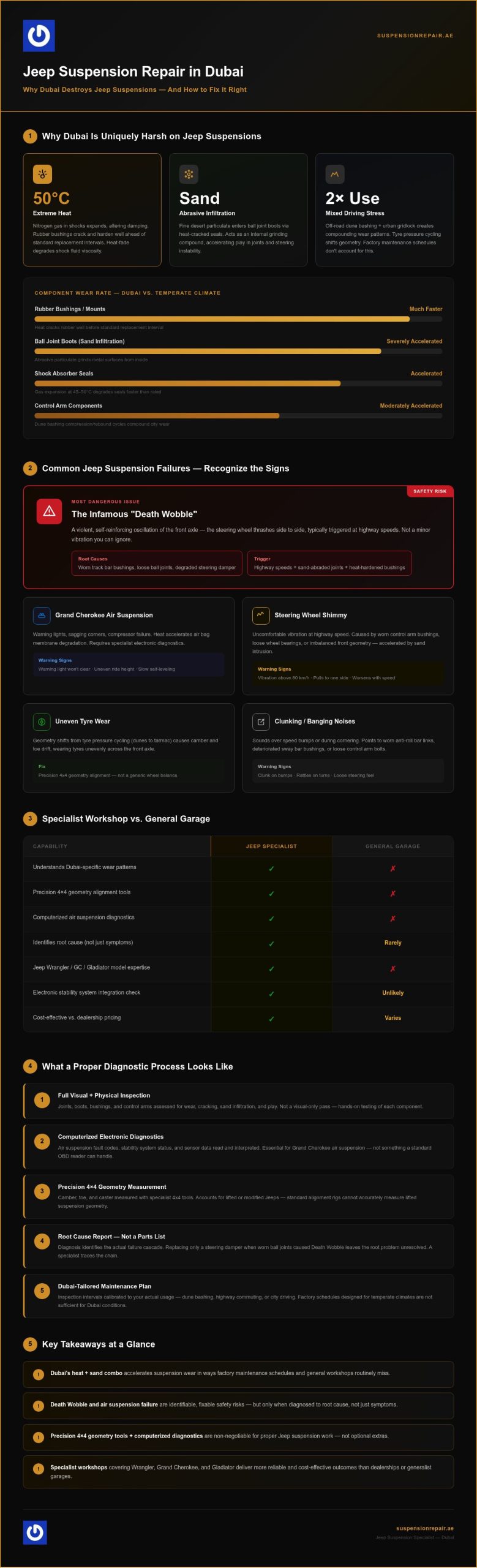
- Dubai’s extreme summer heat and fine desert sand accelerate suspension wear in ways that general workshops routinely miss — understanding these unique environmental factors is the first step to protecting your Jeep.
- The infamous Death Wobble and Jeep Grand Cherokee air suspension failures are not minor inconveniences; they are identifiable safety risks with specific causes that a specialist can diagnose and resolve correctly the first time.
- Choosing proper Jeep suspension repair in Dubai means working with mechanics who use precision 4×4 geometry tools and computerized diagnostics — not a general garage relying on guesswork.
- A thorough diagnostic process covering joints, boots, bushings, and electronic stability systems is what separates a lasting repair from a temporary fix that leaves the root problem unresolved.
- Specialist workshops with dedicated expertise across Jeep Wrangler, Grand Cherokee, and Gladiator models offer a far more cost-effective and reliable path to restored performance than a dealership or generalist alternative.
Understanding the Unique Demands on Jeep Suspension in Dubai
Dubai doesn’t just challenge your Jeep’s suspension; it systematically dismantles it through a combination of environmental stressors that standard maintenance schedules were never designed to address. The factory service intervals printed in your owner’s manual were calibrated for temperate climates with paved roads and moderate seasonal variation. Dubai offers none of that. What it does offer is a relentless combination of extreme heat, abrasive sand, and driving conditions that swing between urban gridlock and full desert off-roading, often within the same weekend.
Understanding how vehicle suspension systems interact with these specific conditions is what separates a workshop that genuinely knows Jeeps from one that simply replaces parts until the problem goes away. It’s also what makes proper Jeep suspension repair in Dubai a genuinely specialist discipline rather than a routine job.
The Impact of Extreme Heat and Sand on Jeep Shocks
When ambient temperatures exceed 45 degrees Celsius, the nitrogen gas charge inside your Jeep’s shock absorbers expands, altering damping characteristics and accelerating seal wear. On long highway drives, heat-induced fade sets in, where the shock’s internal fluid loses viscosity and its ability to control body movement degrades noticeably. You feel it as a floaty, disconnected sensation at speed. Temperatures reaching 50 degrees Celsius also accelerate rubber degradation in suspension mounts, causing the polyurethane and rubber bushings that isolate vibration and maintain geometry to crack, harden, and lose their elasticity far ahead of any standard replacement interval.
Sand compounds the damage. Fine desert particulate works its way into ball joint boots and control arm bushings through microscopic tears that heat has already started to form. Once inside, it acts as an abrasive compound, grinding metal surfaces with every steering input and suspension cycle. The result is accelerated play in joints that should be tight, which is a primary contributor to the instability many Jeep owners experience on the highway.
Off-Roading vs. City Driving: Different Wear Patterns
The stress profiles couldn’t be more different. Dune bashing subjects your Jeep’s suspension to extreme vertical compression and rebound cycles, loading the shocks, springs, and control arms far beyond what urban driving demands. City driving, by contrast, generates consistent lateral stress through high-speed cornering and abrupt lane changes, which targets steering components and anti-roll bar links instead.
There’s also the tyre pressure factor. Dropping tyre pressure for soft sand and re-inflating for tarmac is standard practice, but it subtly shifts suspension geometry with each cycle. Over time, this contributes to uneven wear across the front axle. Don’t dismiss the impact of city-only use either. Jeeps driven primarily in urban environments still face constant low-speed compression stress from speed bumps and poorly maintained road surfaces, making regular suspension inspections just as essential for so-called “mall crawlers” as for dedicated off-roaders.
The honest truth is that no single maintenance schedule fits all Dubai Jeep owners. What’s required is a diagnostic approach that accounts for how, where, and how often you actually drive, which is precisely what a dedicated Jeep suspension repair Dubai specialist is equipped to assess.
Common Jeep Suspension Issues: From Death Wobble to Air Leaks
Knowing your Jeep is struggling is one thing. Knowing exactly what’s failing and why is another entirely. The symptoms that send most Dubai Jeep owners searching for help fall into recognizable patterns, and each one points to a specific mechanical failure that demands a precise response, not a generic parts swap.
Diagnosing the Infamous Jeep Death Wobble
The Death Wobble isn’t a myth, and it isn’t a minor vibration you can ignore. It’s a violent, self-reinforcing oscillation of the front axle that sends the steering wheel thrashing side to side, typically triggered at speeds above 70 km/h after hitting a road imperfection. On Sheikh Zayed Road, that trigger arrives constantly. Car and Driver’s detailed breakdown of the Jeep death wobble explained confirms what specialist mechanics see in practice: the root cause is almost never a single component but a combination of worn track bar bushings, loose ball joints, and a degraded steering stabilizer working against each other.
This is precisely why wheel balancing never fixes it. Balancing addresses rotational imbalance in the tyre and wheel assembly. Death Wobble originates upstream, in the steering and axle geometry. A worn steering stabilizer can mask the wobble temporarily, but replacing it without addressing the underlying track bar play or ball joint wear simply delays the return of the problem. A proper diagnosis isolates each contributing factor before any parts are ordered.
Air Suspension Failure in Modern Jeep Grand Cherokees
The Jeep Grand Cherokee’s air suspension system delivers an exceptional ride when it’s functioning correctly. When it isn’t, the warning signs are unmistakable. Watch for these specific indicators:
- Uneven ride height: One corner of the vehicle sitting noticeably lower than the others, particularly after the Jeep has been parked overnight.
- Compressor running constantly: The air compressor cycling repeatedly to compensate for a slow leak in a failing air spring or air line fitting.
- Warning lights and error codes: Height sensor malfunctions that cause the system to misread ride height and trigger suspension fault warnings even when the springs themselves are intact.
- Audible hissing: A faint hissing from the wheel arch area, most noticeable when the vehicle is stationary and the engine is off.
Catching a leaking air spring early is critical. Left unaddressed, the compressor runs continuously to compensate for pressure loss, overheating and burning out a component that costs significantly more to replace than the spring itself. Height sensor faults are a separate issue entirely and require computerized diagnostics to distinguish from a genuine mechanical failure.
On the question of repair versus conversion: replacing individual air springs and sensors is the most cost-effective route when the compressor is still healthy and the system is otherwise sound. Full conversion to coil springs is a legitimate option for owners who do heavy off-roading and want to eliminate the system’s complexity entirely, but it removes the on-road ride quality the air suspension was designed to provide. A specialist in Jeep suspension repair Dubai can assess your specific system condition and driving profile before recommending either path.
Worn control arms compound every issue described above. As the bushings deteriorate, the front wheels lose precise geometry, producing uneven tyre wear across the inner or outer edge and a steering feel that’s vague and slow to respond. It’s a gradual change, which is why many owners don’t notice it until the tyres are already damaged. If your Jeep’s steering feels like it requires constant small corrections to hold a straight line, the control arms deserve immediate inspection.
Shock absorber failure follows a predictable progression: excessive body bounce over speed bumps, pronounced nose-dive under braking, and eventually visible fluid weeping down the shock body itself. Each stage represents a further loss of control and safety margin. If any of these symptoms sound familiar, book a suspension inspection before the next long drive.
The common thread across all of these failures is that none of them resolve themselves, and Jeep suspension repair in Dubai done correctly means addressing the actual cause rather than the most visible symptom.
Why Choose a Specialized Suspension Shop Over a General Garage?
A general garage sees dozens of different vehicles every day, from family saloons to delivery vans. Suspension work is one item on a long menu. A dedicated suspension specialist sees Jeep-specific failures daily, which means the diagnostic pattern recognition that takes a generalist hours to develop is already built in. That difference isn’t cosmetic. It directly affects whether the root cause gets identified on the first visit or the third.
General workshops frequently approach Jeep suspension complaints by replacing the most visibly worn component, clearing the fault code, and returning the vehicle. If the Death Wobble returns two weeks later, that’s a separate job. A specialist understands that these systems fail in combination, not in isolation, and structures the diagnostic process accordingly. For owners searching for reliable Jeep suspension repair Dubai solutions, that distinction is the difference between a lasting repair and a recurring expense.
There’s also the question of focus. Suspension Repair’s workshop in Dubai operates exclusively on suspension and shock absorber systems across luxury and 4×4 platforms. There’s no engine work, no gearbox queue, no general servicing backlog competing for the same bay. Every tool, every technician, and every diagnostic protocol is oriented toward one discipline. That’s a fundamentally different environment from a general garage, and it shows in the quality of outcomes. You can see that philosophy applied across their ride comfort restoration Dubai work, where the focus is always on restoring the precise handling characteristics the manufacturer intended.
Precision Tools for Jeep 4×4 Geometry
A standard four-wheel alignment machine is adequate for passenger cars. It’s not adequate for a lifted Jeep Wrangler or a Grand Cherokee with a modified ride height. Solid axle Jeeps require specific attention to caster angle and pinion angle, two measurements that directly affect steering returnability and driveline vibration. Get the pinion angle wrong after a lift kit installation and the vibration at motorway speed is indistinguishable from a worn driveshaft. Specialized 4×4 geometry equipment measures these angles accurately and accounts for the axle articulation range that independent suspension vehicles simply don’t have. Shock absorber efficiency testing without removal is another capability that separates specialist workshops from general garages; it identifies damping fade before it becomes a safety issue rather than after.
Genuine vs. Performance Aftermarket Components
The right component choice depends entirely on how the Jeep is used. Mopar genuine parts are the correct answer for Grand Cherokee owners who prioritize the factory ride quality and want to maintain air suspension integrity. For Wranglers and Gladiators that regularly tackle desert terrain, heavy-duty aftermarket shock absorbers calibrated for high-cycle off-road use offer a meaningful performance advantage over standard replacements. Choosing between these options requires understanding the specific load ratings, valving characteristics, and heat tolerance of each component. The American car suspension repair Dubai guide covers this decision framework in detail for owners navigating the same choice across multiple American platforms. The wrong component in the wrong application doesn’t just underperform; it can accelerate wear on adjacent parts and compromise the repair you just paid for.
Specialist knowledge, precision equipment, and application-specific components are what make Jeep suspension repair in Dubai a discipline worth choosing carefully. A general garage can replace a shock absorber. A specialist can restore your Jeep’s geometry, handling, and confidence to exactly where they should be.
The Diagnostic and Repair Process for Your Jeep in Dubai
Replacing parts without a structured diagnostic process is expensive guesswork. A proper Jeep suspension repair Dubai specialist works through a defined sequence, one that identifies the actual failure point rather than the most accessible one. Here’s exactly what that process looks like in practice.
Step-by-Step Suspension Inspection
The inspection begins on the lift, with a comprehensive visual sweep of every joint, boot, and bushing across the front and rear suspension. Ball joints and tie rod ends are tested for play using specialized leverage tools that apply controlled force to isolate movement that a visual check alone would miss. A ball joint with even two millimetres of detectable play under load is a ball joint that needs replacement; that margin is enough to compromise steering precision at highway speed.
Shock absorbers are examined closely for misting, the fine oil film that forms on the shock body before an active leak develops. Misting is an early warning sign that the internal seals are degrading. Catching it at this stage avoids the progressive handling deterioration that follows a full seal failure. For Grand Cherokee owners with Quadra-Lift air suspension, the compressor and line circuit are pressure-tested to identify slow leaks that wouldn’t trigger a fault code until the compressor is already overworked. Each stage of this inspection is documented before any repair recommendation is made.
Restoring Ride Comfort and Handling Safety
Once the diagnostic picture is complete, repairs are prioritized by safety impact first, then performance. Worn struts and shocks are replaced as a pair on each axle to restore balanced damping characteristics; replacing a single unit on a high-mileage Jeep leaves the opposite side working against the new component, which creates handling imbalance rather than resolving it.
Tyre wear patterns tell their own story during this process. Cupping across the tread surface points to shock absorber fade. Feathering on the inner edge indicates toe misalignment from worn control arm bushings. A suspension inspection Dubai that catches these wear patterns early prevents the cost of premature tyre replacement, which consistently exceeds the cost of the suspension component that caused it.
Every component reinstalled during the repair is torqued to the manufacturer’s specification using calibrated tools. This step is routinely skipped by generalists working under time pressure, but it’s not optional. Under-torqued suspension bolts work loose under load; over-torqued fasteners crush bushings and distort joint geometry. Neither outcome is acceptable on a vehicle that carries families at motorway speeds.
After the repair, a structured road test replicates the original conditions that triggered the fault, whether that’s a specific speed threshold, a particular road surface, or a turning manoeuvre. The Jeep doesn’t leave the workshop until the technician can confirm the issue is resolved, not just reduced. If your Jeep is showing any of the symptoms described in this guide, book a diagnostic inspection and get a clear, transparent report before committing to any repair spend.
Expert Jeep Suspension Specialist Solutions at Suspension Repair Dubai
Every workshop in Dubai can swap a shock absorber. What separates a genuine suspension specialists Dubai operation from a general garage is the depth of model-specific knowledge applied to every vehicle that comes through the door. At Suspension Repair Dubai, that knowledge covers the full Jeep lineup: the Wrangler JK and JL with their solid front axle architecture, the Grand Cherokee WK2 and WL with their electronically managed Quadra-Lift systems, and the Gladiator’s unique combination of truck-based load ratings and Wrangler-derived suspension geometry. Each model fails differently, wears differently, and demands a different diagnostic approach. Treating them as interchangeable is where general workshops consistently fall short.
The focus here is exclusive. Suspension, steering, and braking systems are the discipline, not one service among dozens. That concentration means the pattern recognition built across hundreds of Jeep-specific repairs is applied directly to your vehicle, not borrowed from experience with saloons and SUVs that share nothing with a solid-axle 4×4.
Our Specialized Jeep Workshop in Al Quoz
The workshop is located in Al Quoz, Dubai’s established automotive hub, making it accessible for Jeep owners from JBR and Dubai Marina through to Mirdif, Jumeirah, and beyond. The facility is equipped with professional-grade lifts capable of handling the weight and wheelbase of full-size Jeep platforms, alongside diagnostic software that communicates directly with modern Jeep control modules, including the air suspension management systems fitted to current Grand Cherokee models. Every technician in the workshop specializes in suspension, steering, and braking. There’s no division of attention across unrelated disciplines. When your Jeep is on the lift, it has the full focus of a team that works on nothing else.
Transparency is built into the process. Before any repair is approved, you receive a clear diagnostic report explaining exactly what was found, why it matters, and what the recommended course of action is. No ambiguity, no pressure, no parts replaced on assumption.
Booking Your Jeep Suspension Inspection
Scheduling is straightforward. Describe your symptoms when you make contact, whether that’s a steering shimmy at speed, a sagging corner, or a warning light that won’t clear, and the team will prepare the relevant diagnostic tools before your arrival. Your first visit includes a thorough inspection across all key suspension components, with findings explained clearly before any work begins.
Don’t wait for a minor symptom to become a safety issue. If something about your Jeep’s handling doesn’t feel right, that instinct deserves a professional answer. Contact Suspension Repair Dubai today to book your Jeep suspension repair Dubai inspection and get a transparent, expert evaluation of exactly where your Jeep stands.
Your Jeep Deserves a Specialist. Don’t Settle for Less.
Dubai’s heat, sand, and demanding road conditions don’t give your Jeep’s suspension a day off. Whether you’re dealing with Death Wobble on the highway, a sagging Grand Cherokee air spring, or steering that no longer feels precise, the underlying cause won’t resolve itself. It will worsen.
The core message throughout this guide is straightforward: Jeep suspension repair Dubai done correctly requires model-specific knowledge, precision geometry tools, and a diagnostic process that identifies root causes rather than surface symptoms. A general garage can replace a part. A specialist restores your Jeep’s safety, handling, and confidence.
Suspension Repair Dubai’s dedicated team of specialized suspension mechanics brings focused luxury and 4×4 expertise to every inspection, with no competing disciplines and no guesswork. Conveniently located in Al Quoz, the workshop is built for exactly this kind of work.
Don’t wait for a warning sign to become a safety risk. Book your specialist Jeep suspension inspection today and get a clear, transparent assessment from a team that knows your vehicle inside out. Your next drive should feel exactly the way it’s supposed to.
Frequently Asked Questions About Jeep Suspension Repair in Dubai
What are the early warning signs of Jeep suspension failure?
The earliest signs are often subtle: a faint shimmy through the steering wheel at speeds above 80 km/h, the vehicle taking longer to settle after hitting a speed bump, or tyres wearing unevenly across the tread. You might also notice the nose dipping more sharply than usual under braking, or a vague, disconnected feeling when changing lanes. These symptoms rarely appear in isolation; they tend to cluster as multiple components degrade together.
Don’t wait for a dramatic failure to act. In Dubai’s heat, the progression from early wear to a compromised safety margin happens faster than in cooler climates. If two or more of these signs are present simultaneously, a professional inspection is the right next step.
How much does Jeep suspension repair cost in Dubai?
Costs vary considerably depending on the model, the specific components involved, and whether genuine or performance aftermarket parts are used. A Wrangler shock absorber replacement sits at a very different price point from a Grand Cherokee Quadra-Lift air spring and compressor repair. Rather than quoting figures that won’t reflect your specific situation, the most reliable approach is a diagnostic inspection first, which gives you a transparent, itemized report before any commitment is made.
What’s consistently true is that deferred repairs cost significantly more than timely ones. A failed air spring that overworks the compressor turns a single-component job into a two-component replacement. Getting an accurate assessment early is always the more cost-effective decision.
Can you fix the Jeep Death Wobble permanently?
Yes, but only if the diagnosis identifies every contributing factor rather than just the most obvious one. Death Wobble is almost never caused by a single worn part; it’s typically a combination of track bar bushing wear, ball joint play, and a degraded steering stabilizer reinforcing each other. Replacing just the stabilizer suppresses the symptom temporarily without resolving the underlying geometry issue, which is why so many owners experience the wobble returning weeks after a repair.
A permanent fix requires isolating and addressing each worn component in the steering and front axle system, followed by a precise geometry check. When the root causes are properly resolved, Death Wobble doesn’t come back.
Is it better to repair or replace Jeep Grand Cherokee air suspension?
Repair is the right choice in most cases, provided the compressor is still healthy and the fault is limited to one or two air springs or a height sensor. Replacing individual components is considerably less expensive than a full system overhaul, and it preserves the on-road ride quality the air suspension was engineered to deliver. The key is catching failures before a leaking spring destroys the compressor through overuse.
Full conversion to coil springs makes sense for owners doing consistent heavy off-roading who want to eliminate system complexity entirely. For daily drivers and those who value the Grand Cherokee’s road manners, repairing the air system is the more practical and cost-effective path. A specialist assessment of your specific system condition will clarify which route applies to your vehicle.
How long does a typical Jeep shock absorber replacement take?
A straightforward shock absorber replacement on a Wrangler or Gladiator typically takes two to three hours for a pair on one axle. Grand Cherokee air suspension repairs take longer due to the additional steps involved in depressurizing the system, replacing components, and running the electronic calibration sequence afterward. Rust, seized fasteners, and the need for a post-repair geometry check can extend any job, which is why booking in advance and describing your symptoms clearly helps the workshop prepare appropriately.
Does off-roading in the Dubai desert void my Jeep suspension warranty?
This depends on the warranty type and the specific failure. A manufacturer’s warranty on a factory-specification vehicle generally covers defects in materials and workmanship, not wear caused by use beyond the vehicle’s intended parameters. Aggressive dune bashing that causes physical damage to suspension arms or shock bodies is unlikely to be covered. However, a component that fails due to a manufacturing defect should remain covered regardless of how the vehicle was used, though proving that distinction can require documentation.
If your Jeep is modified with a lift kit or aftermarket components, the warranty picture changes further. The safest approach is to keep records of all maintenance and inspections, and to consult a specialist before any off-road modification if warranty coverage is a priority for you.
Why is my Jeep pulling to one side even after an alignment?
An alignment corrects the geometric angles of the wheels, but it can’t compensate for worn components that won’t hold those angles under load. If your Jeep pulls to one side after a fresh alignment, the most likely culprits are worn control arm bushings that allow the wheel to shift position during cornering, a collapsed spring that’s altered ride height on one side, or a sticking brake caliper that’s applying uneven drag. Each of these requires a different fix that alignment alone can’t provide.
Jeep suspension repair in Dubai that addresses pulling correctly starts with a component inspection, not a repeat alignment. Realigning a vehicle with worn bushings produces a result that lasts days rather than months.
How often should I have my Jeep suspension inspected in the UAE?
In UAE conditions, a suspension inspection every 15,000 kilometres is a sensible baseline for Jeeps used primarily on paved roads. For vehicles that regularly tackle desert terrain, every 10,000 kilometres is more appropriate, as the high-cycle stress of dune driving accelerates wear across shocks, joints, and bushings at a meaningfully faster rate. Don’t rely solely on mileage intervals, though; any new symptom, vibration, or change in handling behaviour warrants an inspection regardless of when the last one occurred.
Given how quickly Dubai’s heat degrades rubber components and shock absorber seals, treating suspension inspections as a routine part of your service schedule rather than a reactive measure is the most reliable way to stay ahead of costly failures.