
Did you know that mechanical failures contribute to 22% of road accidents in the UAE? It’s a sobering thought when you’re cruising down the E11 and feel an unsettling vibration through the steering wheel. You might assume a quick wheel alignment will solve the issue, but frequently, the culprit is a deeper uneven tire wear suspension problem Dubai luxury car owners often misdiagnose. We know how frustrating it’s to see expensive, high-performance tires wear down on the edges long before their five-year RTA limit, especially when you fear a generic garage might be overcharging you for a simple fix while ignoring broken components.
The intense heat and fine desert sand of the Emirates act like sandpaper on your vehicle’s delicate bushings and air struts. This guide identifies why your tires are wearing prematurely and explains how specialized suspension repair can restore your vehicle’s signature performance. You’ll learn to spot the specific wear patterns that signal mechanical trouble, understand why precision diagnostics are essential for high-end brands, and discover how to protect your investment before your next RTA inspection. Let’s look at what your tire treads are really trying to tell you about your suspension’s health.
Key Takeaways
- Understand how your suspension maintains the tire contact patch and why tires are the most reliable indicator of mechanical health.
- Identify specific wear patterns like cupping or scalloping to pinpoint an uneven tire wear suspension problem Dubai drivers often face due to failing struts.
- Learn how the combination of intense UAE heat and abrasive desert sand accelerates the drying of rubber seals and the wear of ball joints.
- Discover why complex luxury multi-link and air suspension systems need specialized diagnostic software instead of generic OBD scanners.
- Gain insight into the “Precision First” repair approach, including why replacing components in pairs is essential for vehicle stability.
Why Your Tires Are Wearing Unevenly: The Suspension Connection
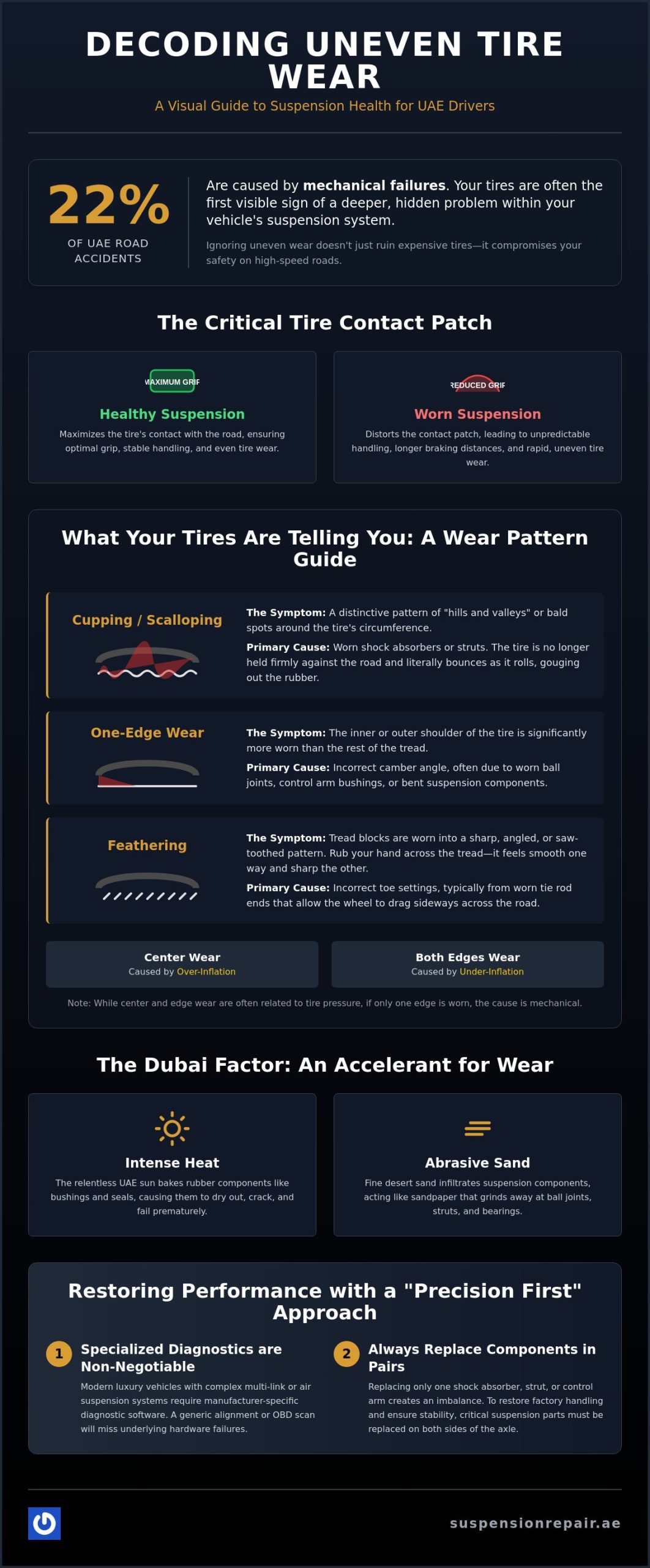
Is your luxury vehicle pulling to one side or vibrating at highway speeds? Your tires are the only point of contact between your car and the Dubai asphalt. This small area of rubber is known as the “tire contact patch.” When your suspension system functions correctly, it maximizes this patch to ensure optimal grip, braking, and stability. However, when internal components fail, that contact patch distorts. This creates an uneven tire wear suspension problem Dubai drivers often ignore until they are forced into an expensive tire replacement or, worse, an RTA inspection failure.
Think of your tires as the “canary in the coal mine” for your vehicle’s health. They are often the first visible indicator that something is mechanically wrong deep within the chassis. If a shock absorber is leaking or a control arm is bent, the tire bears the brunt of that failure. It literally drags across the road at an incorrect angle. On high-speed routes like the E11 or E311, this isn’t just a nuisance. It’s a major safety risk. Reduced contact with the road means longer braking distances and unpredictable handling during emergency maneuvers.
It’s vital to distinguish between a simple alignment issue and a structural suspension problem. Alignment is a calibration of angles. Structural repair involves replacing the actual hardware. If your suspension parts are physically broken or worn, no amount of “tuning” on an alignment rack will fix the issue. You need a specialist who can tell the difference between a car that’s simply out of spec and one that’s physically failing.
The Geometry of Control: Camber, Caster, and Toe
Your suspension uses precise geometry to keep your wheels pointed in the right direction. Camber is the vertical tilt of the wheel. When bushings or ball joints wear out, they allow these angles to shift under the weight of the vehicle. This movement leads to specific types of abnormal tread wear that provide a roadmap for a trained technician to diagnose the root cause. Without these precise angles, your car loses its factory-standard “feel” and safety profile.
Why Alignment Alone Won’t Fix Worn Parts
Have you ever paid for an alignment only to have the steering wheel start shaking again a week later? This happens because of “dynamic alignment.” A car might look perfectly straight while sitting still on a garage rack. But once you’re driving at 120 km/h, the force of the road pushes against worn components, causing the wheels to oscillate. Adjusting a car with worn ball joints is a temporary band-aid fix. It’s significantly more cost-effective to identify and replace the failing part than to keep buying new sets of premium tires every six months.
Deciphering Tire Wear Patterns: What Your Rubber is Telling You
Your tires act as a physical logbook of every mechanical movement your vehicle makes. By reading the tread, you can identify the common culprits behind uneven wear before they result in a total component failure. While many drivers assume a highway vibration means they just need new rubber, the specific pattern of the wear usually points toward a deeper uneven tire wear suspension problem Dubai heat often exacerbates. Understanding these patterns allows you to stop the damage before it ruins a second set of expensive tires.
Not all wear is created equal. Before you book an alignment, check for these specific symptoms:
- Feathering: If the tread blocks feel smooth when you rub your hand one way but sharp the other, you have “feathering.” This is usually caused by incorrect toe settings. Worn tie rod ends allow the wheels to splay outward while driving, dragging the rubber across the asphalt.
- One-Edge Wear: When either the inner or outer edge wears down while the rest of the tire looks new, your camber is out of spec. This is frequently caused by saggy springs or bent struts.
- Center Wear vs. Side Wear: If the wear is only in the middle, your tires are over-inflated. If both outer edges are bald, they are under-inflated. If only one edge is worn, the issue is purely mechanical and related to your suspension geometry.
Spotting ‘Cupping’ and What It Means for Your Shocks
Do you see a series of “hills and valleys” or smooth bald spots around the circumference of the tire? This is called cupping or scalloping. It happens when a worn shock absorber can no longer keep the tire firmly pressed against the road. Instead of rolling smoothly, the wheel bounces like a basketball. Each time it hits the pavement, a patch of rubber is shaved off. If you notice this rhythmic wear, you likely need shock absorber repair Dubai specialists recommend to stop the bouncing and save your vehicle’s stability.
Inner Edge Wear and Luxury Car Sag
Heavy luxury SUVs often suffer from extreme inner edge wear, sometimes called “wire wear.” This occurs when the inner tread disappears so fast the metal cords become visible. Why does this happen? It’s often due to “sag.” As control arm bushings age or air suspension bags lose pressure, the car sits lower than its factory height. This creates negative camber, where the tops of the wheels tilt inward. The inner edge then carries the entire weight of the vehicle, leading to premature failure. If your tires look suspicious, you should schedule a professional tread analysis to catch the issue early.
The Dubai Factor: How Heat and Sand Accelerate Suspension Failure
Dubai’s asphalt may be world-class, but the climate is a relentless assault on your vehicle’s undercarriage. While you enjoy the smooth ride on Sheikh Zayed Road, your suspension is fighting a war against extreme temperature swings and abrasive particles. This environmental stress often manifests as an uneven tire wear suspension problem Dubai luxury car owners discover too late. Why does a system designed to last a decade in Europe fail in less than half that time here? It’s the “Dubai Factor.”
Consider the sheer number of speed bumps, or “sleeping policemen,” in residential areas like Jumeirah or Arabian Ranches. Every time you cross one, your struts must dissipate a massive amount of energy. Over time, this constant cycling leads to micro-leaks in shock absorbers. Combine this with the high humidity in coastal areas, and you have a recipe for corroded air suspension bags and failing electronic ride-height sensors. These sensors are the “brain” of your ride quality; once they fail, the car cannot balance itself correctly, leading to immediate tread damage.
Rubber Degradation in the UAE Climate
In the UAE, summer temperatures regularly exceed 50°C. This intense heat saps the plasticizers from rubber bushings, causing them to harden and crack. Once a bushing loses its elasticity, it can no longer hold the control arm in its precise position. Have you noticed a “clunking” sound when driving over small imperfections? That’s likely a heat-cracked mount. Because luxury vehicles rely on complex multi-link setups, German car suspension specialist Dubai services are essential to ensure these rubber-to-metal bonds are inspected and replaced with region-appropriate parts that can withstand the thermal load.
Sand: The Silent Abrasive
Sand is the silent killer of ball joints and tie rod ends. Fine desert dust is incredibly invasive. It finds its way into the smallest tears in the rubber protective boots that shield your steering and suspension joints. Once inside, the sand mixes with the internal grease to create a grinding paste. This paste rapidly eats away at the polished metal surfaces of the joint, creating “play” in your steering. This looseness is a primary cause of feathering on your tires.
Don’t assume a high-pressure wash at the petrol station is the solution. In fact, pointing a high-pressure nozzle directly at your suspension can force sand and water past the seals and deeper into the joints. This accelerates the very wear you’re trying to prevent. Instead, rely on professional cleaning and inspections that identify breached boots before the internal joint is compromised. Protecting these seals is the most cost-effective way to extend the life of your suspension and your tires.
Beyond Alignment: Why Luxury Cars Need Specialist Diagnostics
Have you ever wondered why your Mercedes still pulls to the right even after three separate wheel alignments? The answer lies in the complexity of modern multi-link systems. High-end vehicles from Audi, BMW, and Porsche don’t use the simple suspension setups found in economy cars. They utilize intricate networks of control arms and electronic actuators designed to provide a specific “ride signature.” When you face an uneven tire wear suspension problem Dubai specialist workshops are often the only ones equipped to find the root cause. A generic garage might see a straight wheel on a rack, but they often miss the microscopic play in a specialized bushing that only appears under the load of a high-speed corner.
Precision is everything for these machines. Performing luxury car suspension repair Dubai requires strict adherence to factory torque-to-yield specifications and brand-specific tools. For example, many European models require the suspension to be in a “normal loaded position” before bolts are tightened. If a technician tightens these while the car is on a lift, the bushings will be pre-stressed and fail within months. Furthermore, any work on these systems necessitates a ride height calibration to ensure the vehicle’s computer knows exactly where the chassis sits in relation to the road.
Diagnosing Air Suspension Leaks
Does your car lean to one side after sitting in the driveway overnight? This is a classic symptom of a leaking air bag. While it might seem like a minor annoyance that fixes itself once the engine starts, it’s a ticking time bomb. A small leak forces the air compressor to run constantly to maintain ride height. This eventually burns out the compressor motor, turning a simple bag replacement into a multi-thousand dirham repair. You can explore our dedicated guide on air suspension repair to understand how we detect these leaks before they escalate.
Electronic Damping and Magnetic Ride Issues
Performance vehicles often feature adaptive damping that adjusts stiffness millisecond by millisecond. If your tires are wearing strangely, the fault might not be mechanical at all. A faulty electronic control module or a pinched sensor wire can cause one shock to remain in “Sport” mode while the others are in “Comfort.” This imbalance creates uneven pressure on the tire treads. Generic OBD scanners usually miss these subtle chassis fault codes. We utilize brand-specific software like Odis for Volkswagen Group, ISTA for BMW, and Xentry for Mercedes to talk directly to your car’s suspension brain. Don’t leave your safety to guesswork; book a specialist diagnostic session today to ensure your luxury vehicle performs as the engineers intended.
Restoring Precision: Professional Suspension Repair in Dubai
Solving an uneven tire wear suspension problem Dubai climate creates requires more than a quick fix. It demands a “Precision First” mindset. We always recommend replacing major components like shocks, struts, or control arms in pairs. Why? If your left strut is leaking, the right one has endured the same 50°C heat and the same thousands of speed bumps. Replacing only one side creates a mechanical imbalance. This leads to unpredictable handling and ensures the uneven wear cycle continues on the older side.
Quality parts are the backbone of a lasting repair. We exclusively utilize OEM or high-quality aftermarket components from manufacturers like Bilstein and Lemförder. These parts are engineered to handle the specific damping rates and thermal loads required by high-performance machinery. Once the new hardware is installed, the final, non-negotiable step is a 3D Computerized Wheel Alignment. This isn’t a simple check; it’s a digital calibration that ensures your wheels are perfectly parallel and perpendicular, protecting your investment from the very first kilometer.
Does a healthy suspension really affect your wallet? Absolutely. Beyond saving you from frequent tire replacements, a correctly aligned suspension improves fuel economy by reducing rolling resistance. It also significantly shortens your braking distance during emergency stops. When your car isn’t fighting against its own geometry, it glides efficiently and safely.
This principle of preventative care applies to all mechanical aspects of your lifestyle. For instance, for those seeking high-quality mechanical maintenance for their home, Brimbank Garage Doors & Repairs provides expert garage door services that mirror the precision required for high-end automotive care.
The Specialist Advantage at Suspension Repair Dubai
Choosing suspension specialists Dubai owners trust ensures your vehicle receives niche expertise that general garages cannot match. We don’t distract ourselves with engine or transmission work. Our technicians focus entirely on the chassis and ride quality of elite brands, from Range Rover and Bentley to Ferrari and Rolls Royce. Every inspection concludes with a detailed report on every bushing, ball joint, and seal. We prioritize transparency, showing you exactly where the wear is occurring before a single bolt is turned.
Book Your Specialist Inspection Today
Are you ready to stop the tire-killing cycle? Don’t let worn-out bushings or leaking struts compromise the safety of your family or the performance of your luxury vehicle. Dubai’s unique driving conditions demand proactive care, and our team is equipped with the brand-specific diagnostic software to find faults that generic scanners miss. Avoid the stress of an RTA inspection failure or the high cost of premature tire replacement. Contact our expert suspension mechanics now to restore your vehicle to its factory-standard precision.
Take Control of Your Vehicle’s Precision
Your luxury vehicle is a masterpiece of engineering, but it’s only as good as the suspension that connects it to the road. We’ve seen how Dubai’s extreme heat and abrasive sand turn your tires into a diagnostic map, highlighting mechanical failures that a simple alignment cannot fix. Ignoring an uneven tire wear suspension problem Dubai heat exacerbates only leads to a cycle of expensive tire replacements and compromised safety on the highway.
Our expert mechanics focus exclusively on suspension and ride comfort, bringing specialized expertise to elite brands like Rolls Royce, Ferrari, and Mercedes. We utilize advanced 3D diagnostics to pinpoint faults in complex air and magnetic ride systems, ensuring every bushing and joint meets factory standards. Don’t let a minor vibration turn into a major repair bill or an RTA failure. Stop killing your tires—Book a Specialist Suspension Diagnostic at our Dubai Workshop and restore the smooth, precise handling you deserve. Your car’s performance is our priority, and we’re here to ensure every journey is as effortless and safe as the day you first drove it.
Frequently Asked Questions
Can a bad suspension cause tires to wear on the inside?
Yes, this is a very common symptom of failing suspension components. When control arm bushings wear out or springs begin to sag, the wheels tilt inward at the top, a condition known as negative camber. This forces the inner edge of the tire to carry the majority of the vehicle’s weight. Over time, this results in the inner tread wearing down to the metal wires while the outer edge looks nearly new.
How do I know if my tire wear is caused by alignment or suspension?
You can usually tell the difference by the presence of secondary symptoms like noise or vibration. If your steering wheel is off-center but the ride is quiet, it’s likely just an alignment issue. However, if you hear clunking over speed bumps or feel a steering wobble, you’re facing an uneven tire wear suspension problem Dubai heat often causes. Alignment is a calibration, but it can’t fix a physically broken or loose part.
How much does it cost to fix uneven tire wear in Dubai?
The total cost depends on whether the root cause is a simple alignment or a structural component failure. While the standard RTA vehicle inspection fee is AED 150, repair costs vary significantly based on your car’s make and the specific parts needed. It’s important to remember that a specialist diagnostic is a small investment compared to the high cost of replacing premium luxury tires every few months.
Is it safe to drive with unevenly worn tires on the highway?
It’s not safe to drive with significant uneven wear, especially at high highway speeds. Tires with compromised tread patterns have much longer braking distances and are far more prone to hydroplaning during rare rain events. On roads like the E11, an unevenly worn tire can also lead to a sudden blowout due to excessive heat buildup in the thinnest parts of the rubber.
Why did my new tires wear out in less than 10,000 km?
New tires should last much longer, so premature wear is a major red flag for a mechanical fault. If your treads are disappearing in under 10,000 km, your “dynamic alignment” is likely failing. This means that while the car looks straight on an alignment rack, the parts are moving excessively while you’re driving. This constant scrubbing against the road surface acts like a belt sander on your new rubber.
What are the first signs of air suspension failure in luxury SUVs?
The most obvious sign is seeing one corner of your SUV “squatting” or leaning after it’s been parked for a few hours. You might also hear your air compressor running more frequently or for longer periods than usual. If you notice a “chassis restricted” message on your dashboard, it’s vital to seek a specialist inspection immediately to prevent the compressor from burning out completely.
Can sand and heat really damage my car’s suspension system?
Yes, the Dubai climate is particularly harsh on these systems. Intense summer heat dries out the rubber seals and bushings that provide flexibility and cushioning. Meanwhile, fine desert sand acts as an abrasive paste when it gets inside the protective boots of ball joints. This combination accelerates mechanical wear, leading to the looseness and play that eventually ruins your tire alignment and ride comfort.
Do I need to replace my shocks if my tires are cupping?
Yes, cupping is almost always a direct result of worn-out shock absorbers or struts. When a shock can’t control the movement of the wheel, the tire begins to bounce as you drive. Each time the tire hits the ground after a mini-bounce, it loses a small patch of rubber. If you see these rhythmic “hills and valleys” on your tread, your shocks are no longer doing their job.