In Dubai’s extreme heat, your Porsche’s air suspension system isn’t just a luxury feature; it’s a ticking clock. You’ve likely noticed your Cayenne or Panamera sitting dangerously low after a night in the garage, or perhaps a “Suspension System Fault” light has turned your morning commute into a stressful ordeal. It is frustrating to feel every speed bump when your car should be gliding, and the confusion of dashboard warnings only adds to the pressure.
We understand the anxiety of facing potential mechanical failure and the fear of massive dealership repair bills. This guide will help you identify the exact cause of the Porsche air suspension problems Dubai owners frequently encounter. Whether you are dealing with the 2025 Taycan retaining ring recall or heat-cracked seals on an older model, you will learn how to resolve these issues using specialist expertise that prioritizes both precision and cost-effectiveness.
We will break down the specific symptoms affecting your vehicle, explain why the UAE climate accelerates component wear, and provide a clear path to restoring your car’s factory-standard ride height and performance.
Key Takeaways
- Learn how to perform the “sagging test” to identify failing air springs before they lead to expensive compressor burnouts.
- Discover why Dubai’s extreme 50°C+ heat and abrasive desert sand are the primary triggers for Porsche air suspension problems Dubai drivers experience.
- Identify model-specific vulnerabilities, including Cayenne strut leaks and Panamera valve block issues, to ensure a faster diagnostic process.
- Avoid the high costs of the “dealer trap” by exploring specialist repair options that focus on replacing individual components rather than the entire system.
- Understand the technical advantages of choosing a specialized Al Quoz workshop that uses Porsche-specific software for pinpoint accuracy.
Recognizing Porsche Air Suspension Warning Signs in Dubai
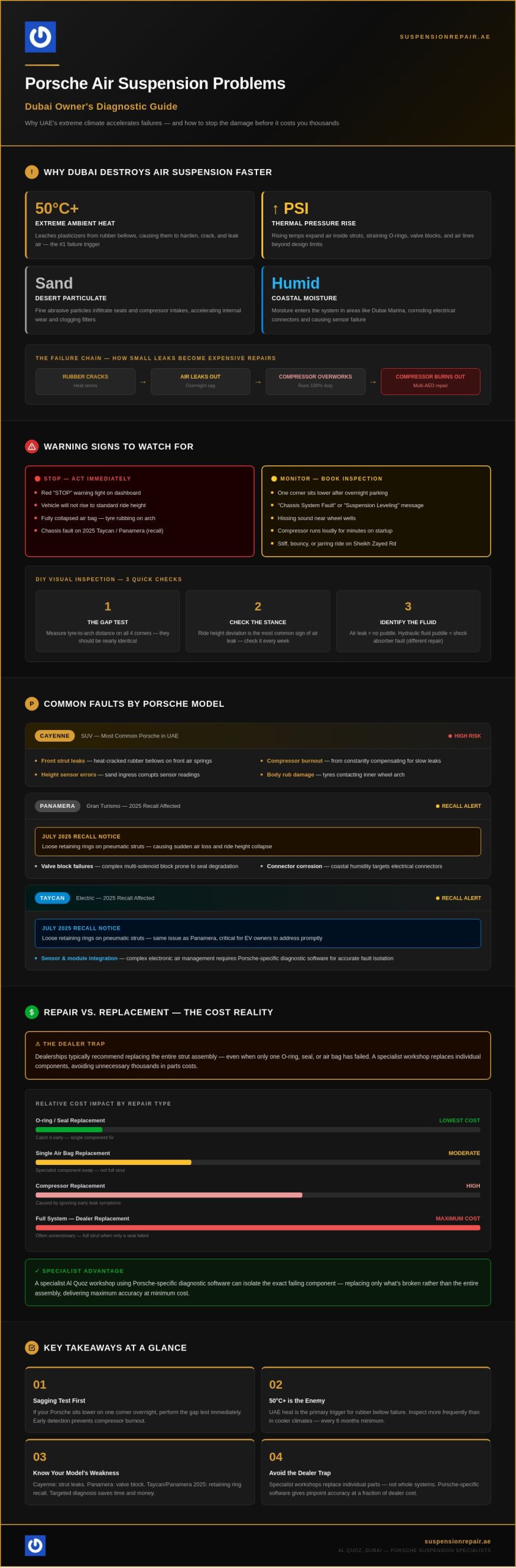
Does your Porsche look like it is kneeling on one side after sitting in your driveway overnight? This “sagging” is often the first indicator that your vehicle is struggling with the early stages of component failure. In the extreme climate of the UAE, the Air suspension system relies on pressurized air bags and precise sensors to maintain a level stance. When a leak develops, usually due to heat-stressed rubber, the air escapes while the car is parked. If you notice one corner sitting lower than the others, don’t ignore it. Identifying the symptoms of Porsche air suspension problems Dubai owners face is the first step toward a cost-effective fix before the damage spreads to other components.
Your dashboard is your next line of defense. A “Chassis System Fault” or “Suspension Leveling” message isn’t just a suggestion; it’s a warning that the control module has detected a pressure drop or a sensor malfunction. For owners of the 2025 Taycan and Panamera, these alerts are particularly critical following the July 2025 recall regarding loose retaining rings on pneumatic struts. Beyond the digital warnings, listen for audible clues. A faint hissing sound near the wheel wells or a compressor that runs loudly for several minutes after you start the engine suggests the system is overworking to compensate for a leak. On high-speed routes like Sheikh Zayed Road or the undulating turns of Hessa Street, a failing system will manifest as a stiff, “bouncy,” or jarring ride that feels more like a budget hatchback than a precision-engineered Porsche.
When is it an Emergency?
Driving with a fully collapsed air bag is a safety risk that can lead to expensive secondary damage. When the suspension fails to lift, the vehicle’s body sits too low, which can cause the tyres to rub against the inner wheel arches during turns or over speed bumps. This creates a risk of tyre blowouts and bodywork damage. Additionally, a minor leak forces the compressor to run continuously. These units aren’t designed for 100% duty cycles; they will eventually burn out, turning a simple seal repair into a multi-thousand dirham replacement. If your Porsche won’t rise to its standard height or the “Stop” warning appears in red, pull over and call for a specialist inspection immediately.
Visual Inspection Tips for Owners
You don’t need to be a mechanic to perform a basic health check on your Porsche. Use these steps to monitor your system:
- The Gap Test: Measure the distance between the top of the tyre and the wheel arch on all four corners. They should be nearly identical.
- Identify the Fluid: If you see a puddle, check the color. Air suspension failure is a gas leak, but hydraulic fluid leaks from the shock absorber portion of the strut indicate a different mechanical fault.
- Check the Stance: Ride Height Deviation is the most common physical symptom of an air leak.
Proactive monitoring saves time and money. If you spot these signs early, a specialist can often replace a single O-ring or air bag rather than the entire strut assembly.
Why Dubai Heat Accelerates Porsche Suspension Failure
Dubai’s environment is a laboratory for mechanical stress. While Porsche engineers design systems for global reliability, the specific combination of 50°C+ ambient temperatures and fine desert particulate creates a unique set of challenges. The rubber bellows in your air suspension are the most vulnerable point. High heat accelerates thermal aging by leaching the plasticizers from the rubber compound. This process causes the material to become brittle and lose its essential elasticity. Once the rubber hardens, it can no longer flex during normal driving, leading to the Porsche air suspension problems Dubai drivers face most often: microscopic cracks that eventually turn into major leaks.
Pressure stress is another critical factor. Basic physics dictates that as temperatures rise, the air inside the suspension tanks and struts expands. This significantly increases the internal pressure, putting immense strain on O-rings, valve blocks, and air lines. When you combine this internal pressure with the high humidity found in coastal areas like Dubai Marina or Jumeirah, the result is a double-edged sword. Moisture can enter the system, leading to corroded electrical connectors and failing height sensors that send incorrect data to the ECU. If you suspect your system is struggling under the summer heat, it is wise to request a professional diagnostic check before a small leak turns into a total system failure.
Thermal Expansion and Seal Integrity
Seals that perform perfectly in European winters often fail during a Middle East summer. The primary culprit is the dramatic expansion and contraction cycle. During the day, components bake in direct sunlight; at night, they cool down. This constant movement wears out the bond between rubber and metal components. Heat-hardened rubber develops tiny fissures that allow pressurized air to escape, causing the overnight sagging discussed in the previous section. This thermal cycling is why even a well-maintained Porsche can suddenly show a chassis fault after a particularly hot weekend.
The “Sandpaper Effect” on Struts
Fine desert sand is more than just a nuisance; it’s a potent abrasive. These tiny particles bypass the protective dust boots and settle on the piston rods. As the suspension moves up and down, the sand acts like sandpaper, scoring the smooth metal surfaces and shredding the internal seals.
- Frequent desert driving increases the frequency of seal failure due to particulate buildup.
- Sand ingress leads to slow leaks that are difficult to detect without specialized diagnostic equipment.
- Preventative cleaning of the wheel wells can help, but it cannot reverse existing internal scoring once it has started.
The abrasiveness of the Dubai environment means that even low-mileage vehicles can suffer from premature wear. If you frequently drive in dusty conditions, your suspension components are working twice as hard to maintain seal integrity.
Common Faults by Porsche Model: Cayenne, Panamera, and Taycan
Every Porsche model interacts with Dubai’s environment differently. While the underlying technology remains similar, the mechanical stress points vary significantly between a heavy SUV like the Cayenne and a low-slung sedan like the Panamera. Understanding these model-specific nuances is essential for an accurate diagnosis. At our specialized Al Quoz workshop, we see that Porsche air suspension problems Dubai owners encounter are rarely “one size fits all” issues. Instead, they follow predictable patterns based on vehicle weight, ground clearance, and usage.
Porsche Cayenne (958/9Y0) Specific Issues
The Cayenne is the workhorse of the Porsche lineup in the UAE, but its weight puts immense pressure on the front air spring assembly. We frequently see failures in the 958 and 9Y0 generations where the front struts develop slow leaks. This often leads to a secondary failure: the compressor relay. If a leak is present, the compressor runs more frequently to maintain pressure. If the relay sticks in the “on” position, the compressor will run until it suffers a total mechanical burnout.
- Yellow Warning: This typically indicates a minor leak or a sensor calibration issue. You can usually drive to a specialist, but you should do so immediately.
- Red Warning: This is a critical failure. The vehicle is too low to safely clear road obstacles. Stop driving to avoid damaging the wheel arches.
Panamera and Low-Profile Suspension Challenges
The Panamera faces a different enemy: Dubai’s high speed bumps. Because the Panamera sits lower to the ground, the air struts must work harder to provide instantaneous lift when you engage the “Lift” mode. A common fault is the valve block sticking. This component distributes air to the four corners; if it fails, your car might refuse to raise or lower on command. Drivers often report a “clunking” noise when navigating speed bumps in areas like Jumeirah, which usually points to a failing air strut or a worn-out PASM (Porsche Active Suspension Management) damper.
For owners of the 2025 Panamera and Taycan, stay alert for specific manufacturing defects. On July 3, 2025, Porsche recalled 284 units due to loose retaining rings on the pneumatic struts. This fault causes sudden air pressure loss and a stiff ride. In the Macan, we more frequently see ride height sensor calibration errors caused by sand interference, alongside occasional leaks in the pressurized air storage tank. These electronic damping complexities require Porsche-specific software to pinpoint whether the fault is a simple sensor recalibration or a mechanical replacement. Specialized diagnosis ensures you don’t pay for a new compressor when only a 200-dirham sensor was at fault.
Porsche Air Suspension Repair vs. Replacement Costs in Dubai
Facing a suspension fault at the dealership often results in a quote that feels more like a down payment on a new car. Why does this happen? Most official agencies in the UAE follow a strict protocol of assembly replacement rather than component-level repair. If your air bag has a minor leak, they will often insist on replacing the entire strut, including the expensive hydraulic damper and integrated electronic sensors. This “dealer trap” is one of the most common Porsche air suspension problems Dubai owners face, turning a manageable mechanical fix into a massive financial burden.
As a specialist workshop in Al Quoz, we take a different approach. We focus on precision diagnostics to determine if we can save your existing hardware. By replacing only the failed component, such as an individual air bellow or a specific valve block, you can restore factory performance at a fraction of the agency price. We prioritize technical accuracy over simple parts swapping. For a broader look at how these systems compare across other luxury brands, see The Ultimate Guide to Car Suspension Repair in Dubai (2026 Edition).
Can You Repair an Air Strut?
It is vital to distinguish between a leaking air bag and a failed internal damper. If your car is sagging but still handles well once lifted, the issue is likely just the rubber air spring. We can often replace just the bag, which is a significant saving. However, if the car feels “bouncy” or you see hydraulic fluid leaking, the internal damper has failed. In these cases, re-sealing is rarely a viable long-term solution. We generally recommend replacing struts in pairs to ensure balanced handling and prevent the older unit from failing shortly after the repair.
The Role of the Air Compressor
Don’t make the mistake of assuming a dead compressor is the root of your trouble. In almost every case, a burnt-out compressor is a symptom of an undiagnosed air leak elsewhere in the system. The unit overworks itself trying to keep a leaking strut inflated until the motor eventually fails. Before we recommend a replacement, we perform a pressure output test. If the compressor is still healthy, we fix the leak first. If it has failed, we identify the leak that caused the burnout to ensure your new unit doesn’t suffer the same fate.
Choosing between genuine Porsche parts and high-quality OEM alternatives like Bilstein or Arnott can also impact your total costs. We provide transparent advice on which parts offer the best longevity for the Dubai climate. If you are tired of dealership prices and want a technical, cost-effective solution, get a specialized repair quote today.
Specialist Porsche Suspension Repair at Our Dubai Workshop
Why risk your vehicle’s performance at a generalist garage? Porsche air suspension systems are masterpieces of engineering that require more than just standard tools. Choosing a specialized Al Quoz workshop ensures that your car receives the dedicated attention it deserves. Car Suspension Repair focuses exclusively on luxury suspension systems, which allows us to provide a level of precision that general repair shops simply cannot match. When you bring your vehicle to us, you aren’t just getting a mechanic; you are getting a partner who understands the technical intricacies of the Porsche air suspension problems Dubai climate creates.
We utilize advanced, Porsche-specific diagnostic software to communicate directly with your vehicle’s ECU. This allows us to determine if a “Chassis System Fault” is caused by a faulty height sensor, a leaking valve block, or a mechanical failure in the strut itself. Our workshop in the heart of Dubai’s automotive hub is equipped to handle everything from the latest Taycan Turbo to classic Cayenne models, ensuring that every diagnostic is backed by data rather than guesswork. Our goal is to restore the legendary agility your Porsche is known for, providing a stress-free, high-end resolution to complex mechanical issues.
Our Diagnostic Process for Porsche
Our approach is methodical and transparent. We begin with a visual leak detection using specialized solutions, followed by an electronic module scan to check for stored fault codes. We don’t stop at identifying the obvious; we test the system under different load conditions to ensure the height sensors and compressors are performing within factory specifications. For a deeper dive into our technical standards, read our guide on being a German Car Suspension Specialist Dubai: The Ultimate Guide to Precision Repair 2026.
Restore Your Porsche Ride Comfort Today
There is a significant difference between a quick “fix” and a true restoration of factory handling. We specialize in luxury and performance brands because we know that a Porsche driver demands perfection. Whether you are navigating the daily traffic of Sheikh Zayed Road or heading out for a weekend drive, your suspension should be invisible and flawless. Don’t settle for a compromise in safety or comfort. Schedule your Porsche suspension inspection at Car Suspension Repair today and let our specialists return your vehicle to its peak performance.
Restore Your Porsche’s Precision and Performance
Don’t let a sagging suspension or a dashboard warning light compromise your safety on the road. As we’ve explored, the unique environmental factors in the UAE make Porsche air suspension problems Dubai owners face a technical challenge that requires immediate and expert intervention. By identifying early symptoms and choosing specialized component repair over full assembly replacement, you can maintain factory handling without the heavy burden of dealership prices.
Are you ready to stop worrying about your car’s stance? Our Al Quoz facility offers high-precision diagnostics and expert shock absorber repair tailored specifically for German engineering. The team at Car Suspension Repair focuses exclusively on these complex systems, ensuring your Cayenne, Panamera, or Taycan receives the dedicated care it needs to handle the intense Dubai heat. Our specialized Porsche suspension mechanics take the logistical burden off your shoulders, providing a transparent and efficient path to restoration.
Beyond local maintenance, for those who wish to experience the pinnacle of luxury travel and high-performance driving, Autobahn Adventures offers exclusive European tours designed for the most discerning enthusiasts.
Take the first step toward a smoother, safer ride today. Book Your Porsche Suspension Diagnosis at Our Dubai Workshop and ensure your vehicle remains as agile as the day it left the showroom. We are here to help you get back on the road with total confidence and peace of mind.
Frequently Asked Questions
Is it safe to drive my Porsche with a suspension warning light?
No, you should not continue driving if you see a red suspension warning light. While a yellow light indicates a minor fault that requires attention, a red light often means the system has collapsed. Driving in this condition can cause your tyres to rub against the wheel arches, leading to expensive bodywork damage and potential tyre blowouts. Pull over safely and contact a specialist for an inspection immediately.
How much does it cost to fix Porsche Cayenne air suspension in Dubai?
The cost of repair depends entirely on which component has failed within the system. Replacing a single air strut or a compressor is a more significant investment than fixing a leaking valve block or a faulty height sensor. Because Porsche systems are complex, the most effective way to manage costs is through a high-precision diagnostic that identifies the specific part needing replacement rather than swapping the entire assembly.
Can I replace just one air strut, or do I need to do both?
You can replace a single air strut, but we strongly recommend replacing them in pairs across the same axle. Suspension components wear at a similar rate; if one side has failed due to age and heat, the other side is likely close to the end of its lifespan. Replacing both ensures that your Porsche maintains a balanced ride height and consistent damping performance on both sides of the vehicle.
Why is my Porsche leaning to one side after being parked?
Your Porsche is leaning because air is escaping from a leak in the air spring or the connecting lines on that specific corner. This “overnight sagging” is one of the most frequent Porsche air suspension problems Dubai drivers encounter. The intense heat causes the rubber bellows to crack, allowing pressurized air to seep out slowly while the vehicle is stationary, which forces the car to tilt.
How long does a Porsche air suspension system typically last in Dubai?
In the UAE, a Porsche air suspension system typically lasts between 5 and 7 years before requiring significant maintenance. The extreme temperatures and high humidity in Dubai accelerate the “thermal aging” of rubber seals and air bags compared to cooler climates. Regular visual inspections at a specialized workshop can help you identify small fissures before they lead to a total system collapse.
What is the difference between PASM and standard air suspension?
PASM is an electronic damping control system that adjusts the stiffness of the shock absorbers in real time, while air suspension replaces traditional metal springs with air bags to control ride height. Most modern Porsches use these systems together. Air suspension provides the lift needed for speed bumps and comfort, while PASM focuses on active stability and agility during high-speed cornering.
Can heat cause my Porsche suspension to fail prematurely?
Yes, extreme heat is the leading cause of premature suspension failure for luxury vehicles in the Middle East. Ambient temperatures above 50°C dry out the plasticizers in the rubber air bags, making them brittle and prone to cracking. This heat also increases the internal pressure within the air tanks, putting additional stress on every seal and connector in the system.
Do I need to go to the Porsche dealer for a suspension reset?
No, you do not need to visit the official dealership for a suspension reset or height calibration. A specialized independent workshop equipped with Porsche-specific diagnostic software can perform the exact same electronic calibrations and module resets. This allows you to receive dealership-level precision and technical expertise without the high agency markups or long waiting times.