What if the thousands of dirhams you just spent on a new set of Michelin or Pirelli tires are being ground away by a problem you can’t even see? Most luxury car owners in the UAE assume that a quick wheel alignment is the cure-all for a steering wheel that vibrates or a car that pulls to the left. It’s incredibly frustrating to invest in premium rubber only to find the inner edges balding again before your next oil change. You’re likely receiving conflicting advice from general tire shops that don’t understand the complex geometry of your vehicle’s handling system. In reality, uneven tire wear suspension repair Dubai specialists provide is often the only way to stop this cycle of wasted money.
We understand that you want to restore that signature “cloud” ride to your SUV while ensuring your vehicle remains RTA-compliant. This 2026 guide teaches you how to identify the mechanical root causes of tread damage, from heat-compromised bushings to leaking air struts. We’ll explain why Dubai’s extreme climate demands a specialized approach to protect your steering precision and safety. By the end of this article, you’ll know exactly how to diagnose suspension fatigue and why a brand-specific specialist is the key to preserving your vehicle’s performance on high-speed roads.
Key Takeaways
- Stop treating symptoms with frequent alignments and learn why uneven tread is often a hidden mechanical failure in your luxury vehicle’s suspension.
- Identify specific tread patterns like cupping or scalloping to pinpoint whether your shock absorbers or control arm bushings have failed.
- Discover how 50°C summer heat thins hydraulic fluids and degrades rubber seals, making specialized uneven tire wear suspension repair Dubai essential for maintaining factory-spec handling.
- Master simple diagnostic techniques like the “bounce test” and visual inspections to catch minor leaks before they lead to expensive RTA inspection failures.
- Learn why high-end marques like Rolls Royce and Bentley require precise OBD-II calibration rather than the generic “replace-all” approach used by standard garages.
The Connection Between Suspension Health and Tire Longevity
Your vehicle’s suspension system is the only thing managing the violent forces between the road and your car’s chassis. While many drivers view shocks and struts as comfort components, their primary job is safety. They maintain the tire’s “contact patch,” which is the small area of rubber actually touching the asphalt at any given second. When your suspension components degrade, that contact patch becomes inconsistent. This leads to uneven tire wear suspension repair Dubai specialists often see in high-performance vehicles. If you ignore these signs, you’ll inevitably face uneven or accelerated tire wear that ruins a brand-new set of tires in weeks.
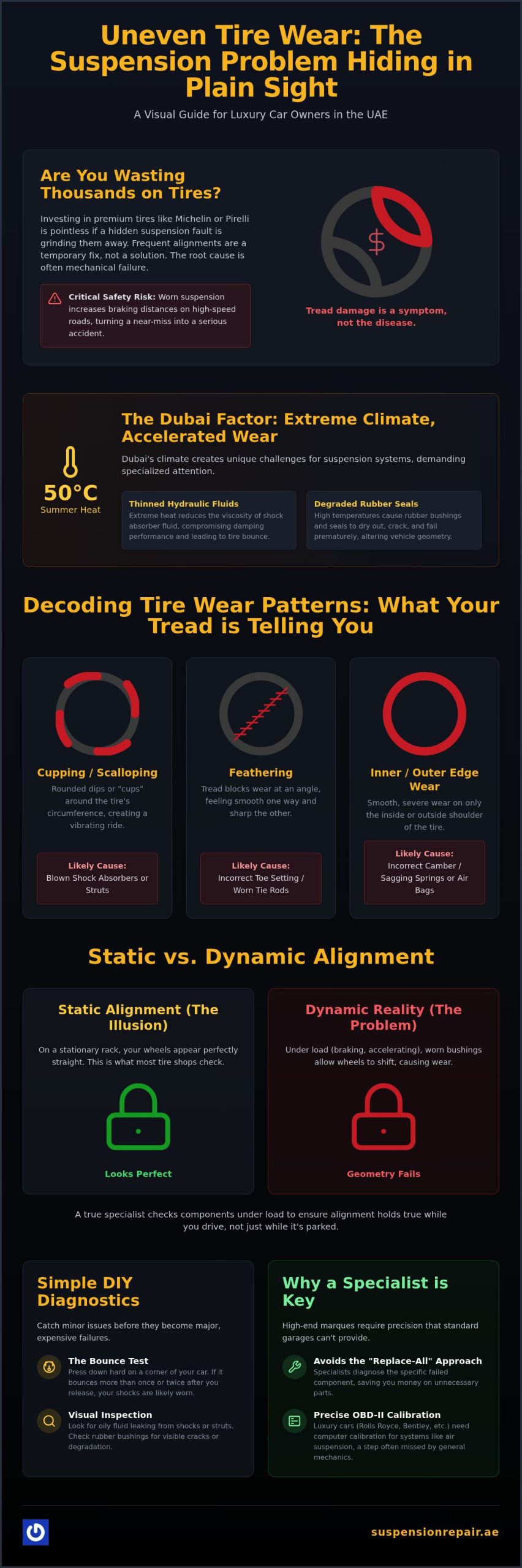
It’s vital to understand that tread damage is a lagging indicator. By the time you notice balding edges or cupping, the mechanical failure has likely been in progress for months. This isn’t just a financial issue; it’s a critical safety risk. A tire that isn’t firmly pressed against the road cannot provide the friction needed for emergency stops. On Dubai’s fast-moving highways, suspension-related tire wear can significantly increase your braking distances, potentially turning a close call into a serious accident.
The Role of Damping in Tire Stability
Think of your car’s springs as the components that support the weight, while the dampers (shocks) control the energy. Without functional dampers, your tires would bounce uncontrollably after every minor road imperfection. This “hopping” effect means the tire is momentarily airborne, which creates flat spots and erratic wear patterns. When a shock absorber loses hydraulic pressure, it can no longer settle the spring’s oscillation quickly. Damping is the management of spring energy to ensure consistent tire-to-road contact. Without this control, your luxury SUV will lose its composed feel and eat through its tires at an alarming rate.
Static vs. Dynamic Alignment
Why does your car still wear through tires even after a standard alignment? The answer lies in the difference between static and dynamic geometry. A general tire shop might get your car perfectly straight on a stationary rack, but everything changes once you’re moving. Worn control arm bushings or ball joints allow the wheels to “toe-out” or shift camber under the stress of braking and acceleration. This is especially common in luxury German and British marques that use complex multi-link systems. Professional uneven tire wear suspension repair Dubai requires checking these components under load to ensure your car stays aligned while you’re actually driving, not just while it’s parked.
Decoding Tire Wear Patterns: What Your Tread Is Telling You
Your tires are the most honest diagnostic tool you have. While a standard garage might just suggest a rotation, a professional uneven tire wear suspension repair Dubai specialist looks at the specific “scarring” on the rubber to find the mechanical culprit. Understanding these patterns saves you from replacing expensive premium tires every few months. For a foundational look at maintenance, check these Tire Care Essentials to see how alignment and tread health interact.
Feathering occurs when the tread blocks wear down at an angle. If you run your hand across the tire and it feels smooth in one direction but sharp in the other, your “toe” setting is out. This is rarely just an alignment issue; it’s often caused by worn tie rods or steering linkage components that have developed play over time. Constant vibration from Dubai’s high-speed roads can accelerate this wear, turning a minor misalignment into a shredded tire in weeks.
If you see smooth wear on just one side of the tire, it usually points to sagging springs or failing air bags. This is common in older luxury vehicles where the suspension has physically settled, forcing the wheel into a permanent tilt that grinds down the rubber. This “one-sided” wear is a clear signal that your car’s geometry is no longer within factory specifications.
Cupping: The Bouncing Tire Syndrome
Cupping, or scalloping, appears as a series of rounded dips or “cups” around the tire circumference. This is the classic signature of blown shock absorbers or struts. When these components fail, they can’t stop the tire from bouncing like a basketball on the road. This pattern is particularly prevalent in high-mileage SUVs like the Range Rover or Audi Q7, where the heavy weight of the vehicle accelerates damper fatigue. You can often feel these dips before you see them by running your palm along the edge of the tread.
Edge Wear and Bushing Fatigue
Inner or outer edge wear is frequently linked to camber issues. In luxury German marques like BMW and Mercedes, the multi-link suspension relies on complex rubber bushings to maintain wheel position. When these bushings soften or tear, the wheel “squats” under the car’s weight. This creates permanent negative camber, eating the inner edge of the tire. If your air suspension fails and the car sits low, this effect is amplified. You can find more detail in our Luxury Car Suspension Repair Dubai Guide. If you’ve noticed these patterns on your vehicle, it’s time to consult a specialist for a technical inspection.
The Dubai Factor: Why Local Roads Accelerate Suspension Failure
Dubai presents a unique set of mechanical challenges that most vehicle manufacturers don’t account for in standard service intervals. Statistics show that vehicles in desert regions experience breakdown rates 300% higher than those in temperate climates. This isn’t just bad luck. It’s the result of environmental stressors that target your car’s most sensitive moving parts. When you are dealing with uneven tire wear suspension repair Dubai specialists must look beyond standard alignment to see how the environment is physically dismantling your chassis components.
The cumulative stress of residential “sleeping policemen” also plays a significant role. Frequent encounters with speed bumps in areas like Jumeirah or Emirates Hills put repeated, high-impact loads on your struts. Over time, this constant compression causes spring fatigue and can even bend mounting hardware. According to the National Highway Traffic Safety Administration, maintaining proper tire and suspension health is a critical safety requirement, especially as rubber components age. In Dubai, the legal limit for tire age is five years, but suspension rubber often fails much sooner due to the “dry rot” caused by intense UV exposure and fluctuating humidity.
Heat and Hydraulic Integrity
Thermal thinning is perhaps the most invisible enemy of your car’s handling. During the summer, ambient temperatures regularly exceed 50°C, causing the hydraulic oil inside your shock absorbers to lose its viscosity. When the oil thins out, the internal valving can no longer provide the resistance needed to control spring movement. This leads to the “misting” or leaking often seen on failed struts. For high-performance marques like Porsche, Ferrari, or Lamborghini, using OEM-spec fluid is critical. Generic fluids often lack the thermal stability required to maintain consistent damping at these extreme temperatures, leading to a bouncy ride and rapid tread destruction.
The Sand and Dust Challenge
Desert dust isn’t just a nuisance for your paintwork; it’s a powerful abrasive. Fine sand particles eventually find their way into the protective rubber boots of ball joints and tie rods. Once inside, the sand acts like sandpaper, grinding away at the polished metal surfaces and destroying the internal seals. This ingress is particularly dangerous for air suspension systems. The rubber bellows on a Range Rover or Mercedes can trap grit in their folds, which eventually punctures the bag as it inflates and deflates. To prolong your suspension life, we recommend regular undercarriage pressure washes to remove salt and sand buildup before they can penetrate these sensitive seals. If you suspect your seals are already compromised, you should book a technical inspection immediately to prevent a total system collapse.
DIY Troubleshooting: When to Seek Professional Suspension Repair
Identifying a suspension failure early can save you thousands of dirhams in premature tire replacement and secondary mechanical damage. While some issues require specialized diagnostic tools, many warning signs are visible to the naked eye or audible during a slow drive through your community. If you suspect your vehicle’s handling has softened, performing a few basic checks will help you determine if it’s time for uneven tire wear suspension repair Dubai specialists to intervene. Catching these symptoms before your next RTA inspection can prevent a failed certificate and potential vehicle impoundment.
Performing the Home Bounce Test
The bounce test remains one of the most effective ways to gauge the health of your shock absorbers. Walk to each corner of your vehicle and push down firmly on the fender with your full weight, then quickly release. A healthy suspension should rebound to its original height and settle almost immediately, usually after about one and a half oscillations. If the car continues to bounce or feels “floaty,” your dampers have likely lost their hydraulic pressure. You should stop the test if you hear any metal-on-metal contact; this indicates a completely collapsed strut that is no longer safe for high-speed highway driving.
Beyond the bounce, look for physical evidence of failure. Use a flashlight to inspect the strut body for “misting,” which appears as a dark, oily film that attracts desert dust. While a tiny bit of moisture is normal, actual drips indicate a blown seal. Listen closely as you navigate speed bumps at low speeds. Deep clunking sounds usually point toward worn control arm bushings, while high-pitched squeaks often signal that a ball joint has lost its internal lubrication and is physically grinding.
Identifying Air Suspension “Squat”
Owners of luxury SUVs like the Range Rover or BMW X7 should perform a “leaning” test. Park your vehicle on a level surface overnight and check the ride height at each wheel the following morning. If one corner sits significantly lower than the others, you likely have a pinhole leak in an air bag or a failing valve block. Ignoring this “squat” forces your air compressor to run continuously to maintain ride height, which can lead to a total compressor burnout. Replacing a compressor is far more expensive than patching a leak early. If your car is leaning or sitting low, contact our specialist team to book a diagnostic session before a minor leak becomes a major system failure.
Specialist Solutions: Restoring Factory Precision in Al Quoz
Why do general garages often fail to fix luxury handling issues permanently? Most standard shops treat every car the same, but ultra-luxury marques like Rolls Royce and Bentley require proprietary OBD-II suspension calibration to function correctly. When we replace a component, the vehicle’s central computer must be told how to manage the new part’s damping rates and ride height. Without this digital handshake, even the most expensive hardware won’t perform as intended. Professional uneven tire wear suspension repair Dubai services involve more than just turning a wrench. They require a deep understanding of the software that governs your car’s physical behavior.
We prioritize a component-level repair philosophy rather than the “replace everything” approach favored by many dealerships. If only a specific bushing or a single air bag has failed, there’s no reason to charge you for an entire control arm or strut assembly. This targeted method can save you thousands of dirhams while achieving the same high-end results. Our goal is always a complete Ride Comfort Restoration Dubai experience that makes your vehicle feel brand new. Once the mechanical work is finished, a precision wheel alignment is mandatory. This final step is what locks in the benefits of your uneven tire wear suspension repair Dubai, ensuring your new tires don’t suffer the same fate as the old ones.
Precision for Performance Brands
Performance vehicles from Audi and BMW utilize complex multi-link suspension systems that have dozens of pivot points. Each one must be perfectly tight to maintain high-speed stability. We use specialized hydraulic presses and brand-specific pullers to ensure every bushing is seated to factory tolerances without damaging the aluminum arms. For high-end shock absorbers, we provide nitrogen charging to maintain consistent pressure and prevent fluid cavitation during aggressive driving. This level of technical detail doesn’t just improve your drive; it maintains your vehicle’s resale value. A documented history of specialist maintenance is a significant asset when it’s time to renew your RTA registration or sell your vehicle.
Choosing a Specialized Suspension Shop in Dubai
Exotic and luxury cars shouldn’t be trusted to a shop that spends most of its time on economy sedans. You need a team that understands the nuances of air suspension leak detection and magnetic ride control. A focused Suspension Shop Dubai offers the diagnostic depth required to find the “ghost” vibrations that generic scanners miss. We stand behind our workmanship with warranties that give you peace of mind on every journey. Don’t let a minor suspension rattle turn into a major safety hazard or a failed inspection. Protect your tires and restore your ride by choosing expert intervention. Contact our Specialist Workshop today to schedule your technical evaluation.
Secure Your Investment and Restore Driving Precision
Your luxury vehicle deserves more than a temporary fix from a general tire shop. Don’t let Dubai’s extreme 50°C heat and abrasive desert sand dictate the lifespan of your premium rubber. Recognizing the difference between simple misalignment and deep-seated mechanical failure is the first step toward saving thousands of dirhams in premature replacements. Professional uneven tire wear suspension repair Dubai specialists provide the technical precision your vehicle needs to glide over speed bumps and maintain absolute stability at highway speeds. It’s about protecting your safety and your car’s resale value simultaneously.
Based in the automotive hub of Al Quoz, our workshop utilizes advanced diagnostic software specifically engineered for complex luxury air suspension systems. We specialize in restoring the factory-spec handling of Rolls Royce, Bentley, and elite German marques through component-level repairs that target the root cause of tread damage. Stop the cycle of wasted tires and restore the effortless “cloud” ride you expect from a high-end SUV. Book Your Specialist Suspension Inspection in Dubai today to ensure your vehicle is ready for the road ahead. We look forward to helping you drive with total confidence.
Frequently Asked Questions
Can bad suspension cause uneven tire wear even if my alignment is good?
Yes, a perfect static alignment doesn’t guarantee your wheels stay in position while moving. Worn shock absorbers lead to “tire hopping,” which creates scalloped dips in the tread. This is why uneven tire wear suspension repair Dubai specialists focus on dynamic stability. If your dampers can’t control the spring’s energy, your tires will wear prematurely regardless of how straight they look on an alignment rack. We recommend a full mechanical inspection to identify these hidden failures.
How often should I have my suspension inspected in Dubai?
We recommend a professional suspension check every 10,000 to 15,000 kilometers or during your routine service. Dubai’s environment is particularly harsh on rubber components. The combination of 50°C summer heat and frequent high-impact speed bumps in residential areas like Al Barsha means that bushings and seals degrade faster than in temperate climates. Regular inspections help you catch minor leaks before they lead to a failed RTA certificate or expensive compressor failure.
What are the first signs of air suspension failure in a Range Rover?
The most common early warning sign is “squatting,” where one corner of the vehicle sits lower than the others after being parked overnight. You might also notice the air compressor running longer than usual or making a louder, more strained noise. If you see a “Suspension Fault” warning on your dashboard, the system is already struggling. Catching these pinhole leaks early prevents the compressor from burning out, which is a much costlier repair.
Is it cheaper to fix the suspension or just replace the tires more often?
It’s always more cost-effective to repair the suspension. A single set of premium tires for a luxury SUV can cost thousands of dirhams. If your suspension is compromised, those new tires might only last a few months before the tread is ruined again. Investing in uneven tire wear suspension repair Dubai services addresses the root cause. This protects your investment in high-end rubber and ensures you aren’t stuck in a cycle of constant tire replacement.
Why does my car make a clunking noise when going over speed bumps?
Clunking sounds are typically the result of “play” in your suspension joints. When rubber bushings crack or ball joints lose their internal lubrication, metal components strike each other during compression. This is very common in Dubai due to the cumulative stress of residential speed bumps. If you hear a deep thud or metallic knock when navigating bumps, it’s a clear signal that a component has failed and is no longer absorbing impact energy correctly.
Can I replace just the worn bushings, or do I need a whole new control arm?
In many cases, we can replace just the worn bushings using specialized hydraulic presses. This component-level repair is a significant advantage of using a specialist workshop over a main dealership. While dealers often insist on replacing the entire control arm assembly, our technical approach allows us to restore factory precision at a lower cost. However, if the ball joint is integrated into the arm and has failed, a full replacement may be necessary for safety.
How long does a professional suspension diagnostic take in Dubai?
A comprehensive suspension diagnostic at our Al Quoz facility typically takes between 45 and 60 minutes. During this window, our specialists perform a visual inspection of all boots, seals, and bushings. We also use advanced OBD-II diagnostic software to check for electronic faults in air suspension systems. Once the physical and digital checks are complete, we provide a detailed report on the health of your dampers, struts, and linkage components to guide your repair decisions.
Will a suspension repair improve my car’s fuel efficiency?
Yes, a healthy suspension system contributes to better fuel economy. When your wheels are misaligned or your suspension is sagging, it creates increased rolling resistance. Your engine has to work harder to push the vehicle forward against these dragging forces. By restoring your car’s factory-spec geometry and ensuring your tires maintain a perfect contact patch, you reduce friction. This efficiency gain helps you get more kilometers out of every tank of fuel on Dubai’s highways.