Why does your Audi look like it’s kneeling every time you park in the Dubai Mall lot? It’s a common sight for luxury car owners in the UAE, yet it never fails to trigger a sense of dread. You likely fear that a “Suspension Malfunction” light means a massive bill or a vehicle that’s no longer safe for the school run. We understand that your priority is maintaining that legendary German ride quality without being exploited by dealership markups. Dealing with Audi air suspension problems doesn’t have to be a financial nightmare if you know how to identify the warning signs early.
This article provides a clear roadmap to help you diagnose whether you’re facing a simple sensor calibration issue or a more serious compressor failure. We’ll explore how Dubai’s intense summer heat stresses your air bags and what you need to fix to pass your next mandatory RTA inspection. You’ll learn the specific symptoms of a failing system and how to find a specialist workshop in Dubai that offers dealer-level precision at a fraction of the cost. By the end, you’ll have the confidence to make an informed decision and get your Audi back to its peak performance.
Key Takeaways
- Understand how your Audi’s ECU monitors ride height and why ignoring early warning lights can lead to expensive compressor burnouts.
- Identify the most frequent Audi air suspension problems in the UAE, specifically how extreme heat causes rubber fatigue in your vehicle’s air bellows.
- Learn why specialist ODIS diagnostic software is critical for distinguishing between simple sensor errors and genuine mechanical leaks.
- Compare the financial benefits of replacing individual air bags versus complete strut assemblies using high-quality aftermarket brands like Arnott.
- Discover why a dedicated suspension specialist in Dubai offers the precise calibration needed to restore factory performance without dealership prices.
Understanding the Audi Adaptive Air Suspension System & Warning Signs
Audi’s Adaptive Air Suspension (AAS) isn’t just a luxury perk; it’s a complex, pressurized air-spring system designed for peak performance. Unlike traditional steel springs, this system uses rubber air bellows to manage the vehicle’s weight and absorb road impact. The Electronic Control Unit (ECU) acts as the system’s brain, monitoring and adjusting the ride height up to 100 times per second. This constant recalibration ensures a perfect balance between plush cabin comfort, high-speed aerodynamics, and necessary ground clearance for varied Dubai road conditions. Understanding the Audi Adaptive Air Suspension System is the first step in diagnosing why your vehicle might be losing its composure.
Ignoring small Audi air suspension problems often leads to a domino effect of mechanical failures. If an air bag has a pinhole leak, the compressor pump must work overtime to maintain the required pressure. This constant cycling quickly leads to compressor burnout. What starts as a relatively simple seal or bag replacement can quickly turn into a much more expensive repair job involving the entire pneumatic circuit if left unchecked.
Visual Symptoms: The ‘Audi Lean’ and Low Ride Height
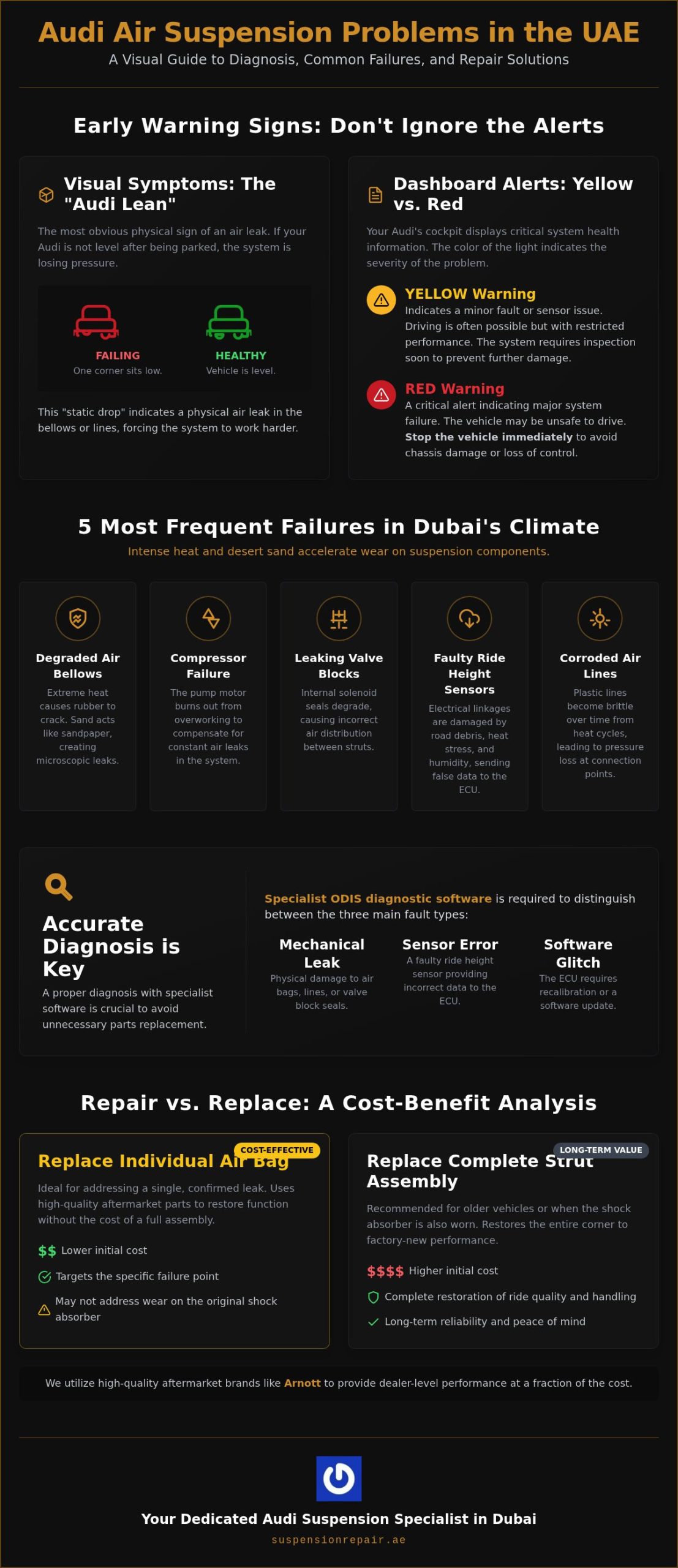
Have you noticed your Audi sitting lower on one corner after being parked for more than two hours? This is the classic “Audi Lean.” If you find the car’s body resting almost on the tires, it’s likely sitting on its “bump stops,” which are the last line of defense against bottoming out. We define “static drop” as the primary indicator of a physical air leak within the bellows or the connecting lines. It’s a clear signal that the system can no longer hold pressure without active assistance from the pump. Don’t ignore a car that looks uneven; it’s a physical cry for help from your suspension system.
Dashboard Alerts: Yellow vs. Red Suspension Lights
Your Audi Virtual Cockpit provides real-time feedback on the system’s health. A yellow “Level Control” icon usually indicates a minor fault or a sensor that’s out of calibration. You can often still drive, though the car might feel stiffer or handle poorly. However, a red suspension warning is a critical alert. It means the system has suffered a major failure and the vehicle is likely unsafe to operate. You might see messages like “Suspension fault: you can continue driving with restrictions” or “Vehicle too low.” If the red light appears, stop the vehicle immediately. Continuing to drive can damage the chassis or lead to a dangerous loss of control at high speeds.
The 5 Most Frequent Audi Air Suspension Failures in Dubai
Dubai’s environment is uniquely hostile to pneumatic systems. While Audi engineers for global conditions, the combination of 50°C summer peaks and fine desert sand accelerates Audi air suspension problems beyond typical wear rates. Understanding these five common failure points helps you catch issues before they leave you stranded on the Sheikh Zayed Road.
- Degraded Air Bellows: Intense heat causes the rubber to lose elasticity and develop hairline cracks.
- Compressor Failure: The motor burns out from constant operation as it tries to compensate for system leaks.
- Leaking Solenoid Valve Blocks: Internal seals fail, which causes air to migrate incorrectly between struts.
- Faulty Ride Height Sensors: Road debris or extreme thermal stress damages the electrical linkages.
- Corroded Air Lines: Plastic lines become brittle over time, leading to pressure loss at the connection points.
Air Bellow Leaks: The Silent Killer of Comfort
Rubber and sand are a terrible mix. In the UAE, fine dust particles settle into the folds of the air bellows. As the suspension moves, this sand acts like sandpaper, grinding away the protective coating until a microscopic puncture forms. You can often confirm this at home using the ‘soapy water test’. Spray a mixture of dish soap and water onto the bellows; if you see growing bubbles, you’ve found your leak. Remember that air springs are designed to age together. If the front left bag has failed, the front right has endured the same thermal stress and likely needs a professional inspection to avoid a second trip to the workshop.
Compressor Burnout: A Costly Consequence of Neglect
Your suspension compressor isn’t designed for continuous use. It operates on a specific duty cycle, meaning it should only run briefly to top up the reservoir or adjust height. When a leak occurs, the compressor fights a losing battle to stay level. You’ll hear it first: a loud buzzing or humming from the front wheel well. Eventually, the pump overheats and seizes. This is a classic example of how adaptive suspension systems work against themselves when a fault is present. A small seal repair ignored today can lead to an expensive compressor replacement tomorrow.
Sometimes the issue isn’t the air itself, but the instructions. Faulty ride height sensors send garbled data to the ECU, causing the car to sit at awkward angles even if the bags are airtight. Similarly, a leaking solenoid valve block can cause “cross-talk,” where air meant for the rear right strut ends up in the front left. These electrical and pneumatic nuances are common Audi air suspension problems that require specialized tools to pinpoint accurately. Catching these early ensures your Audi remains roadworthy for its next RTA inspection.
Diagnostic Framework: Is It a Leak, a Sensor, or a Software Glitch?
How do you determine if your Audi needs a new air bag or just a 50-dirham fuse? It starts with a precise diagnostic framework. Stop guessing and start measuring. We rely on Audi-specific ODIS (Offboard Diagnostic Information System) or VCDS software to communicate directly with your vehicle’s ECU. Generic scanners often fail to read the specific pressure values within the reservoir, leading to misdiagnosis and unnecessary parts replacement. Before you authorize any major work, check the air suspension relay and fuse. It’s the most overlooked cheap fix in the UAE. A blown relay can cause the compressor to stay on until it burns out or prevent it from starting at all, mimicking a total system failure.
Sometimes the issue is purely digital. A manual height calibration can often resolve minor “software glitches” where the car sits unevenly despite having no physical leaks. By recalibrating the zero-point for each corner, we can rule out electronic drift before moving to mechanical teardowns. This methodical approach is the only way to effectively manage Audi air suspension problems without overspending.
VCDS Fault Codes Every Audi Owner Should Know
When we plug in the diagnostic tool, specific codes tell the story of your suspension’s health. Code 01583 (Leak in System Detected) is a red flag. It means the ECU has noticed the compressor running for an extended duration without achieving the required pressure. Code 01772 (Signal from Level Control Pressure Sensor) is different; it often points to a wiring fault or a failing sensor rather than a physical hole in a bag. We define an ‘implausible signal’ as a scenario where a ride height sensor sends data that contradicts physical reality, such as reporting a height that is impossible given the current air pressure levels.
Physical Inspection vs. Computerized Data
A computer scan is only 50% of the diagnostic story for Audi suspension systems. While the software tracks pressure and voltage, it cannot see a cracked rubber bushing or a bent control arm. These mechanical failures often produce clunking noises that owners mistake for air strut issues. On newer models like the Audi SQ7 and SQ8, the diagnostic process is even more complex due to the 48V system. This high-voltage circuit powers the active roll stabilization, which works in tandem with the air springs. A fault in the 48V system can mimic Audi air suspension problems, requiring a specialist who understands both pneumatic and high-voltage electrical architectures to find the true root cause.
Repairing vs. Replacing: A Cost-Benefit Analysis for Dubai Owners
When faced with Audi air suspension problems, your first question is likely about the bottom line. Should you replace just the leaking rubber bellow or the entire strut assembly? Replacing only the air bag is a cost-effective solution if the internal hydraulic damper is still in good condition. However, if your Audi has high mileage, the internal shock absorber may already be worn. In such cases, installing a new bag on a tired strut is a false economy. Dubai’s extreme thermal cycles also mean that once one component fails, the other is usually not far behind. We recommend a full assembly replacement for owners planning to keep their vehicle for another three to five years.
What about refurbished parts? While they appear attractive on paper, the 50°C Dubai summer is unforgiving. Refurbished units often use lower-grade rubber seals that can’t withstand the intense heat and pressure as well as new components. For a luxury vehicle, the performance gap is noticeable. Choosing new parts ensures your vehicle maintains its factory-spec handling and safety margins during high-speed highway cruising.
Can You Repair an Audi Air Strut?
You might see “seal kits” advertised as a quick fix for leaking air shocks. Do they actually work? In our experience, these are temporary bandages. While they might stop a minor hiss for a few weeks, they don’t address the underlying rubber fatigue. Furthermore, if your strut is internally leaking oil, it is non-repairable. Oil contamination quickly degrades the new rubber bag, leading to a secondary failure. If you notice oily residue on your suspension components, a full shock absorber replacement Dubai is the only reliable path forward.
Long-term Reliability of Aftermarket Solutions
Do you have to pay dealership prices for genuine Audi parts? Not necessarily. High-quality aftermarket brands like Arnott offer components that often exceed OEM specifications at a more accessible price point. However, fitment is everything. Consulting a German car suspension specialist Dubai ensures that these parts are calibrated correctly to your vehicle’s software. Incorrect installation can disable your Audi’s “Drive Select” system, leaving you stuck in one damping mode regardless of your settings.
Avoid “Air to Coil” conversion kits. While they eliminate future Audi air suspension problems, they strip the car of its luxury identity and can negatively impact your resale value in the UAE market. Most importantly, significant structural modifications might complicate your annual RTA inspection. To keep your ride quality and legal status intact, stick to a pressurized system. If you’re unsure which route is best for your Q7, A8, or e-tron, contact our specialist team for a detailed health check.
Specialized Audi Suspension Repair in Dubai: The Expert Solution
Why trust a generalist with a system as complex as Audi’s Adaptive Air Suspension? Most multi-brand garages in Dubai lack the specialized ODIS diagnostic tools and nitrogen charging stations required for a factory-standard repair. Without precise height re-calibration, even a brand-new air bag won’t perform correctly. Car Suspension Repair focuses exclusively on luxury car suspension repair Dubai to ensure every sensor and valve block communicates perfectly with the ECU. This specialization is particularly critical for high-performance RS models, where the suspension must handle extreme lateral forces and rapid damping adjustments.
A successful repair doesn’t end when the parts are bolted on. We perform a rigorous post-repair road test followed by a final digital height re-calibration. This ensures your Audi sits perfectly level and maintains its aerodynamic efficiency at highway speeds. Car Suspension Repair bridges the gap between expensive dealerships and cut-rate garages by offering dealer-level precision at an independent workshop value. By focusing only on suspension, our technicians have the specific experience needed to resolve Audi air suspension problems that general mechanics often overlook.
Our Audi Diagnostic and Repair Process
We believe in total transparency. Our process starts with a comprehensive pressure test of the entire pneumatic circuit to isolate the leak. We then verify the solenoid valve block’s integrity and check the health of your ride height sensors. Unlike other shops, we provide detailed reporting that shows you exactly where the failure occurred before we begin any work. Once the mechanical repair is complete, we perform the essential ECU coding to reset the system’s adaptive parameters. We use dealer-level equipment at independent workshop value to ensure your Audi’s luxury performance is restored without the inflated costs.
Book Your Audi Suspension Inspection in Dubai
Are you still driving with a collapsed air spring? You’re risking more than just a bumpy ride. A bottomed-out suspension can cause immediate damage to your inner fenders, tires, and even the chassis. Don’t let a small leak turn into a catastrophic repair bill or a failed RTA inspection. We provide fast, model-specific quotes for the entire Audi range, from the Q7 to the e-tron GT. Contact our Audi suspension specialists today for a comprehensive diagnostic and rediscover the comfort your vehicle was designed to provide.
Restore Your Audi’s Signature Drive Quality Today
Your Audi’s air suspension is a masterpiece of engineering that deserves more than a guesswork repair. We’ve explored how Dubai’s extreme thermal cycles accelerate Audi air suspension problems by stressing rubber bellows and overworking compressors until they seize. Identifying these leaks early is the only way to avoid the excessive costs often associated with official dealerships. Whether it’s a simple sensor calibration or a full strut replacement, technical precision is non-negotiable for maintaining your safety on the road.
Why settle for a generalist when you can access Dubai’s only dedicated suspension workshop? Our specialized Audi suspension mechanics use advanced ODIS diagnostics to pinpoint faults with surgical precision. This ensures your vehicle remains comfortable, aerodynamic, and ready to pass its next RTA inspection without any lingering dashboard warnings. Don’t let a minor hiss turn into a major mechanical failure. Get an Expert Audi Suspension Diagnosis in Dubai today and enjoy the peace of mind that comes with professional, transparent service. Your car is ready to return to its peak performance.
Frequently Asked Questions
Can I drive my Audi if the air suspension has failed?
Driving with a failed system is dangerous and highly discouraged. If the vehicle is sitting on its bump stops, you risk immediate structural damage to the fenders and tires. Furthermore, the lack of damping severely compromises your braking distance and steering response. It’s best to have the car recovered to a specialist workshop to avoid compounding Audi air suspension problems with expensive bodywork repairs.
How much does it cost to fix Audi air suspension problems in Dubai?
The total investment depends on whether you require a simple sensor replacement, a new air bellow, or a complete compressor unit. While costs in Dubai vary based on part availability and model year, labor rates are typically more manageable at specialized independent workshops compared to dealerships. Always request a comprehensive diagnostic scan first to ensure you aren’t paying for parts your vehicle doesn’t actually need.
How do I reset the air suspension on my Audi Q7 or A8?
You can attempt a basic reset through the MMI by toggling “Jack Mode” on and then off. However, a software reset won’t fix a physical air leak or a burnt-out motor. For a true system recalibration, a technician must use ODIS or VCDS software to reset the adaptation values and ensure each corner is level according to factory specifications. This process aligns the physical height with the ECU’s digital commands.
Why does my Audi sit lower after being parked in the Dubai heat?
Extreme UAE temperatures cause the rubber in your air bellows to expand and contract, which accelerates the formation of hairline cracks. While some minor settling is normal as air cools, a noticeable drop on one side usually indicates a slow leak. Dubai’s fine sand also gets trapped in the folds of the bags, acting as an abrasive that eventually punctures the material under high thermal stress.
How long do Audi air suspension bags typically last?
On average, Audi air suspension components last between 80,000 to 110,000 kilometers. However, the harsh environmental conditions in the Middle East often shorten this lifespan. High thermal stress and constant exposure to desert dust mean you should start inspecting your air bags for signs of rubber fatigue or “perishing” once your vehicle passes the five-year mark to ensure continued roadworthiness.
Is it better to replace one air strut or both at the same time?
We strongly recommend replacing air struts in pairs across the same axle. Because these components endure identical road conditions and heat, the second strut usually fails shortly after the first. Replacing both simultaneously ensures balanced handling, even tire wear, and saves you the logistical headache of returning to the workshop for a second repair just a few weeks later. It’s the most efficient long-term solution.
What is the difference between a yellow and red suspension warning light?
A yellow light indicates a non-critical fault, such as a sensor calibration error or a minor leak that the compressor can still manage. You can usually drive to a service center for a checkup. A red light is a critical warning that the system has failed completely or the car is too low to drive safely. If you see red, pull over and call for assistance immediately to prevent chassis damage.
Does Audi air suspension require regular maintenance?
While the system is largely self-contained, proactive care can prevent premature Audi air suspension problems. Ensure your technician inspects the air bellows for sand accumulation during every oil change. If you are looking for expert mechanical support, you can visit Quattro Auto for comprehensive maintenance services. Keeping the rubber clean and free of desert grit prevents the abrasive wear that leads to punctures. Additionally, checking the air dryer and relay during major services can prevent moisture buildup and expensive compressor burnout.