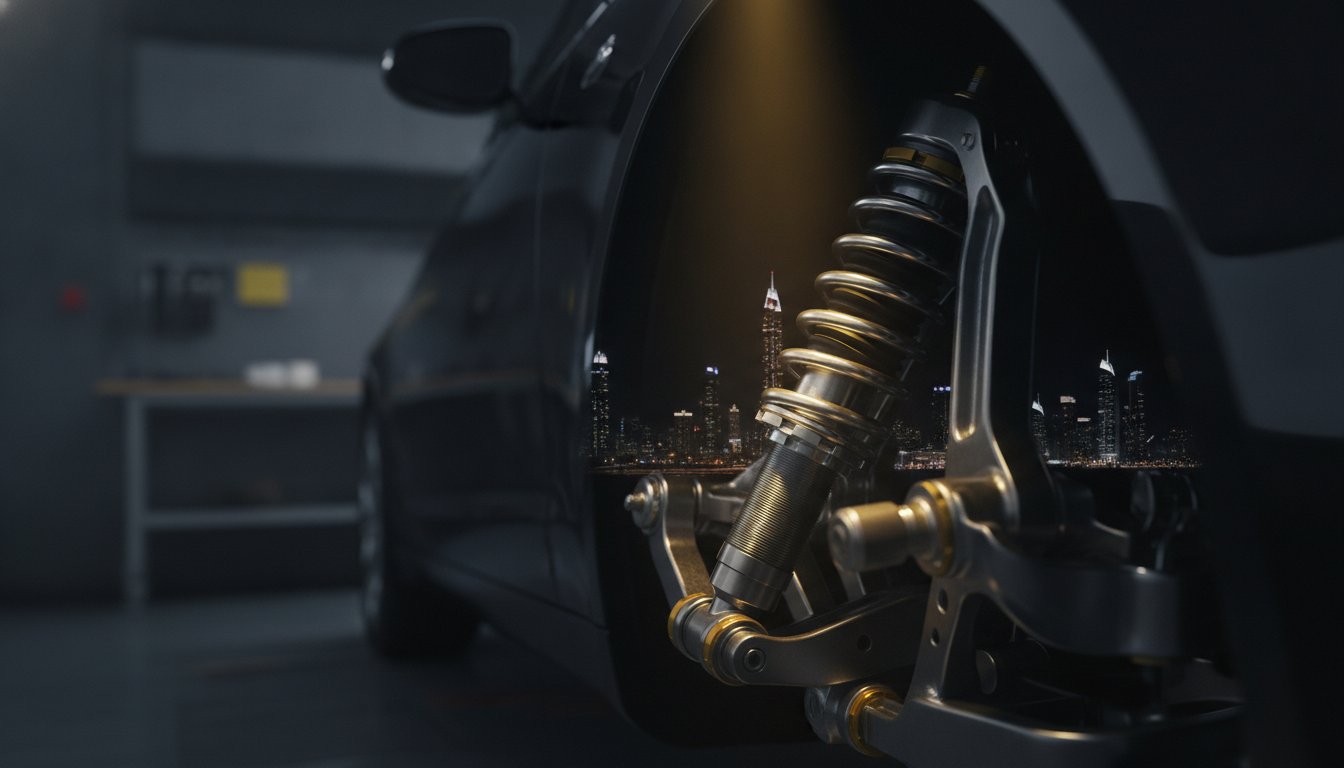
That persistent bounce after every speed bump or pothole isn’t just annoying – it’s your car telling you something is seriously wrong. If your vehicle continues to rock, dip, or sway long after the road smooths out, you’re likely dealing with a failing suspension system, and ignoring it puts both your safety and your car’s long-term health at risk. Getting the right car bouncing after bumps repair isn’t a luxury; it’s a necessity.
You already know the feeling. That unsettling lurch, the loss of control through corners, the way your vehicle just won’t settle. It’s uncomfortable, it’s worrying, and figuring out where to start can feel overwhelming, especially when you’re driving a high-performance or luxury vehicle that demands specialized care.
This guide cuts through the confusion. You’ll discover the most common reasons your car bounces after bumps, understand which suspension components are likely to blame, and learn how to find trusted, expert repair solutions right here in Dubai. Whether you drive a BMW, a Range Rover, or a Mercedes, the answers you need are ahead.
Key Takeaways
- A car that keeps bouncing after bumps is signaling a failing suspension system – understanding which components are involved helps you act before minor wear becomes major damage.
- Knowing the right steps to take before visiting a mechanic can save you time and money, especially when driving a luxury or performance vehicle that requires specialized diagnostics.
- Getting the correct car bouncing after bumps repair means choosing quality replacement parts and expert technicians – the wrong fix can compromise your vehicle’s handling and safety.
- Driving with a compromised suspension isn’t just uncomfortable – it directly affects your braking performance and puts you at serious risk on Dubai’s roads.
- Specialized suspension repair for brands like BMW, Mercedes, and Range Rover demands focused expertise, and this guide shows you exactly where to find it in Dubai.
Understanding Car Bouncing: What It Means for Your Vehicle
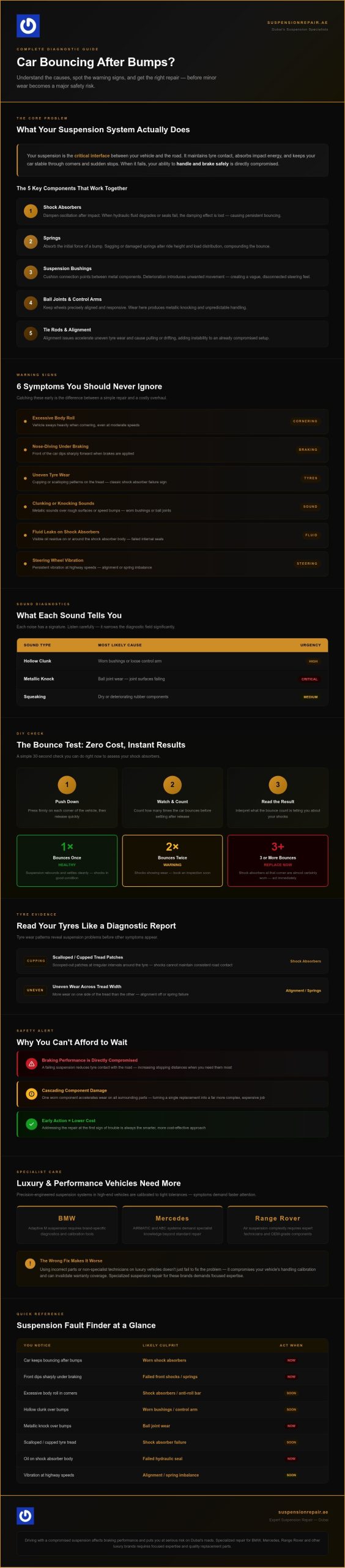
Your suspension system is doing a lot more than just smoothing out the ride. It’s the critical interface between your vehicle and the road, responsible for maintaining tyre contact, absorbing impact energy, and keeping your car stable through corners and sudden stops. When it starts to fail, that persistent bounce you feel isn’t just a comfort issue. It’s a direct signal that your vehicle’s ability to handle and brake safely is being compromised.
The suspension system itself is a network of interconnected components, each playing a specific role. Shock absorbers dampen the oscillation after impact. Springs absorb the initial force of a bump. Bushings cushion the connection points between metal components, reducing noise and vibration. Control arms, ball joints, and tie rods all contribute to keeping your wheels precisely aligned and responsive. When any one of these elements wears out, the entire system’s performance degrades, and the effects are immediate and noticeable.
What Causes My Car to Bounce on Bumps?
Worn shock absorbers are the most common culprit. A functioning shock absorber controls how quickly your suspension compresses and rebounds. Once the internal hydraulic fluid degrades or seals fail, the damping effect is lost and your car continues to bounce long after the bump has passed. Damaged or sagging springs compound the problem by altering your vehicle’s ride height and load distribution. Deteriorated suspension bushings introduce unwanted movement into the system, creating that vague, disconnected feeling through the steering wheel. Alignment issues accelerate uneven tyre wear and cause the vehicle to pull or drift, adding instability to an already compromised setup.
Identifying the Symptoms of a Bouncy Ride
Recognizing the warning signs early is the difference between a straightforward repair and a costly overhaul. Watch for these specific indicators:
- Excessive body roll when cornering, even at moderate speeds
- Nose-diving under braking, where the front of the car dips sharply
- Uneven tyre wear, particularly cupping or scalloping patterns on the tread
- Clunking or knocking sounds over rough surfaces or speed bumps
- Fluid leaks visible on or around the shock absorber body
- A steering wheel that vibrates at highway speeds
For luxury and performance vehicles, these symptoms demand even faster attention. Precision-engineered suspension systems in vehicles like BMW, Mercedes, and Range Rover are calibrated to tight tolerances. Continued use with worn components doesn’t just worsen ride quality; it accelerates wear on surrounding parts, turning a single-component replacement into a far more complex job. Addressing car bouncing after bumps repair at the first sign of trouble is always the smarter, more cost-effective approach.
Diagnosing the Problem: Steps to Take
You’ve identified the symptoms. Now comes the critical next step: figuring out exactly what’s failing before you spend a single dirham on parts or labour. Accurate diagnosis is what separates a targeted, cost-effective repair from a frustrating cycle of guesswork. The good news is that some initial checks are well within reach before you book a workshop visit.
Home Diagnostics: What You Can Do
Start with the bounce test. Push down firmly on each corner of your vehicle, then release. A healthy suspension rebounds once and settles. If your car continues to bounce two or three times, the shock absorbers at that corner are almost certainly worn. It’s a simple, zero-cost check that gives you immediate directional information.
Walk around the vehicle and listen carefully during a slow drive over a speed bump or rough patch. A hollow clunking sound typically points to worn bushings or a loose control arm. A metallic knocking suggests ball joint wear. A squeaking noise under compression often indicates dry or deteriorating rubber components. Each sound has a signature, and paying attention to it narrows the diagnostic field significantly.
Your tyres tell the story too. Look closely at the tread surface. Cupping or scalloping, where the tread appears to have scooped-out patches at irregular intervals, is a classic sign of shock absorbers that can no longer maintain consistent tyre contact with the road. Uneven wear across the tread width points toward alignment or spring issues.
When to Seek Professional Help
Home checks have a ceiling. If your vehicle is pulling sharply to one side, if the steering feels vague or unresponsive, or if you notice visible fluid leaking from a shock absorber body, stop driving and get a professional assessment immediately. These aren’t symptoms to monitor; they’re indicators of a system that’s already compromised your safety.
For luxury and performance vehicles, this threshold is even lower. A BMW’s adaptive suspension, a Range Rover’s air suspension system, or a Mercedes with Active Body Control operates on entirely different tolerances than a standard passenger car. Generic diagnostic equipment simply won’t capture the nuances of these systems accurately. Specialist technicians use brand-specific diagnostic software to read fault codes, assess electronic damping control modules, and evaluate air suspension compressor performance, details that a general workshop will miss entirely.
During a professional suspension assessment, expect a full visual inspection of all suspension components, a road test to replicate the symptoms, and a computerized wheel alignment check. The results will map exactly which components need attention and in what order of priority. That kind of clarity is what makes proper car bouncing after bumps repair efficient rather than expensive.
If you’re unsure where to start, reach out to a suspension specialist who understands the specific demands of your vehicle before the problem escalates further.
Repairing the Bouncy Suspension: Solutions and Options
Diagnosis confirmed. Now the real work begins. Understanding what the repair process actually involves, how long it takes, and what drives the cost helps you make informed decisions rather than simply accepting whatever a workshop tells you. This is where many vehicle owners lose control of the situation, and it doesn’t have to go that way.
Types of Repairs: What to Expect
Shock absorber replacement is the most frequently performed suspension repair. The process involves removing the wheel, unbolting the shock absorber from its upper and lower mounting points, and fitting a new unit. On a standard vehicle, a single shock absorber replacement typically takes one to two hours per corner. On a luxury vehicle with adaptive or electronically controlled damping, the process is more involved. New units need to be calibrated to the vehicle’s electronic control module, not just bolted in place. Skipping that step produces a repair that feels wrong from the moment you drive away.
Strut replacement follows a similar process but requires additional steps because the strut is a structural component that integrates the spring, shock, and mounting hardware into a single assembly. Any strut replacement must be followed by a full wheel alignment check. No exceptions. Fitting new struts without realigning the wheels immediately introduces tyre wear and handling problems that negate the repair entirely.
Bush replacement is often overlooked but critically important. Worn suspension bushings allow metal-to-metal contact between components, accelerating wear across the entire system. Replacing them restores the precise movement geometry your suspension was designed to maintain. It’s detailed work that requires proper pressing tools and experience with the specific vehicle’s subframe geometry.
Parts quality is non-negotiable for luxury and performance vehicles. OEM-specification or OEM-equivalent components maintain the calibration your vehicle’s suspension was engineered around. Fitting substandard parts to a BMW, Range Rover, or Mercedes doesn’t just compromise ride quality; it can introduce handling characteristics the vehicle was never designed for, creating new risks rather than resolving existing ones.
Choosing the Right Repair Shop
Not every workshop is equipped to handle the demands of a precision suspension system. For luxury vehicles, the right shop makes a measurable difference in the quality and longevity of the repair. Here’s what to look for and ask before committing:
- Brand-specific experience: Ask directly whether the technicians have hands-on experience with your exact make and model. A specialist who works on BMW suspension daily understands tolerances and procedures that a generalist simply won’t.
- Diagnostic capability: Confirm they use manufacturer-compatible diagnostic software, not generic OBD tools. Electronic suspension systems require brand-level access to read fault codes accurately.
- Parts sourcing transparency: Ask whether they use OEM or OEM-specification parts and whether you can see the parts being fitted. Reputable shops welcome this question.
- Post-repair alignment: Any suspension repair that involves replacing load-bearing components must include a four-wheel alignment check. If a shop doesn’t mention this automatically, treat it as a warning sign.
- Focused specialization: A shop that works exclusively on suspension systems brings a depth of expertise that a general service centre can’t replicate. Suspension specialists handle the full range of related components daily, which directly affects diagnostic accuracy and repair precision.
Proper car bouncing after bumps repair isn’t just about swapping out a worn part. It’s about restoring your vehicle to its engineered specification with the right components, the right tools, and technicians who understand exactly what they’re working on. That level of care is what separates a repair that lasts from one that simply delays the next problem.
If your vehicle is a luxury or performance model, choosing a suspension specialist in Dubai who focuses exclusively on these systems isn’t a premium option; it’s the practical one. The cost of getting it wrong the first time is always higher than getting it right.
Safety First: Is It Safe to Drive a Bouncy Car?
The short answer is no. A vehicle that continues bouncing after bumps isn’t just uncomfortable to drive; it’s actively dangerous. Your suspension system is the foundation of your car’s handling, braking, and stability. When it’s compromised, every other safety system in your vehicle, including your ABS and traction control, is working against a weakened base. The consequences of ignoring that are serious.
Here’s the core problem. Worn shock absorbers reduce your tyres’ ability to maintain consistent contact with the road surface. During braking, that loss of contact translates directly into longer stopping distances. On Dubai’s high-speed roads and highways, even a marginal increase in stopping distance can be the difference between a safe stop and a collision. Body roll through corners becomes unpredictable, and sudden evasive manoeuvres, the kind you don’t plan for, become genuinely hazardous.
There’s a legal dimension here too. Under UAE traffic regulations, vehicles are required to be roadworthy at all times. Driving with a demonstrably failed suspension system, particularly one that affects steering and braking, can expose you to liability in the event of an accident. If an investigation determines that a mechanical fault contributed to a collision, the consequences extend well beyond the repair bill.
Neglect also compounds the financial damage. A failed shock absorber puts additional stress on the springs, control arms, and bushings surrounding it. What starts as a single component replacement can escalate into a full suspension overhaul if the root cause isn’t addressed promptly. For luxury vehicles, that escalation is particularly costly.
Immediate Actions to Take
If your car is bouncing severely while driving, reduce your speed immediately and avoid sharp cornering or heavy braking where possible. Pull over safely if the handling feels unstable or unpredictable. There are no reliable temporary fixes for a failed shock absorber or broken spring; these are structural failures that require professional attention. If the vehicle feels unsafe, don’t drive it. Arrange for it to be transported to a specialist rather than risking a journey that could end badly.
Preventative Maintenance: Keeping Your Suspension Healthy
Prevention is always cheaper than repair. Have your suspension inspected as part of every scheduled service, and don’t ignore early warning signs like minor clunking or slight body roll. Avoid aggressive driving over speed bumps and rough surfaces, as repeated hard impacts accelerate wear on every component in the system. For luxury and performance vehicles, using a suspension specialist for routine checks rather than a general service centre ensures that early-stage wear is caught before it becomes a structural issue requiring full car bouncing after bumps repair.
- Schedule regular suspension inspections at every major service interval
- Replace worn components promptly rather than monitoring them through additional wear cycles
- Moderate your speed over speed bumps to reduce peak impact loads on shock absorbers and springs
- Check tyre pressures consistently, as incorrect inflation increases suspension stress
- Address alignment issues immediately after any kerb strike or pothole impact
Your suspension’s longevity is directly tied to how you drive and how consistently you maintain it. Proactive care keeps repair costs predictable and your vehicle safe. If you’re overdue for a suspension check or you’re already experiencing symptoms, contact a suspension specialist in Dubai before the situation deteriorates further.
Contact Us for Expert Suspension Repair in Dubai
You’ve read the warning signs. You understand what’s failing and why it matters. Now the only question is: what are you going to do about it? Every kilometre you drive on a compromised suspension is a kilometre that’s adding stress to surrounding components and reducing your margin of safety on the road. The time to act is now, not after the next pothole makes the decision for you.
Proper car bouncing after bumps repair requires more than a willing mechanic. It demands specialists who work exclusively on suspension systems, who understand the precise tolerances of luxury and performance vehicles, and who use diagnostic tools that match the sophistication of the cars they’re servicing. That’s exactly what Suspension Repair in Dubai delivers.
Get in Touch with Our Specialists
Booking a consultation with Suspension Repair is straightforward. Contact the team directly through the website to schedule your diagnostic appointment. Whether you drive a BMW, Range Rover, Mercedes, Porsche, or any other luxury or performance vehicle, the technicians here have the brand-specific expertise and diagnostic capability to identify the root cause accurately and repair it correctly the first time.
Before your visit, a few simple steps will help the team get straight to work:
- Note when the bouncing occurs, whether it’s after every bump, during cornering, or under braking, as this detail helps narrow the diagnosis immediately
- Describe any sounds you’ve noticed, clunking, squeaking, or knocking, and at what point in the vehicle’s movement they appear
- Bring your service history if available, particularly records of any previous suspension work or alignment checks
- Note the vehicle’s current mileage and any recent impacts, such as kerb strikes or pothole hits, that may have triggered the symptoms
The more context you can provide, the faster and more precisely the team can diagnose the issue. That means less time in the workshop and a more targeted repair.
Choosing a suspension specialist isn’t just about fixing what’s broken today. It’s about protecting your vehicle’s handling, your tyres, and your safety through every drive that follows. Suspension Repair focuses exclusively on suspension systems, which means the depth of expertise here isn’t spread thin across general servicing. It’s concentrated exactly where your vehicle needs it.
Don’t let a bouncing car become a safety incident. Reach out to Suspension Repair in Dubai today and get your vehicle back to the standard it was built for.
Your Next Drive Shouldn’t Feel Like This
A car that won’t stop bouncing isn’t a minor inconvenience. It’s a safety issue that compounds with every kilometre you delay. Throughout this guide, you’ve seen how worn shock absorbers, damaged springs, and deteriorated bushings work together to undermine your vehicle’s handling, braking, and stability on Dubai’s roads.
The key points are straightforward. Accurate diagnosis comes first. Quality parts and proper post-repair alignment are non-negotiable. And for luxury vehicles, car bouncing after bumps repair demands technicians who specialise exclusively in suspension systems, not generalists working across every mechanical discipline.
That’s precisely what sets Suspension Repair apart. Expert technicians focused solely on suspension systems, with deep experience across luxury and performance brands, mean your vehicle gets the precision it was engineered for, not a generic fix that creates new problems down the road.
Don’t wait for the next pothole to make the decision for you. Contact us today for expert suspension repair services and get your vehicle handling the way it should.
Frequently Asked Questions About Car Bouncing After Bumps Repair
What causes my car to bounce after going over bumps?
The most common cause is worn shock absorbers that have lost their ability to dampen the rebound after impact. Once the internal hydraulic fluid degrades or seals fail, your suspension keeps oscillating instead of settling. Sagging springs, deteriorated bushings, and worn ball joints all contribute to the problem, and in many cases, several components are failing simultaneously rather than just one.
Road conditions in Dubai, particularly repeated impacts from speed bumps and uneven surfaces, accelerate this wear faster than many drivers expect. High temperatures also degrade rubber suspension components more quickly, making regular inspections especially important in this climate.
Is it safe to drive my car with a bouncy suspension?
No, it isn’t. A compromised suspension directly reduces your tyres’ road contact during braking, which extends stopping distances at the worst possible moment. Body roll becomes unpredictable through corners, and any sudden evasive manoeuvre becomes significantly harder to control. These aren’t theoretical risks; they’re immediate, measurable reductions in your vehicle’s safety performance.
Under UAE traffic regulations, vehicles must be roadworthy at all times. Driving with a demonstrably failed suspension system can create legal liability if a mechanical fault contributes to an accident. If the handling feels unstable, reduce speed and arrange a professional assessment before driving further.
How can I tell if my shock absorbers are worn out?
The bounce test is the quickest self-check available. Push down firmly on one corner of your vehicle and release. If the car bounces more than once before settling, the shock absorber at that corner is likely worn. Visible fluid leaking from the shock body is another clear indicator that the internal seals have failed and the unit needs replacing.
Cupping or scalloping on your tyre tread, where the rubber shows irregular scooped-out patches, is a strong secondary sign. It indicates the shock absorber can no longer maintain consistent tyre contact with the road surface, causing uneven wear at the points where the tyre bounces and lands repeatedly.
What are the signs that I need suspension repair?
Key warning signs include persistent bouncing after bumps, excessive body roll during cornering, nose-diving under braking, clunking or knocking sounds over rough surfaces, and a steering wheel that vibrates at highway speeds. Any one of these symptoms warrants an inspection; multiple symptoms appearing together means the repair is overdue.
For luxury and performance vehicles, the threshold for seeking professional car bouncing after bumps repair should be lower. Precision-engineered suspension systems in brands like BMW, Range Rover, and Mercedes operate within tight tolerances, and continued use with worn components accelerates wear across surrounding parts rapidly.
How much does it typically cost to repair a bouncy suspension?
Repair costs in Dubai vary depending on which components need replacing, the make and model of your vehicle, and whether OEM or OEM-specification parts are used. Luxury and performance vehicles generally carry higher parts and labour costs than standard passenger cars due to the complexity of their suspension systems and the specialist diagnostic equipment required.
The most accurate way to understand your specific cost is to book a diagnostic assessment with a suspension specialist. Attempting to estimate costs without a proper inspection often leads to either underpreparing for the actual scope of the repair or replacing components that didn’t need attention in the first place.
Can I repair my car’s suspension myself?
Basic checks like the bounce test or a visual inspection for fluid leaks are within reach for most owners. However, the actual repair work is a different matter. Replacing shock absorbers, struts, or bushings requires specialist tools, precise torque specifications, and a post-repair wheel alignment check. Without these, a DIY attempt can introduce handling problems that are worse than the original fault.
For luxury vehicles with adaptive or electronically controlled suspension systems, self-repair isn’t a realistic option. New dampers need to be calibrated to the vehicle’s electronic control module using brand-specific diagnostic software. Fitting components without that calibration step produces a repair that performs incorrectly from the first drive.
How long does a suspension repair usually take?
A straightforward shock absorber replacement on a standard vehicle typically takes one to two hours per corner. Strut replacement takes longer because the assembly integrates the spring, shock, and mounting hardware, and must always be followed by a full wheel alignment check before the vehicle is returned. Bush replacement is detailed work that varies depending on the vehicle’s subframe design.
For luxury vehicles requiring electronic calibration after component replacement, additional time is needed to ensure the new parts communicate correctly with the vehicle’s control systems. A specialist who focuses exclusively on suspension systems will give you a realistic timeframe upfront based on your specific vehicle and the scope of the repair required.