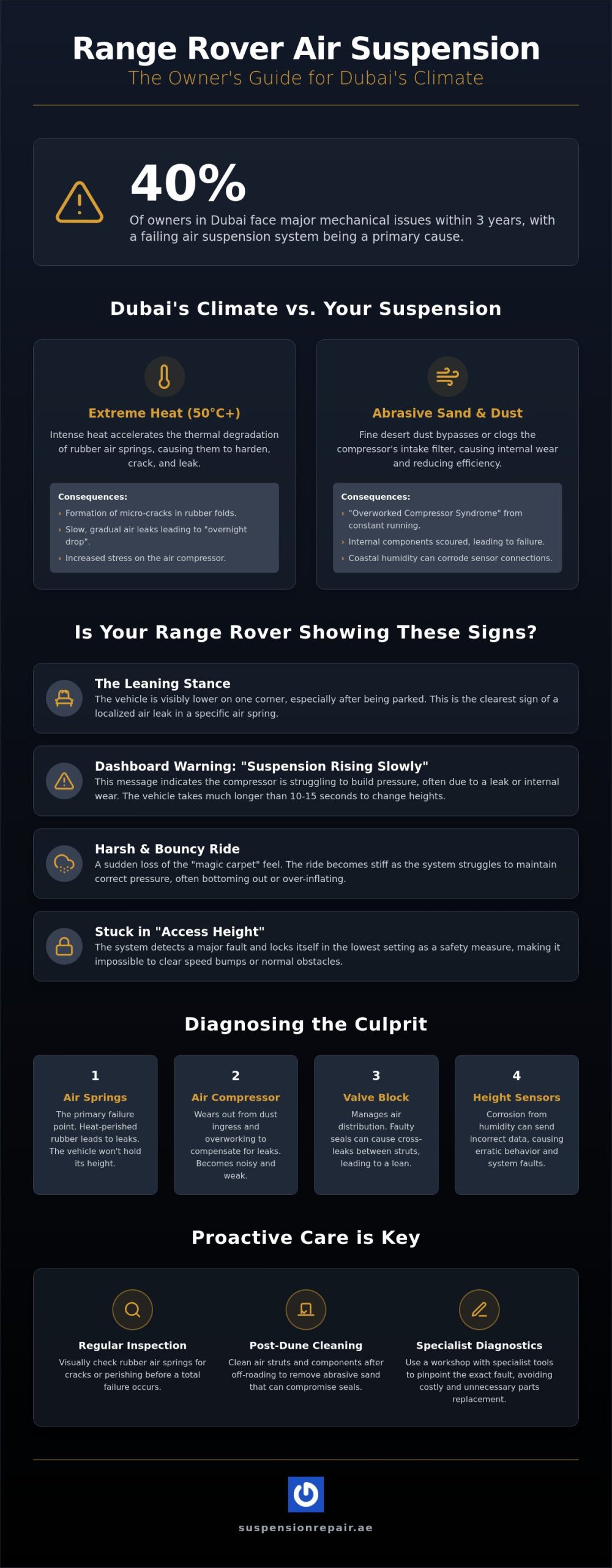
Did you know that nearly 40% of Range Rover owners in Dubai experience significant mechanical issues within their first three years of ownership? Most of these drivers eventually discover that the primary culprit is a failing air system. It’s incredibly frustrating to find your luxury vehicle slumped on its axles or stubbornly stuck in “access height” during a 45-degree summer afternoon. You invested in a Range Rover for its world-class ride quality, but the extreme desert heat and fine sand often turn that comfort into an unreliable headache. Dealing with Range Rover air suspension problems Dubai conditions create shouldn’t mean settling for astronomical dealership bills or a compromised driving experience.
We understand that you need a solution that balances technical expertise with proactive, specialized care. This guide will show you exactly how to identify, diagnose, and resolve your suspension issues using expert advice tailored for the UAE’s unique environment. You’ll learn how to restore your vehicle’s original comfort while implementing preventative measures to avoid future breakdowns. We’ll preview common failure points like perished rubber seals and overworked compressors, explain the legalities of suspension modifications, and show why a specialist workshop is your best defense against the harsh local climate.
Key Takeaways
- Understand why Dubai’s extreme heat cycles accelerate the wear of rubber air springs and how to spot perishing before a total failure occurs.
- Identify the most common Range Rover air suspension problems Dubai owners encounter, including the “leaning” stance and noisy compressor symptoms.
- Avoid the “parts cannon” approach by using precise diagnostics to distinguish between simple air leaks, faulty valve blocks, or malfunctioning height sensors.
- Learn essential preventative care, such as cleaning your air struts after off-roading in the dunes to stop sand from compromising the system’s seals.
- Discover why a specialist suspension workshop offers a more reliable, cost-effective alternative to general garages for restoring your luxury ride quality.
Common Range Rover Air Suspension Problems in Dubai’s Climate
Range Rover’s Electronic Air Suspension (EAS) is a sophisticated system designed to provide a “magic carpet” ride across both city highways and desert dunes. It relies on a complex network of rubber air springs, height sensors, and a high pressure compressor to maintain vehicle leveling. While Air suspension technology is highly durable in temperate climates, Dubai’s environment is uniquely hostile to these components. The combination of extreme thermal cycles, fine abrasive sand, and coastal humidity creates a perfect storm for Range Rover air suspension problems Dubai owners must face. Understanding these environmental stressors is the first step toward preventing a total system collapse.
The Impact of 50°C Heat on Rubber Air Springs
Dubai’s summer temperatures frequently peak at 50°C, but road surface temperatures can climb much higher. This intense heat triggers a chemical process known as thermal degradation in the rubber air bags. Over time, the rubber loses its elasticity and begins to harden, a process similar to unwanted vulcanization. This leads to the formation of micro cracks, particularly in the folds of the air spring where the material flexes most.
Do you notice your vehicle sitting lower after being parked for a few hours? Parking in direct sunlight accelerates “overnight drop” symptoms. The heat causes the air inside the bags to expand and then contract sharply when the car is moved to a cooler garage or as the sun sets. This constant expansion and contraction stresses the weakened rubber until those micro cracks become full leaks. Unlike a catastrophic bag failure that happens instantly, these heat induced leaks are often subtle at first, slowly draining the system and forcing other components to work harder.
Why Dust and Sand Ingress Kill Air Compressors
The air compressor is the heart of the EAS system, but it has a major weakness in the UAE: its intake filter. Fine desert dust, particularly the microscopic silt found in areas like Al Qudra, can eventually bypass or clog the compressor’s filtration system. Once grit enters the internal cylinders, it acts like sandpaper, scouring the seals and reducing the compressor’s ability to build pressure.
This leads to “overworked compressor” syndrome. If your air springs have even a minor leak, the compressor must run almost continuously to keep the vehicle at the correct height. In stationary Dubai traffic, there’s very little airflow to cool the unit. It quickly overheats, leading to internal mechanical failure. Watch for these warning signs:
- The compressor sounds louder or more “rattly” than usual.
- The dashboard displays a “Suspension Rising Slowly” message.
- The vehicle takes more than 10 to 15 seconds to change ride heights.
Coastal humidity also plays a role. In areas like Dubai Marina or Jumeirah, the salt heavy air can cause corrosion on the electrical connectors of the height sensors. When these sensors send “jittery” or incorrect data to the ECU, the system may overcompensate, causing the vehicle to lean or bounce unpredictably.
Identifying the Signs: Is Your Range Rover Dropping or Leaning?
Is your car sitting lower on the front left corner? Does it look “tired” after a night in the driveway? A leaning Range Rover is the most obvious indicator of a localized air leak. Understanding How modern air suspension systems work helps you realize that a lean isn’t just a cosmetic issue; it’s a sign of structural failure. You might also hear a distinct hissing sound from the wheel arch after you turn off the engine. This is the sound of expensive compressed air escaping through a perished rubber seal or a cracked air bag.
Driving on Sheikh Zayed Road should feel effortless. If your ride suddenly feels stiff or you’re bouncing over minor road joints, your struts are likely over-inflated or bottomed out. Perhaps the most frustrating symptom is the “Access Height” trap. This happens when the system detects a major fault and refuses to lift the car from its lowest setting. It’s the car’s way of protecting itself, but it effectively leaves you driving a luxury SUV with the ground clearance of a sports car. This makes it impossible to clear speed bumps without scraping the underbody.
The “Overnight Drop” and Uneven Ride Height
Use the “finger test” to verify your suspicions. Park on level ground and check the gap between the top of the tire and the wheel arch. If you can fit four fingers on the right side but only two on the left, you have a leak. Don’t be fooled if the car “wakes up” and levels itself when you start the engine. While the car looks fine once running, the compressor is working double time to mask a mechanical failure. If you continue driving like this, you’ll eventually hit the “bump stops.” Driving on bump stops is dangerous. It transfers every road vibration directly to the chassis, quickly damaging expensive bushings and control arms. If you notice a drop, it’s time to consult a specialist for a visual inspection.
Decoding Dashboard Warning Messages
Your dashboard is your first line of defense against Range Rover air suspension problems Dubai heat makes more frequent. A “Suspension Fault: Normal Height Only” message usually means the ECU has detected a minor leak or a sensor discrepancy. In contrast, a red “Stop Safely” alert is critical. It means the system can no longer maintain a safe ride height, and your car may become unstable at high speeds. Immediate intervention is required to prevent an accident.
Many owners try a quick software reset via an OBDII tool to make the light go away. This might clear the code temporarily, but it rarely fixes the mechanical cause of the failure. A software reset is a band-aid, not a cure for a leaking air bag. The “Height Restricted” message is a safety limp mode that prevents the vehicle from reaching highway speeds while the suspension is unstable. Don’t ignore these warnings. A proactive repair is always cheaper than a total system overhaul.
Diagnostics: Air Leak, Valve Block, or Height Sensor?
When your vehicle fails to level, the temptation is to start replacing the most expensive parts first. This “parts cannon” approach is a costly mistake that leads to wasted time and unnecessary expenses. Solving Range Rover air suspension problems Dubai drivers encounter requires a methodical diagnostic process. We must determine if the fault is mechanical, like a leaking reservoir tank, or electronic, such as a corrupted signal from a height sensor. Without specialized tools, you’re simply guessing at a very expensive problem.
The valve block acts as the traffic controller for your suspension. It’s responsible for distributing high pressure air from the reservoir tank to each corner independently. If the internal solenoid valves fail to seal properly due to moisture or debris, you’ll experience “cross-axle leaks.” This is where air migrates from one bag to another, causing the car to lean even if the air bags themselves are perfectly intact. Testing the air tightness of the reservoir and the integrity of the lines is the only way to rule out these hidden leaks.
Why Professional Diagnostics Save You Money
Did you know a $50 height sensor can perfectly mimic the symptoms of a $1000 air strut failure? If a sensor sends a static or “frozen” voltage to the ECU, the system may refuse to inflate that specific corner. This leads many owners to believe the bag is blown when the fix is actually much simpler. By reading live data from the suspension control module, a specialist can see exactly what each sensor is reporting in real time. This level of precision is why it’s vital to follow a luxury car suspension repair Dubai guide that emphasizes specialist tools over general guesswork.
Valve Block Failure vs. Air Line Leaks
While air bags perish from external heat, your air lines often suffer from extreme engine bay temperatures. These plastic lines can become brittle and crack near heat shields or tight bends. In a general garage, they might use the old “soapy water test” to find bubbles. While this is effective for large holes, it often misses the slow, microscopic leaks that plague Range Rovers in the UAE. These tiny leaks are the silent killers of compressors.
Specialist workshops use ultrasonic leak detection to find the source of the trouble. This technology “hears” the high frequency sound of escaping air that the human ear cannot detect. We also pressure-test the reservoir tank. If the tank can’t hold its 15-bar pressure, your compressor will burn out trying to fill a bucket with a hole in the bottom. Don’t let a minor leak turn into a total system overhaul; get a definitive diagnosis first.
Proactive Maintenance: Preventing Total Suspension Failure
Do you want to wait until your vehicle is slumped on its axles before taking action? Proactive maintenance is the only way to stay ahead of Range Rover air suspension problems Dubai conditions inevitably cause. While these systems are robust, they aren’t “set and forget.” If you’ve spent the weekend exploring the dunes at Al Qudra, your first stop should be a thorough underbody wash. Fine desert sand accumulates in the rubber folds of the air springs. If left there, it acts like sandpaper, grinding away at the rubber every time the suspension flexes. This simple cleaning habit can add years to the life of your struts.
Pay close attention to how your car behaves during startup. Does it seem to rise slightly slower than it did last year? Never ignore a sluggish rise time. This is often the first sign that your compressor is losing efficiency or that a micro-leak is forcing the system to work harder. In the Middle East, we follow a strict 100,000km rule for suspension health. By this mileage, the structural integrity of the rubber and the efficiency of the valve blocks have usually been compromised by heat. We recommend a full system refresh at this stage to avoid a catastrophic failure on the highway.
Maintaining proper tyre alignment is another overlooked factor. When your wheels are out of alignment, the suspension geometry changes. This forces the air bags to inflate unevenly to keep the car level, putting unnecessary lateral stress on the suspension joints and bushings. A simple alignment check can prevent premature wear on much more expensive air components.
Routine Inspections for Early Strut Wear
Your air struts are dual-purpose components. They contain both an air bag and a hydraulic damper. During your regular oil change, ask your mechanic to check for fluid misting or oil leaks from the damper portion. If the hydraulic fluid leaks out, the air bag has to handle all the road shocks alone, leading to an immediate burst. Inspect the rubber gaiters for tears or sand accumulation that could puncture the inner lining. We strongly advise a comprehensive biannual suspension check-up before the extreme summer heat hits to ensure your system is pressure-tight.
Calibrating Your Suspension for Dubai Roads
Dubai’s residential communities, like Jumeirah or Arabian Ranches, are famous for their aggressive speed bumps. If your suspension isn’t perfectly calibrated, these bumps put uneven stress on your control arms and bushings. Electronic height re-calibration is essential after any component replacement or even a significant tyre alignment. This ensures the ECU knows exactly where “level” is. For a deeper look at how we handle these delicate adjustments, read our ride comfort restoration Dubai case study. If you suspect your ride height is uneven, book a professional calibration session today to protect your investment.
Specialized Range Rover Suspension Repair at Our Dubai Workshop
Why trust a general mechanic with one of the most complex systems in your vehicle? Most garages in Dubai are “jacks of all trades,” handling everything from basic oil changes to major engine overhauls. This diluted focus often leads to misdiagnosis and unnecessary part replacements. We take a different approach. By focusing exclusively on luxury car suspension and shock absorbers, we provide a level of technical precision that general workshops simply cannot match. Resolving Range Rover air suspension problems Dubai presents requires an intimate understanding of British luxury engineering that only comes from specialized, daily experience with these specific chassis.
Our workshop is designed as a boutique center for suspension excellence. We don’t do engines, and we don’t do transmissions. This singular focus allows us to invest in high-end diagnostic tools that general shops find too expensive to justify. From ultrasonic leak detectors that find microscopic fissures in air lines to reservoir pressure testers that ensure your system can hold its required 15-bar load, our equipment is tailored for one job: restoring your ride quality. We treat your Range Rover as a precision instrument, not just another car on the lift.
Why a Dedicated Suspension Mechanic Beats a General Garage
Range Rover’s air-over-oil systems are incredibly sophisticated. They require specialized diagnostic software that communicates directly with the Land Rover chassis control modules to read live height data and valve duty cycles. A general garage often relies on generic scanners that miss these deep-seated electronic faults. We utilize the exact technical protocols required to calibrate your vehicle back to factory standards. If you’re seeking the British car suspension repair Dubai specialists recommend, you need a team that understands the specific quirks of the L405 and L460 platforms. Don’t let an amateur use your luxury SUV as a learning tool.
Restoring Your Range Rover’s Signature Ride
The ultimate goal of our service is to restore your vehicle’s “magic carpet” ride. We don’t just want your car to sit level in the driveway; we want it to glide over the road with the same poise it had the day it left the showroom. This requires more than just fixing leaks. It involves checking the health of every bushing, control arm, and hydraulic damper in the system. We are committed to using high-quality parts that are specifically tested to withstand the thermal expansion and abrasive sand of the UAE climate.
We understand the stress and safety concerns that come with a failing suspension. That’s why we offer a transparent, specialist-led process that takes the logistical burden off your shoulders. Your safety and comfort are our primary metrics for success. Choose a partner that values your time and understands the gravity of mechanical reliability. Let us provide the expert, professional intervention your Range Rover deserves to get you back on the road with total peace of mind.
Restore Your Range Rover’s Signature Performance
Don’t let a leaning chassis or a noisy compressor ruin your premium driving experience. The extreme UAE climate makes Range Rover air suspension problems Dubai drivers encounter a common reality rather than a rare fluke. From heat-degraded air bags to sand-clogged valve blocks, these complex issues require more than just a temporary software reset. You need an expert who understands the unique engineering of British luxury brands and prioritizes the restoration of original ride comfort.
Are you ready to stop guessing and start driving with total confidence again? Choosing a specialist workshop ensures your vehicle receives the technical precision it deserves. Our exclusive focus on luxury air suspension systems means we have the specific tools to diagnose faults accurately the first time. This protects you from the expensive guesswork often found in general garages. Take a proactive step toward vehicle safety and long-term reliability today. Book Your Range Rover Suspension Inspection at Our Dubai Specialist Workshop and experience the difference of dedicated expertise. Your vehicle is a precision instrument; let’s keep it that way.
Frequently Asked Questions
Can I drive my Range Rover with an air suspension fault?
No, you shouldn’t drive your vehicle if a major suspension fault is present. While a minor “Normal Height Only” warning might allow for a short trip to a workshop, driving on “bump stops” will cause immediate and expensive damage to your chassis, control arms, and bushings. It also significantly compromises your steering and braking safety, making the vehicle unpredictable at highway speeds.
Why does my Range Rover lower itself when parked overnight in Dubai?
An “overnight drop” is a clear indicator of a slow leak within the air springs or the valve block seals. Dubai’s extreme temperature fluctuations cause the rubber components to expand and contract, which eventually creates micro cracks. If you notice one corner sitting lower than the others, it’s a sign that the air is escaping while the compressor is inactive. You should address this immediately to prevent your compressor from burning out.
How much does it cost to fix Range Rover air suspension in Dubai?
The total cost depends entirely on the specific component that has failed. Replacing a simple height sensor is far more affordable than replacing a complete air strut or a high pressure compressor. We recommend a specialist diagnostic session to identify the exact source of the leak. This precision prevents you from paying for a “parts cannon” approach where functional components are replaced unnecessarily.
Can I convert my Range Rover air suspension to coil springs?
Yes, conversion is possible, but it comes with significant trade-offs. While coil springs eliminate air system failures, they permanently degrade the signature luxury ride quality and off-road capability of your vehicle. Additionally, any suspension modification in Dubai requires prior approval from the Roads and Transport Authority (RTA). Unapproved modifications can result in heavy fines, black points, and vehicle impoundment.
How long does an air suspension repair typically take?
Most standard repairs, such as replacing a single air strut or a height sensor, can be completed within three to five hours. If the system requires a full recalibration or if we are diagnosing complex electrical faults in the wiring loom, it may take a full working day. Our specialized workshop prioritizes efficiency to ensure you’re back on the road as quickly as possible without compromising on safety.
Is it always the air bag that is leaking, or could it be something else?
It isn’t always the air bag. While rubber perishes over time, many Range Rover air suspension problems Dubai owners encounter are actually caused by faulty valve blocks, brittle air lines, or malfunctioning height sensors. A noisy compressor often indicates it’s working too hard to overcome a leak elsewhere in the system. Accurate testing is the only way to distinguish between these different failure points.
What is the “Suspension Fault: Normal Height Only” message?
This message indicates that the suspension control module has detected a non-critical fault and has locked the vehicle into its standard driving height as a safety precaution. It effectively disables the “Access” and “Off-Road” height settings to prevent potential damage. While the car is still drivable in this state, it serves as an early warning that a component is failing and requires professional attention before it turns into a red “Stop Safely” alert.
Does the Dubai heat really affect my air suspension system?
Yes, the intense heat is the primary catalyst for Range Rover air suspension problems Dubai drivers face. Temperatures reaching 50°C accelerate the vulcanization of rubber air bags, causing them to crack and leak prematurely. Furthermore, compressors are forced to work much harder in the heat, often leading to internal overheating and mechanical seizure during long periods of idling in stationary traffic.